Traditional fish and chips
Ingredients
Method
- Peel the potatoes and cut them into thick 1.5 cm chips. Rinse them in cold water and dry them thoroughly with a tea towel.
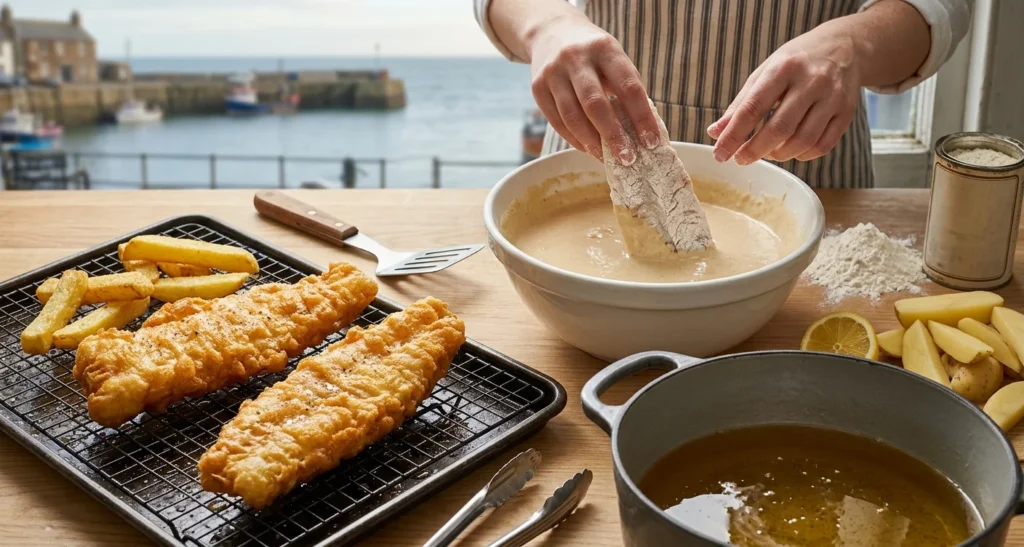
- Make the batter: mix 200 g of flour, the baking powder and the salt, then pour in the ice-cold lager while whisking until you have a smooth, thick batter that coats the spoon. Chill for 30 minutes.
- Heat the oil to 140 °C. Cook the chips for 6 to 8 minutes, without letting them colour, until tender. Drain them on a rack.
- Raise the oil to 180 °C. Pat the fish dry with kitchen paper, season it with salt, dust it with flour, then dip it in the batter. Lower it gently into the oil and fry 2 pieces at a time for 5 to 7 minutes, turning them, until deep golden. Drain on a rack and keep warm in the oven at 100 °C.
- Return the chips to the oil at 180 °C for 3 to 4 minutes, until golden and crisp. Drain and salt.
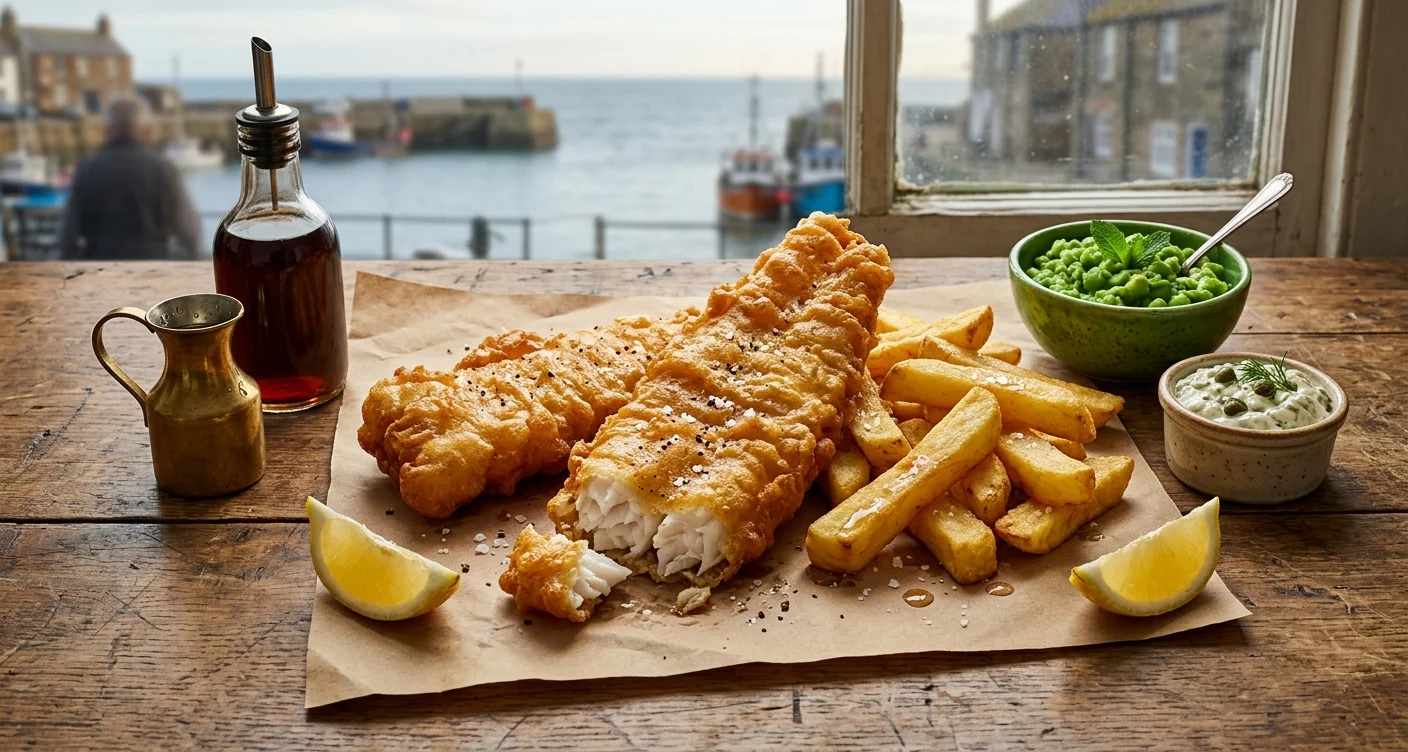
- Serve immediately with lemon wedges, malt vinegar, tartare sauce and mushy peas.
Notes
Pearly white fish in a golden beer batter that crunches with every bite, thick chips that stay fluffy inside and a splash of malt vinegar: fish and chips is the British national dish. Here is our traditional fish and chips recipe, just like in the best English chippies, with homemade tartare sauce and mushy peas.
Fish and chips, a British story
Fish fried in batter arrived in London with Sephardic Jewish families from Spain and Portugal, who cooked it on Fridays to eat cold on the Sabbath. Chips, meanwhile, were already sold in the north of England. Around 1860, shops in London and Lancashire had the idea of serving the two together, and fish and chips was born.
It became the meal of the working class, cheap and filling. During the Second World War, it was one of the few dishes that was never rationed. It used to be wrapped in newspaper; today it comes in white or kraft paper, to be eaten by the sea or on the way home from the pub.
The traditional fish and chips recipe
Traditional fish and chips rests on three things: a firm white fish, a light batter and thick chips cooked twice. Frying is done in hot neutral oil. Some chippies in the north of England still use beef dripping, which gives a very distinctive flavour.
The fish and chips batter
The classic fish and chips batter is a beer batter: flour, a little baking powder, salt and ice-cold lager. The bubbles in the beer and the baking powder make it light and puffy, and the cold makes it crispier when it hits the hot oil. It should be thick, like a cream that coats the spoon. A pinch of paprika in the batter gives it a lovely golden colour.
Fish and chips without beer
For fish and chips without beer, replace the lager with the same amount of ice-cold sparkling water and add an extra half teaspoon of baking powder. The batter will be just as light, with a more neutral taste. It is the ideal version for children.
What is the best fish for fish and chips?
The fish should be white, firm-fleshed and cut into thick pieces, so it stays moist inside while the batter turns golden. Cod is the most popular choice in England. In the north of England and in Scotland, people prefer haddock, which has a slightly stronger flavour. Pollock, coley and hake also work very well and are often cheaper. Choose fish from sustainable fisheries, with a certification label, whenever you can.
How to make proper chip shop chips
English chips are thicker than French fries: about 1.5 cm on each side. They are cut from floury potatoes such as Maris Piper or King Edward. The secret is double cooking: first at 140 °C to cook them through, then at 180 °C just before serving to make them golden and crisp. That way they stay fluffy inside.
Homemade fish and chips sauce
The best-known sauce is tartare sauce. For a homemade fish and chips sauce, mix 150 g of mayonnaise with 2 gherkins and 1 tablespoon of capers, chopped, a small finely diced shallot, a tablespoon of parsley and a few drops of lemon juice. In the UK, chip shops also often serve a mild, slightly sweet curry sauce, or simply ketchup.
Mushy peas for fish and chips
Mushy peas are the iconic side for fish and chips. The traditional version is made with dried marrowfat peas, soaked overnight with a pinch of bicarbonate of soda and then simmered until they form a thick purée. For a quick version, cook 300 g of frozen peas for 5 minutes, drain them and roughly crush them with 20 g of butter, salt, pepper and, if you like, a few mint leaves.
Seasoning fish and chips with vinegar
In the UK, fish and chips is never served without salt and vinegar: salt and a generous splash of malt vinegar over the chips and fish. This brown vinegar, made from malted barley, has a mellow, slightly toasted taste. If you can’t find it, cider vinegar will do. Find more ideas for seasoning your dishes in our spice guide.
Easy oven-baked fish and chips
For an easy, lighter oven-baked fish and chips, skip the liquid batter. Dip the fish in flour, then in beaten egg and finally in panko breadcrumbs mixed with a tablespoon of oil. Bake for 15 to 18 minutes at 200 °C on a tray lined with baking paper. For the chips, toss them with 2 tablespoons of oil and bake for 35 to 40 minutes at 220 °C, turning them halfway through.
Fish and chips in the air fryer
In the air fryer, liquid beer batter drips through the basket: use the panko coating from the oven version instead. Cook the fish for 10 to 12 minutes at 200 °C, turning it halfway. Cook the chips first, 18 to 22 minutes at 200 °C with a tablespoon of oil, shaking the basket two or three times.
Gluten-free fish and chips
For gluten-free fish and chips, replace the flour with a mix of 120 g of rice flour and 80 g of cornflour, and use a gluten-free beer or sparkling water. Dust the fish with cornflour. The batter is even crispier.
Fish and chips with a Thermomix
A food processor won’t replace the fryer, but it makes the batter and the sauce in no time. Blend the flour, baking powder, salt and cold beer for 15 seconds at medium speed, then chill. Then pulse the gherkins, capers, shallot and parsley for a few seconds before stirring them into the mayonnaise for the tartare sauce.
How many calories are in homemade fish and chips?
A portion of homemade fish and chips (150 g of fish and 250 g of chips) contains about 760 calories, without sauce. Tartare sauce adds around 150 calories per portion. At a chip shop, a large portion often exceeds 1,000 calories. To lighten the dish, choose the oven or air fryer version, serve a smaller portion of chips and swap some of the tartare sauce for mushy peas.
Storage: how to reheat fish and chips
Fish and chips is best eaten straight away, while the batter is still crisp. Leftovers keep for 1 day in the fridge, in a closed container. To reheat, place the fish and chips on a rack and put them in the oven for 10 minutes at 180 °C, or in the air fryer for 4 to 5 minutes at 180 °C. Avoid the microwave, which makes the batter soggy.
More fish and potato recipes
Do you love fish? Try fiskekaker, soft Norwegian fish cakes. For potatoes, discover Spanish patatas bravas with their spicy sauce, or German currywurst, another great street food classic.
Frequently asked questions
Why isn’t my batter crispy?
The oil wasn’t hot enough, the batter wasn’t cold enough, or you fried too many pieces at once. Use a cooking thermometer, keep the batter in the fridge until the last moment and fry 2 pieces at a time.
Which oil is best for fish and chips?
A neutral oil that handles high heat: groundnut oil is the best, sunflower oil also works. Strained once cool, it can be reused two or three times.