Fiskekaker (Norwegian fish cakes)
Ingredients
Method
- Cut the fish into pieces, pat it dry carefully with kitchen paper and keep it in the fridge until the last moment.
- Blend the fish with the salt in a food processor for 1 minute, until you have a smooth, sticky paste.
- Add the potato starch, white pepper, nutmeg and egg, and blend for a few seconds. Then pour in the very cold milk a little at a time, pulsing, until the mixture is smooth, light and firm enough to hold on a spoon. Stir in the chives with a spatula.
- Melt some of the butter in a large frying pan over a medium heat.
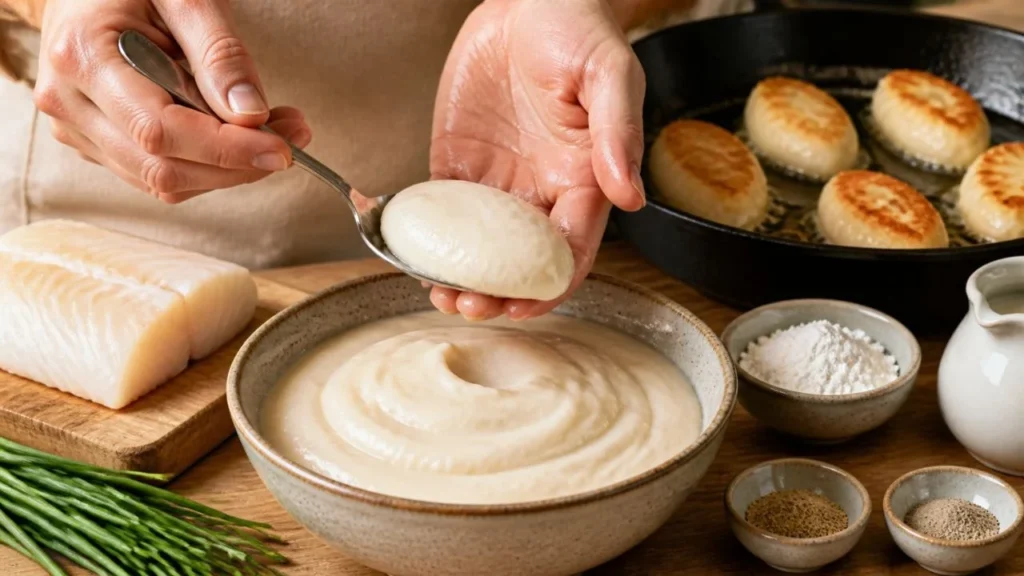
- With a wet tablespoon, scoop up some mixture, shape an oval cake about 2 cm thick and place it in the pan. Flatten it slightly. Carry on with the rest, in batches, adding more butter.
- Cook for 3 to 4 minutes on each side, until the fiskekaker are well browned and firm to the touch. Lower the heat if the crust colours too quickly.
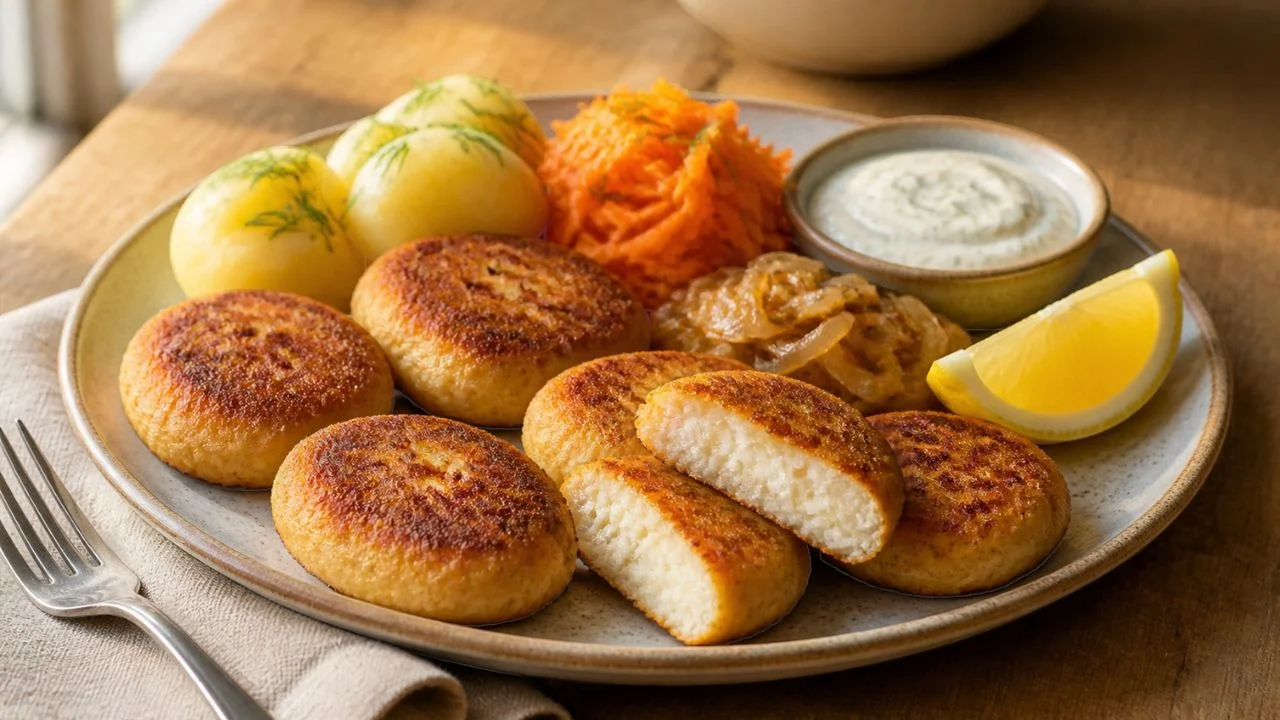
- Serve hot with boiled potatoes, grated carrots, caramelised onions and a dill sauce, or leave to cool and eat on bread.
Notes
Golden outside, white and soft inside, fiskekaker are one of Norway’s best-loved dishes. These Norwegian fish cakes are made with blended white fish, milk and potato starch, then browned in butter in a frying pan. In this fiskekaker recipe, we explain which fish to choose, how to get the mixture right, how to cook them and what to serve them with.
Fiskekaker, a Norwegian fish speciality
In Norwegian, fiskekaker means “fish cakes”. It is the ultimate Norwegian fish speciality, from a country whose coasts have always lived from fishing. People buy them at the fishmonger, eat them in school canteens, for a weekday dinner or cold on a slice of bread. They are the seafood cousins of kjøttkaker, the Norwegian meatballs: the same flattened shape and the same family-cooking spirit.
A traditional fiskekaker recipe
A traditional fiskekaker recipe is very simple: white fish, salt, potato starch, milk and a few gentle spices. The secret lies in working the mixture. First you blend the fish with the salt: the salt makes the flesh sticky and elastic, like a dough. Then you add the starch, followed by the very cold milk a little at a time. The mixture becomes smooth, light and almost mousse-like. That is what gives fiskekaker their unique texture, both firm and soft.
Which white fish for fish cakes?
The best white fish for fish cakes in the Norwegian style is cod, haddock or pollock (saithe). Choose very fresh fish with no skin or bones. Pat it dry well: wet fish gives a soft mixture that spreads in the pan. Frozen fish works too, as long as you thaw it in the fridge and drain it well. Keep it cold until the last moment; this is essential for the mixture to hold.
Potato starch in fish cakes
As for kjøttkaker, Norwegians use potetmel. Potato starch in fish cakes binds the mixture without making it heavy and holds on to the milk during cooking. With flour or breadcrumbs, the cakes would be denser. The milk must be very cold, straight from the fridge: a mixture that warms up in the food processor turns grainy and loses its lightness.
How to make fiskekaker
Here is how to make fiskekaker with no fuss. Blend the cold fish with the salt for a minute. Add the starch, spices and egg, then the milk in small amounts. With a wet spoon, shape oval cakes 2 cm thick and place them in hot butter. Allow 3 to 4 minutes per side. It is really a very quick minced fish patty recipe: 40 minutes from start to finish.
Fiskekaker: oven or frying pan?
Should you cook fiskekaker in the oven or in a frying pan? The pan is the traditional method: the butter gives a golden crust and an irresistible nutty flavour. The oven is a lighter, more practical option for a large batch: place the cakes on a tray lined with baking paper, brush them with a little melted butter and bake for 15 to 18 minutes at 200 °C. They will be paler but very soft.
Spices for fish cakes
The spices for fish cakes are subtle, to respect the delicate flavour of the fish. Nutmeg, or mace, its outer layer, is the most traditional. White pepper lifts the mixture without leaving black specks. Chives or dill bring freshness. Some add a little lemon zest. To discover more pairings, see our spice guide.
Scandinavian fish cakes
Fiskekaker belong to a large family: Scandinavian fish cakes. In Denmark, people eat fiskefrikadeller, often with remoulade. In Sweden, fiskbullar are poached fish balls served in sauce. Norwegian fiskekaker stand out for their very fine, almost mousse-like mixture and for being fried in butter.
Fiskekaker variations
Every region of Norway has its own version. On the west coast, around Bergen, fiskekaker are often finer and whiter, with plenty of milk. In the north, they are sometimes made with saithe, which has a stronger flavour. Some families add a little grated onion, others a hint of ginger. There are also fiskeboller, poached fish balls served in white sauce, and fiskepudding, the same mixture baked in a loaf tin. With leftover mixture, nothing goes to waste.
Which sauce for fish cakes?
The simplest sauce for fish cakes is a white dill sauce: a butter and flour roux loosened with milk or fish stock, then finished with fresh dill and a squeeze of lemon. Melted butter with capers and lemon is another quick option. In Norwegian families, fiskekaker are also often served with a brown onion sauce, løksaus.
What to serve with fiskekaker
The most classic sides for fiskekaker are boiled potatoes, raw grated carrots (råkost) dressed with a little lemon, and onions gently caramelised in butter. Peas, cabbage or a cucumber salad also work well. Leftovers are happily tucked into a lefse, the Norwegian potato flatbread.
Fiskekaker sandwich, even with brunost
In Norway, fiskekaker are also eaten cold, on a slice of buttered bread, for lunch or in a packed lunch. Some Norwegians even try a fiskekaker sandwich with brunost, the caramelised brown cheese. It is a surprising sweet and savoury match that remains a curiosity rather than a tradition. The most common choice is still bread with a few slices of cucumber or pickle.
Our tips for perfect fiskekaker
Keep everything very cold: the fish, the milk and even the food processor bowl if you can. Don’t blend for too long once the milk is in. Cook a small test cake to check the seasoning before shaping the rest. Wet the spoon between each cake so they slide off easily. Finally, don’t overcrowd the pan: the cakes should brown, not steam.
Frequently asked questions about fiskekaker
Can you freeze fiskekaker?
Yes, once cooked. Let them cool, then freeze them flat before putting them in a bag. They keep for 3 months and reheat in a frying pan or in the oven.
My mixture is too runny, what should I do?
The fish was probably too wet or the milk added too quickly. Add a spoonful of starch and chill the mixture for 15 minutes before shaping.
Can you make fiskekaker without a food processor?
Yes, by chopping the fish very finely with a knife, then working it for a long time with the salt using a spatula. The texture will be a little less fine, but still delicious.