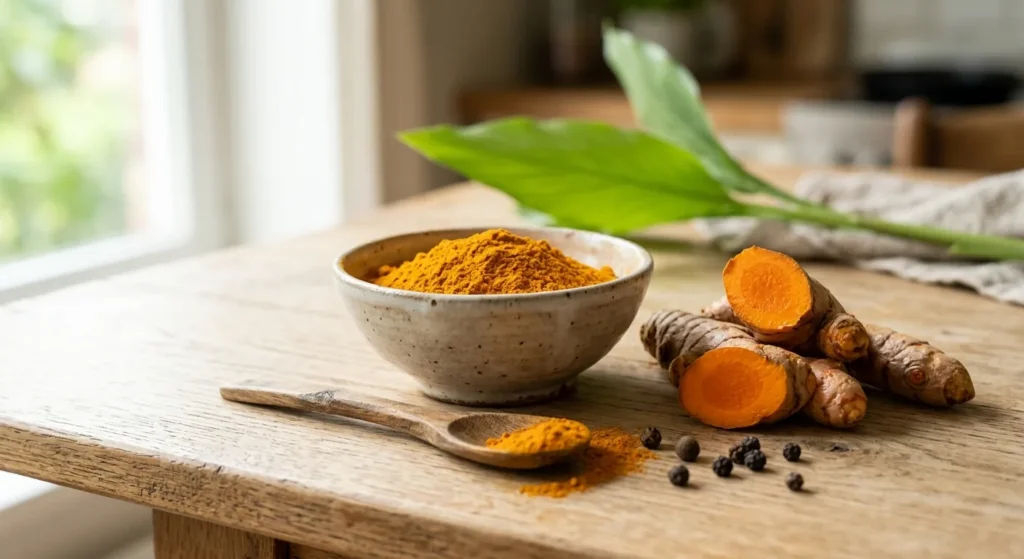
The golden spice of Indian cooking, the star ingredient of golden milk, a bestseller on “wellness” shelves: turmeric is everywhere. It is credited with countless virtues, from joints to digestion to skin. But what do we really know about the health benefits of turmeric? Between traditional knowledge, scientific studies and the precautions you need to know, here is an honest overview of what this spice can, and cannot, do for you.
From the origins of turmeric to its benefits: ancient knowledge
Turmeric (Curcuma longa) has been used in India for more than 4,000 years, as we explain in our article on the history of turmeric. In Ayurvedic medicine, it was recommended for digestion, the skin and everyday ailments. Traditional Chinese medicine has also used it for centuries.
These traditional uses caught the attention of researchers. Over the past forty years or so, thousands of studies have been published on turmeric, and above all on its best-known molecule, curcumin. The results are often encouraging, but much of the research comes from laboratory or animal experiments. Human trials are rarer and often small. That is why, in the European Union and the UK, no health claim is officially authorised for turmeric: a product cannot claim to treat or prevent a disease.
Turmeric’s secret: curcumin and its antioxidant properties
Turmeric and curcumin: what’s the difference?
The ground turmeric you buy for cooking is simply the dried, ground rhizome. It contains many compounds: fibre, essential oils and above all curcuminoids, the pigments responsible for its yellow colour. The best known of these is curcumin.
An important point: the powder contains only about 2 to 5% curcumin. A teaspoon of turmeric (about 3 g) therefore provides less than 150 mg of curcumin. Food supplements, on the other hand, use concentrated extracts that can contain up to 95%. These are not the same amounts at all, and they don’t call for the same precautions.
In the laboratory, curcumin acts as an antioxidant: it helps neutralise free radicals, the unstable molecules involved in oxidative stress and cell ageing. It is one of the most studied areas, even if the real effect in our bodies remains difficult to measure.
Turmeric and black pepper: why the combination works
Curcumin’s big weakness is that it is very poorly absorbed by the gut. It dissolves poorly in water, and the liver eliminates it quickly. As a result, only a tiny fraction reaches the bloodstream.
This is where black pepper comes in. Its pungent compound, piperine, slows down the elimination of curcumin. In a frequently cited study published in 1998, adding piperine increased the amount of curcumin found in the blood twentyfold. Curcumin also dissolves in fat: cooking it with a little oil, butter, milk or coconut milk helps the body absorb it. Traditional cuisines understood this long before science did: in India, turmeric is almost always cooked in fat and paired with pepper.
Turmeric as an anti-inflammatory: joints and pain
Turmeric benefits for joints
This is the most common question: is turmeric good for your joints? In the laboratory, curcumin dampens several chemical messengers of inflammation (such as NF-kB and certain cytokines). This is what has earned it its reputation as a natural anti-inflammatory.
In humans, several small clinical trials on knee osteoarthritis suggest that turmeric extracts may slightly reduce pain and stiffness. Reviews of these studies remain cautious: the trials are few, often short, and use concentrated extracts rather than the spice itself. Turmeric does not repair cartilage and does not replace treatment. If you suffer from joint pain, talk to your doctor before taking a supplement, especially if you are already on medication.
Turmeric benefits for digestion and the stomach
A recognised traditional use
Digestion is the area where the use of turmeric is best established. The European Medicines Agency recognises its traditional use to relieve mild digestive problems: a feeling of fullness after meals, slow digestion and bloating. This status is based on a long tradition of use, not on robust clinical trials.
Turmeric is thought to stimulate the production of bile, which helps digest fats. That is one of the reasons it goes so well with rich, saucy dishes. A few studies have looked at irritable bowel syndrome, with results still too limited to draw conclusions.
Turmeric and the liver: beware of popular myths
You often read that turmeric “detoxes” or “protects” the liver. The reality is more nuanced. In 2022, Anses, the French food safety agency, recorded around a hundred cases of liver damage, including hepatitis, in people taking turmeric-based food supplements. Similar cases have been reported in other countries. These effects remain rare and concern concentrated extracts, often combined with piperine, not the spice used in cooking. But they show that “detox” promises should be treated with caution.
Turmeric benefits for the skin and face
In India, turmeric has been part of beauty rituals for centuries, such as the Haldi ceremony before weddings. A turmeric face mask, mixed with yoghurt or honey, is still popular for brightening the complexion.
As for the science, curcumin has shown antibacterial and soothing effects in the laboratory, and a few small studies have looked at acne or psoriasis. But the evidence remains weak. Two practical tips if you want to try it: first do a patch test on a small area (contact allergies do exist), and be aware that turmeric stains the skin yellow for a few hours. If you have a skin condition, ask a dermatologist for advice.

How to enjoy turmeric every day
When should you take turmeric to get the benefits?
The best time is with meals. Dietary fats help curcumin get into the body, and the spice is better tolerated by the stomach. Add it towards the end of cooking or to a sauce with a drizzle of oil and a twist of black pepper.
Powder, capsules or tea: which form should you choose?
- Ground turmeric every day: this is the simplest and safest form. Half a teaspoon to a teaspoon a day in your cooking (rice, soups, roasted vegetables, curries) is enough to enjoy its flavour and its compounds.
- Fresh turmeric: grated like ginger, it has a brighter, more peppery taste. It keeps for a few weeks in the fridge.
- Turmeric and ginger tea: a comforting hot drink, ideal in winter. Ginger, a cousin of turmeric, also has a traditional use against nausea. Add a pinch of pepper and a dash of milk or honey.
- Golden milk: the traditional Indian version, in which the milk provides the very fats that help absorption.
- Food supplements: they provide much higher doses. They are not harmless (see below) and should be taken on the advice of a healthcare professional. To choose well, see our guide to fresh turmeric, powder or capsules.
Turmeric: contraindications, risks and precautions
Used as a spice, turmeric is eaten without any problem by millions of people every day. The precautions mainly concern food supplements and high doses. Health authorities advise asking a doctor or pharmacist before taking them, and avoiding them in the following cases:
- Anticoagulant or antiplatelet treatment (blood thinners): turmeric can strengthen their effect and increase the risk of bleeding.
- Gallstones or liver and bile duct disease: by stimulating bile, it can make the condition worse.
- Pregnancy and breastfeeding: because there is not enough data on the safety of high doses.
- Taking medication (for diabetes, chemotherapy, etc.): the piperine often added to supplements can change the effect of certain treatments.
- Before surgery: stop taking supplements a few days beforehand, because of the risk of bleeding.
European authorities have set an acceptable daily intake for curcumin of 3 mg per kilo of body weight, or about 180 mg a day for a person weighing 60 kg. At high doses, the most common side effects are digestive: stomach ache, nausea and diarrhoea.
The benefits of turmeric at a glance
| Claimed benefit | What the science says | Most suitable form |
|---|---|---|
| Antioxidant | Shown in the laboratory, effect in humans difficult to measure | Powder in cooking, with pepper and fat |
| Joints, inflammation | A few small encouraging trials on knee osteoarthritis | Extracts, only on medical advice |
| Digestion | Traditional use recognised in Europe for mild problems | Powder in dishes, tea |
| Liver, “detox” | Not proven; rare cases of liver damage with supplements | Spice in cooking only |
| Skin | Weak evidence | Face mask, after a patch test |
Frequently asked questions about the benefits of turmeric
When should you take turmeric?
With meals, with a little fat and black pepper. That is how it is best absorbed and best tolerated.
Why combine turmeric and black pepper?
Because the piperine in black pepper slows down the body’s elimination of curcumin, which greatly increases the amount that reaches the bloodstream.
What are the side effects of turmeric?
In cooking, it is very well tolerated. High-dose supplements can cause digestive problems and, more rarely, liver damage. They are not recommended with blood thinners, if you have gallstones or during pregnancy.
Conclusion: a kitchen treasure to enjoy with common sense
The benefits of turmeric are real in the kitchen: it colours and flavours your food and adds antioxidant compounds, while aiding digestion according to ancient tradition. Beyond that, science is making progress but has not yet confirmed all the promises made for it. The safest and most enjoyable approach is to include it in your daily diet, with a little pepper and fat.
To discover the roots and legends of this spice, read our article on the history of turmeric. And make your own comforting drink with our traditional golden milk recipe.
This article is for information only and does not replace the advice of a doctor or pharmacist.
