Golden yellow, fragrant and warming, curry is probably the most famous spice blend in the world. Sprinkle it into chicken with coconut milk, a vegetable curry or a lentil soup, and the kitchen instantly smells of India. Yet many people think it is a single spice, or confuse it with turmeric. In this guide, we explain what curry really is, its ingredients, its possible benefits, the difference between Indian curry, Thai curry and Madras curry, and how to make your own homemade blend. You will also find our recipes for chicken curry, vegetable curry and chickpea curry.
What exactly is curry?
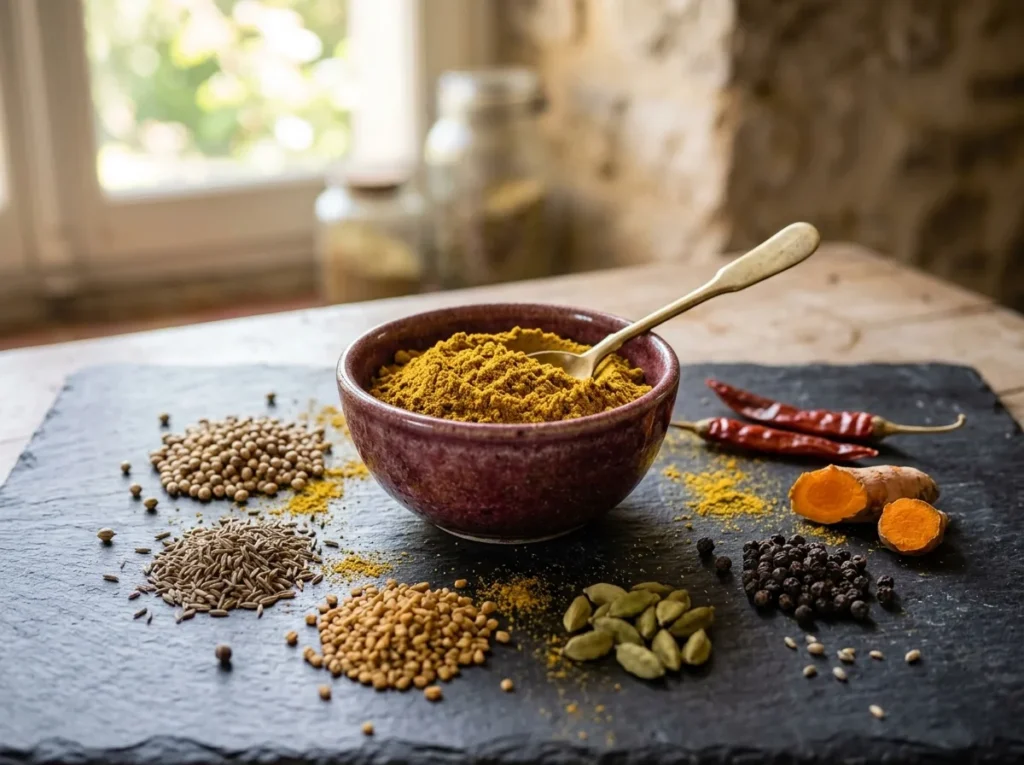
Curry is not a plant. It is a blend of ground spices, and its base is almost always the same: coriander seeds, turmeric, cumin, fenugreek, chilli and pepper. Every brand and every family then has its own recipe.
The word comes from the Tamil kari, a language of southern India, where it referred to a spiced sauce served with rice. In the 18th century, the British living in India adopted the word for any dish cooked in a spiced sauce. Back in England, they wanted to recreate those flavours. Merchants therefore came up with a ready-made blend, curry powder, sold in London from the end of the 18th century.
In India, then, there is no such thing as “one” curry. Every cook prepares the spices to suit the dish, often frying them whole in oil or toasting them just before grinding. These blends are called masalas. The curry powder we know is a Western, practical and balanced version of this cuisine.
What is in curry powder?
The recipe varies, but a classic curry powder usually contains:
- Coriander seeds: often the main ingredient, with a mild, lemony note.
- Turmeric: it provides the yellow colour and an earthy note.
- Cumin: warm and slightly smoky, it adds depth.
- Fenugreek: in small amounts, it gives curry its typical smell, with a hint of maple syrup.
- Chilli: it determines how hot the curry is, from mild to very hot.
- Black pepper and ginger: for bite and warmth.
- Depending on the recipe: mustard seeds, cardamom, cloves, cinnamon, curry leaves or garlic.
Remember to read the label if you have an allergy. Some shop-bought curry powders contain mustard or celery, two allergens that must be highlighted in bold in the ingredients list. Others contain salt, sugar, flour or flavourings.
Curry and turmeric: what is the difference?
This is the most common mix-up. Turmeric is a single spice: the dried, ground root of a plant from the ginger family, Curcuma longa. Curry is a blend that contains turmeric, usually between 20 and 30%, along with ten or so other spices.
| Turmeric | Curry | |
|---|---|---|
| What it is | A single spice (dried root) | A blend of 6 to 15 spices |
| Colour | Intense orange-yellow | Golden yellow to orange-brown |
| Taste | Earthy, slightly bitter | Warm, fragrant, more or less hot |
| Heat | None at all | Mild to hot depending on the chilli |
| Uses | Colour and flavour, golden milk | Saucy dishes, soups, marinades |
So you can replace a little curry powder with turmeric for colour, but not the other way round if you want to keep a neutral taste: curry brings many other flavours. To learn all about the golden spice, read our article on the benefits of turmeric. And to discover one by one the spices that make up curry, explore our spice guide.
The benefits of curry
Curry combines several spices that have been studied for their effects on health, and that is where its reputation comes from. However, it is important to keep things in proportion:
- Turmeric and curcumin: curcumin, the yellow pigment in turmeric, has been widely studied for its antioxidant and anti-inflammatory effects. But most studies use high-dose supplements. A teaspoon of curry powder contains about 0.5 to 1 g of turmeric, which is only a few tens of milligrams of curcumin.
- Pepper: the piperine in black pepper increases the body’s absorption of curcumin. That is a good reason to cook curry with a little pepper and some fat.
- Digestion: cumin, coriander and ginger have long been used to help digest rich dishes, without solid evidence of any therapeutic effect.
- Less salt: like all spices, curry adds plenty of flavour and often lets you use less salt.
Curry is not a remedy. No health claim is authorised in the European Union for curry, nor for turmeric. Its real benefit for health is that it makes dishes based on vegetables, lentils, chickpeas and rice delicious, and these are at the heart of a balanced diet.
Indian curry: the real curry?
In India, each region has its own spices and ways of cooking. In the north, dishes are often based on cream, yoghurt or tomato, and finished with garam masala, a blend of “warming” spices: cinnamon, cardamom, cloves, cumin, coriander and pepper. Unlike curry powder, garam masala rarely contains turmeric. It is a different blend, not a “real curry”.
In the south, cooks tend to use coconut milk, tamarind, mustard seeds and fresh curry leaves, an aromatic plant unrelated to curry powder. Indian cooks often fry whole spices in hot oil at the start of cooking, a technique called tadka, which releases all their aromas.
Madras curry
Madras curry takes its name from the former city of Madras, now Chennai, in southern India. It is a British-style blend, hotter and redder than classic curry powder, because it contains more chilli. It is perfect for meat dishes, lentils and vegetable curries that need some character. If you cannot handle heat, choose a mild curry instead.
Mild or hot curry: how to choose?
How hot a curry is depends almost entirely on how much chilli it contains. A mild curry contains little chilli, or a mild one such as paprika, and puts the emphasis on turmeric, coriander and cumin. A hot curry contains cayenne pepper or stronger dried chillies.
For a family with children, choose a mild curry and offer chilli separately at the table. If your dish is too spicy, add coconut milk, yoghurt or a little sugar, and serve it with plain rice. A mild curry can always be spiced up, whereas a curry that is too hot is hard to rescue.
Indian curry and Thai curry: what is the difference?
Thai curry has almost nothing in common with Indian curry apart from the name:
- Indian curry is mainly made with ground dry spices, like curry powder.
- Thai curry is a paste of fresh ingredients pounded together: chillies, lemongrass, galangal (a root related to ginger), garlic, shallot, makrut lime zest and often shrimp paste. It is fried first, then coconut milk is added.
There are several Thai pastes: green curry, made with fresh green chillies, often the hottest; red curry, based on dried red chillies; yellow curry, milder, which contains turmeric; and massaman, mild and fragrant with cinnamon and cardamom. Be aware that most Thai pastes contain shrimp paste or fish sauce: check the label if you cook vegetarian food.
Homemade curry powder recipe
Making your own homemade curry powder takes ten minutes, and the aroma is nothing like a powder that has been sitting in a cupboard for months. Here is a balanced recipe of medium heat.
For a small jar:
- 3 tablespoons of coriander seeds
- 2 tablespoons of cumin seeds
- 1 teaspoon of fenugreek seeds
- 1 teaspoon of mustard seeds
- 1 teaspoon of black peppercorns
- the seeds from 4 green cardamom pods
- 3 cloves
- 1 to 3 small dried chillies, depending on how hot you want it
- 2 tablespoons of ground turmeric
- 1 teaspoon of ground ginger
Heat a dry frying pan over a medium heat. Toast the coriander, cumin, fenugreek and mustard seeds, the pepper, cardamom, cloves and chillies for two to three minutes, stirring constantly, until they smell fragrant. Be careful not to burn them: fenugreek turns bitter if it blackens. Leave to cool completely, then grind finely in a coffee grinder kept for spices only. Add the ground turmeric and ginger, mix and store in a jar. For a mild curry powder, replace the chillies with a teaspoon of paprika.
Chicken curry with coconut milk
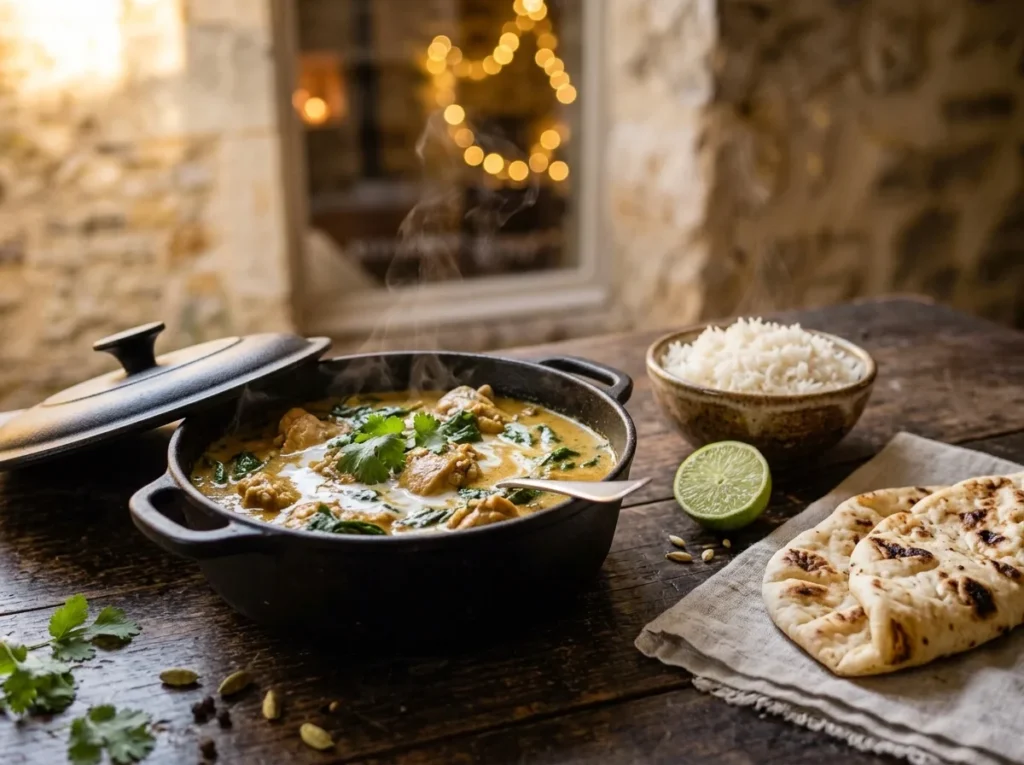
Chicken curry with coconut milk is the great family-meal classic. Here is our recipe for four people.
Cut 600 g of chicken breasts or boneless thighs into pieces. In a casserole dish, fry a large sliced onion in two tablespoons of oil for five minutes. Add three cloves of garlic and a 3 cm piece of fresh ginger, both grated, then two tablespoons of curry powder. Cook for a minute, stirring: the spices should smell fragrant without burning. Add the chicken and brown it for a few minutes. Pour in 400 ml of coconut milk and 200 g of chopped tomatoes, season with salt and pepper and simmer for twenty minutes over a low heat. At the end of cooking, add a handful of spinach or fresh coriander and a squeeze of lime juice. Serve with basmati rice or naans.
Vegetable curry
Vegetable curry is cheap, comforting and perfect for using up the vegetables in the fridge. Fry an onion, garlic and ginger, add two tablespoons of curry powder, then about 1 kg of vegetables cut into pieces: sweet potato, carrots, cauliflower, courgette, pepper, peas or spinach. Pour in 400 ml of coconut milk and a glass of water, and simmer for twenty to twenty-five minutes, until the vegetables are tender. Put the hard vegetables in first and the softer ones, such as courgette and spinach, towards the end of cooking.
For a detailed step-by-step version, see our vegetable curry with coconut milk recipe.
Reheated curry is often even better the next day, because the spices have had time to flavour the sauce.
Chickpea curry
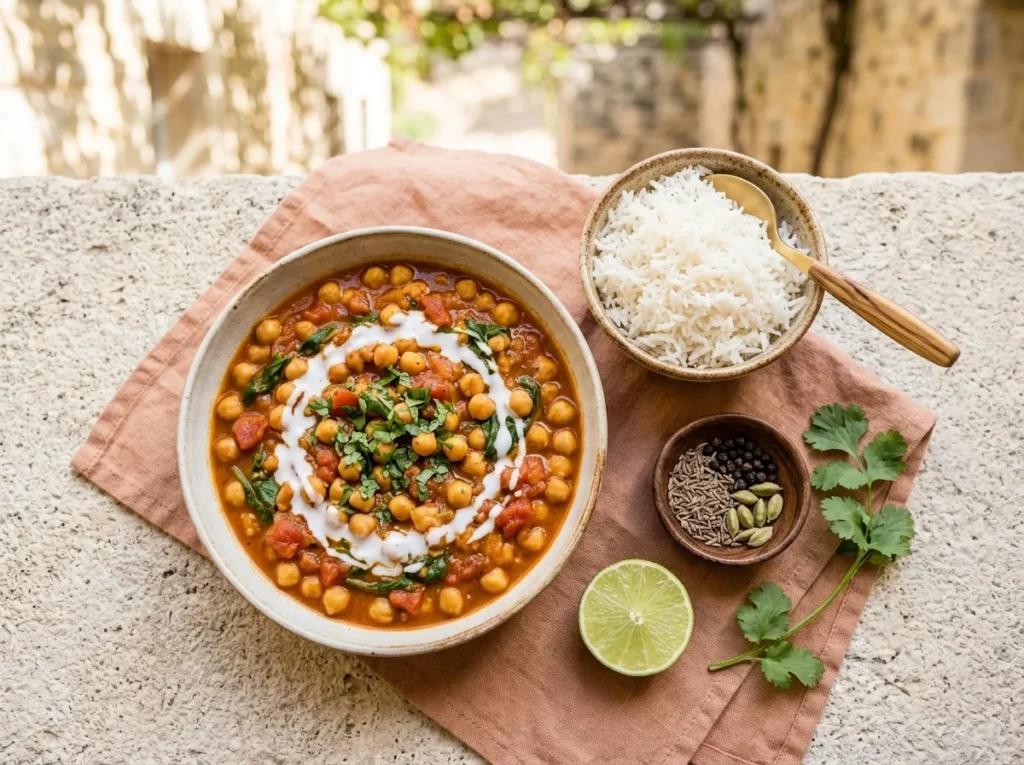
Chickpea curry is inspired by Indian chana masala, a dish of chickpeas in tomato sauce that is very popular in northern India. Rich in plant protein and fibre, it makes a complete meal with rice.
Fry a sliced onion in a little oil, add two cloves of garlic, a piece of grated ginger and a tablespoon of curry powder. Pour in 400 g of chopped tomatoes, then 500 g of cooked, drained chickpeas. Simmer for fifteen minutes, adding a little water if the sauce gets too thick. Add a teaspoon of garam masala at the end of cooking, along with lemon juice and fresh coriander. For a milder version, add a few spoonfuls of coconut milk.
Do you like chickpeas with turmeric? Try our pan-fried chickpeas with spinach and turmeric too.
Vegetarian curry: our ideas
Curry is perfectly suited to vegetarian and even vegan cooking. Here are a few ideas for a vegetarian curry:
- Lentil dal: red lentils simmered with curry powder, tomato and coconut milk. Discover our recipe for red lentil dal with coconut milk.
- Tofu curry: cubes of firm tofu, browned in a pan, then added to a curry sauce with vegetables.
- Sweet potato and spinach curry: mild, colourful and popular with children.
- Egg curry: hard-boiled eggs served in a curried tomato sauce, an Indian classic.
- Cauliflower and pea curry: inspired by aloo gobi, with potatoes.
Curry without coconut milk
Coconut milk is not essential, and many Indian curries do not contain any. For a curry without coconut milk, you can use:
- Plain yoghurt: it gives a creamy, tangy sauce. Add it off the heat or over a very low heat, otherwise it curdles.
- Tomato: chopped tomatoes or passata, for a lighter sauce.
- Cashew cream: soaked cashew nuts blended with a little water, very creamy.
- Single cream or oat cream: for a mild, creamy version.
- Vegetable stock: for a thinner curry, to serve like a soup.
Curry: precautions
In cooking, curry is safe for most people. A few useful precautions:
- Allergies: check for mustard, celery or peanuts in shop-bought blends.
- Sensitive stomach: a hot curry can cause heartburn or reflux. In that case, choose a mild curry.
- Anticoagulant treatment: the amounts used in cooking pose no known problem, but turmeric supplements are not recommended without medical advice.
- Quality: buy your spices from reliable brands and sellers. Turmeric adulterated with lead-containing colourings has already been withdrawn from sale in several countries.
How to store curry
Curry powder keeps in an airtight jar, away from light, heat and moisture. It stays good for about six months to a year, but it gradually loses its aroma. A curry powder that barely smells of anything when you open the jar can be replaced. Avoid storing it above the cooker.
An opened Thai curry paste keeps in the fridge, in its closed pot or a small jar, for about two to three weeks, or as stated on the label. To keep it for longer, freeze it in portions in an ice cube tray. A cooked curry dish keeps for two to three days in the fridge, or three months in the freezer.
Frequently asked questions about curry
Is curry spicy?
Not necessarily. Mild curry contains very little chilli, whereas hot curry and Madras curry are much spicier. Check what it says on the jar.
Can I use turmeric instead of curry powder?
For colour, yes. For flavour, no: it will lack the coriander, cumin and other spices. Instead, mix ground turmeric, cumin and coriander.
Does curry powder need to be cooked?
Yes, ideally. Fry it for a minute in hot oil with the onions: it loses its raw powdery taste and releases its aromas.
How much curry powder should I use?
Allow about half a tablespoon of curry powder per person in a dish with sauce, so two tablespoons for four, adjusted to how hot the blend is.
This article is for general information only and is not a substitute for advice from a doctor or pharmacist.