Æbleskiver (Danish pancake balls)
Ingredients
Method
- Mix the flour, baking powder, baking soda, sugar, vanilla sugar, cardamom, lemon zest and salt.
- Whisk the egg yolks with the buttermilk and melted butter, pour onto the dry ingredients and mix just enough to get a smooth, thick batter.
- Whip the egg whites to stiff peaks and gently fold them into the batter with a spatula, in two additions.
- Heat the æbleskiver pan over medium heat. Put a little melted butter in each well and fill them almost to the rim.
- After 1 to 2 minutes, when the edge is golden, pierce the ball with a wooden skewer and give it a quarter turn: the still-liquid batter flows into the well.
- Keep turning a quarter turn at a time until you get a closed sphere, then let it brown for 2 to 3 more minutes, turning. The center must be cooked (a skewer comes out dry).
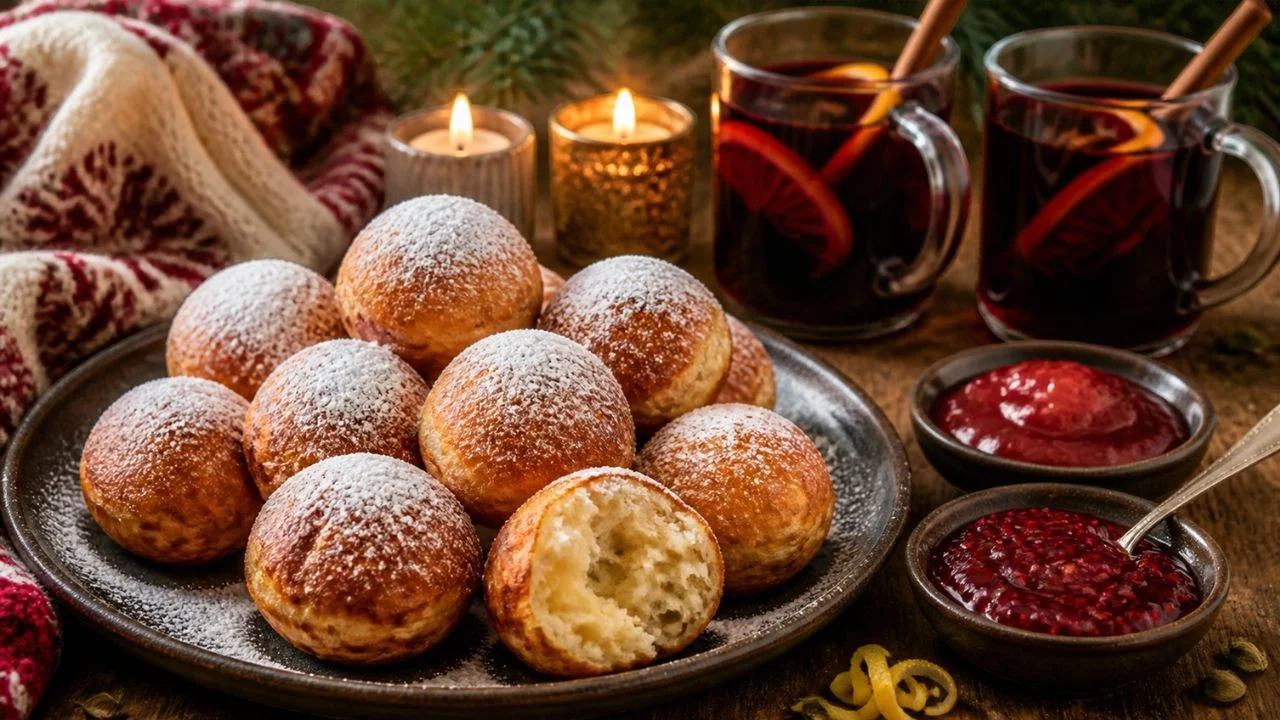
- Serve piping hot, dusted with powdered sugar, with a small bowl of jam for dipping.
Notes
Golden outside, fluffy as a cloud inside and perfectly round: æbleskiver (also written aebleskiver) are the little Danish pancake balls of winter. In Denmark, people eat them all through December with powdered sugar, jam and a glass of mulled wine. Here is our complete aebleskiver recipe, with a buttermilk batter, whipped egg whites for lightness and all the technique to turn them into balls.
Æbleskiver, a Danish pastry specialty
Æbleskiver are probably the most endearing Danish pastry specialty. The name is intriguing: æble means “apple” and skiver means “slices”. Originally, slices or pieces of apple were cooked in the batter. This Danish apple fritter changed over time, and today most æbleskiver contain no apple at all. The name stayed.
They are made in a special pan, the æbleskivepande, known in Denmark since at least the 17th century. During Advent, Danes buy them hot at Christmas markets or make them at home, often with children, who love watching them turn into balls.
A recipe for round pancake balls
If you have seen those funny “3D pancakes” on social media, they are almost always æbleskiver. This really is a recipe for round pancake balls: the batter is close to American pancake batter, but it is cooked in half-sphere wells and turned as it cooks to form a complete ball. You get a thin golden crust and a very airy center, with no deep-frying.
The æbleskiver pan
The æbleskiver pan is a heavy pan, usually cast iron, with seven half-sphere wells (sometimes nine). Cast iron is ideal because it heats very evenly, so all the balls brown at the same time. Before first use, season it like any cast-iron pan: oil it and heat it. Nonstick and electric models also exist; they are practical but brown a little less well. Always grease each well generously with melted butter.
Making aebleskiver without a special pan
No Danish pan? You can make aebleskiver without a special pan. The best alternative is a Japanese takoyaki pan: the wells are smaller, so are the balls, and they cook a little faster. A mini-pancake pan gives small thick round pancakes, not spheres, but the taste is exactly the same. An electric cake-pop maker also works.
Buttermilk aebleskiver batter
The secret of a fluffy æbleskiver is buttermilk aebleskiver batter (kærnemælk in Danish). Its acidity reacts with the baking soda and baking powder, which makes the batter rise and gives it a pleasant, slightly tangy taste. If you have none, mix 400 ml of milk with 1 tablespoon of lemon juice and let it stand for 10 minutes.
Aebleskiver with whipped egg whites
For truly airy balls, make aebleskiver with whipped egg whites. Separate the eggs, put the yolks in the batter, then whip the whites to stiff peaks and fold them in at the end, gently, without overmixing. This step gives a crumb as light as a soufflé. Use the batter quickly, before the whites deflate.
Spices for aebleskiver
The spices for aebleskiver are those of a Nordic Christmas. Green cardamom is the most traditional: half a teaspoon is enough to scent the whole batter, just like in our Swedish kanelbullar. Lemon zest adds freshness, vanilla adds sweetness. A pinch of cinnamon is welcome if you like gingerbread flavors. Find more pairings in our spice guide.
How to turn aebleskiver
Here is how to turn aebleskiver without stress. In Denmark, people use a knitting needle, a wooden skewer or a thin fork. Fill the wells almost to the top. When the edge starts to brown, after 1 to 2 minutes, pierce the crust at the side and rotate the ball a quarter turn: the cooked part comes up and the liquid batter runs into the bottom. Repeat a quarter turn a little later, then again, until the ball is closed. Then just roll it from time to time so it browns on all sides.
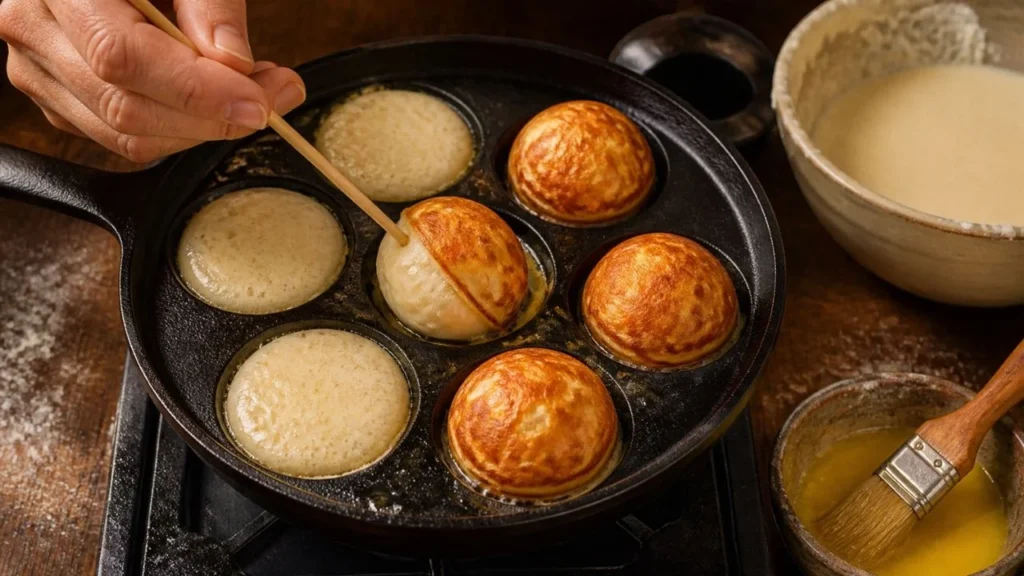
The right heat is medium: too high and the outside burns before the center is cooked; too low and the balls dry out. The first batch is often a test, so don’t be discouraged. Check doneness with a skewer, which should come out dry.
Aebleskiver fillings and serving
When it comes to aebleskiver fillings and toppings, tradition is simple: serve them hot, dusted with powdered sugar, with a small bowl of raspberry or strawberry jam. Everyone dips a ball in the jam, then in the sugar. Some people fill them before turning: drop a small spoonful of applesauce, a cube of sautéed apple or a square of chocolate into the center of the batter, then close it. It is a lovely way to return to the apple æbleskiver of the past.
A Danish Christmas recipe
Æbleskiver are the ultimate Danish Christmas recipe, together with risalamande. They are eaten all through Advent, at office Christmas parties and on family afternoons, with gløgg, the Scandinavian mulled wine with spices, raisins and almonds. They belong on a Nordic holiday table next to our Norwegian krumkake. For a complete Danish meal, start with smørrebrød and finish with æbleskiver.
A traditional Scandinavian snack
Outside Christmas, æbleskiver make an excellent traditional Scandinavian snack, a fun alternative to waffles and crêpes. Children love turning them themselves, under supervision. Serve them with hot chocolate or tea, while they are still hot: that is when they are at their best.
Our tips for perfect æbleskiver
Mix the batter just enough: overworked, it gives denser balls. Heat the pan well before pouring the batter and grease each well for every batch. Fill the wells to the top, otherwise the ball stays flat on one side. Keep the cooked balls warm in an 80 °C (175 °F) oven while you make the next batches.
Frequently asked questions about æbleskiver
Can you make æbleskiver ahead?
Yes. Once cooked and cooled, they keep 2 days in a closed box and freeze very well. Reheat them for 5 minutes in a 180 °C (350 °F) oven. In Denmark, frozen æbleskiver are sold all winter.
Why are my æbleskiver raw in the middle?
The heat is probably too high. Turn it down a little and cook longer, rolling the balls more.
Can you keep the batter until the next day?
It is better to use it right away, because the whipped whites deflate and the baking powder loses strength. You can prepare the dry mix ahead.