Open a cardamom pod and breathe in: a fresh, almost minty scent, both lemony and slightly sweet, escapes straight away. In India, people chew it after a meal; in the Middle East, it flavours coffee; in Sweden, it fills sweet buns. Nicknamed the “queen of spices”, cardamom is also one of the most expensive spices in the world. In this guide, we look at the health benefits of cardamom, the difference between green and black cardamom, the best ways to use it in cooking, and the precautions worth knowing.
What exactly is cardamom?
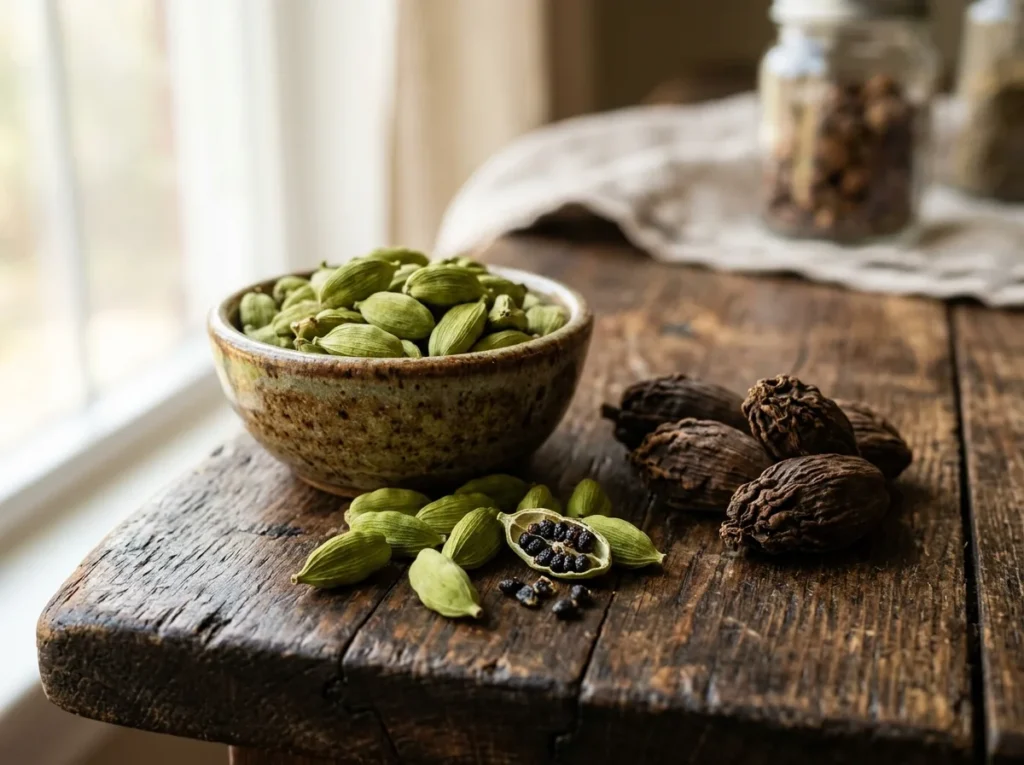
Green cardamom (Elettaria cardamomum) is a large perennial plant native to the rainforests of southern India. It belongs to the same family as ginger and turmeric, the Zingiberaceae. What we harvest are its fruits: small, oval green capsules, the pods, picked by hand just before they ripen and then dried. Each pod holds around fifteen small, sticky black seeds that are highly aromatic.
Today, Guatemala is the world’s leading exporter of green cardamom, ahead of India, which produces a great deal but also consumes an enormous amount of it. It is also grown in Sri Lanka, Tanzania and Papua New Guinea.
Its distinctive scent comes from its essential oils, in particular 1,8-cineole (also called eucalyptol), which gives it its freshness, and alpha-terpinyl acetate, responsible for its floral and lemony notes.
Green vs black cardamom: what’s the difference?
Despite sharing a name, green cardamom and black cardamom do not come from the same plant and are not used in the same way. There is also a so-called “white” cardamom. Here is how to tell them apart.
| Cardamom | Origin | Appearance | Flavour and uses |
|---|---|---|---|
| Green | Elettaria cardamomum, India, Guatemala, Sri Lanka | Small, oval, pale green pod, about 1 to 2 cm | Fresh, lemony, floral; desserts, coffee, tea, rice, curries |
| Black | Amomum subulatum, Nepal, India (Sikkim), Bhutan | Large, wrinkled brown pod, 2 to 3 cm | Smoky, camphor-like, woody; slow-cooked dishes, dhals, biryanis, meat |
| White | Bleached green cardamom | Pale beige pod | Milder and less fragrant; light-coloured bakes |
Black cardamom is dried over a wood fire, which gives it its characteristic smoky taste. It is no substitute for green cardamom in a dessert: it could make it taste like a campfire. In a lentil dish or a stew, on the other hand, it works wonders. In the rest of this article, unless stated otherwise, we are talking about green cardamom, the most common kind in shops.
The health benefits of cardamom
Cardamom has been used for more than two thousand years in Indian Ayurvedic medicine, mainly for digestion and fresh breath. Modern research is also taking an interest, but human studies remain few and small. Most have tested powdered cardamom at doses of around 3 g per day, far more than a pinch in a dish. Finally, bear in mind that in Europe no health claim is authorised for cardamom.
Cardamom and digestion
This is the most widespread traditional use. Like ginger or cumin, cardamom is considered a carminative spice: it is thought to help reduce bloating and wind, and to ease minor cramps after a heavy meal. In the laboratory, its essential oils have shown a relaxing effect on the intestinal muscles. Clinical evidence remains limited, but a cup of cardamom tea after a meal is a pleasant habit and safe for most people.
Cardamom and fresh breath
In India, people commonly chew a pod or a few cardamom seeds after a meal, often mixed with fennel seeds. It is not just tradition: the cineole it contains has a refreshing effect, and laboratory studies show that cardamom extracts inhibit certain mouth bacteria linked to bad breath and tooth decay. Chewing a pod is no replacement for brushing your teeth, but it is an effective natural trick to freshen your breath, for example after a garlicky dish.
Other areas being studied
A few small clinical trials, carried out mostly in India and Iran, suggest that powdered cardamom taken for a few weeks might slightly lower blood pressure in people with hypertension, and improve certain markers of inflammation in overweight people. These results are interesting, but too limited to draw conclusions from. Cardamom is in no way a substitute for medical treatment.
Cardamom tea and its benefits
An infusion is the simplest way to enjoy cardamom every day. Warm and fragrant, it is a popular after-dinner drink thanks to its reputation as a digestive, or a comforting caffeine-free drink in the evening.
For 1 cup:
- 3 or 4 green cardamom pods
- 250 ml water
- Optional: a thin slice of ginger, a piece of cinnamon stick, a slice of lemon or a teaspoon of honey
Method: lightly crush the pods with the flat of a knife to crack them open. Bring the water to a simmer, add the pods, cover and leave to steep for 10 minutes off the heat. Strain, sweeten if you like, and drink hot.
How to use cardamom
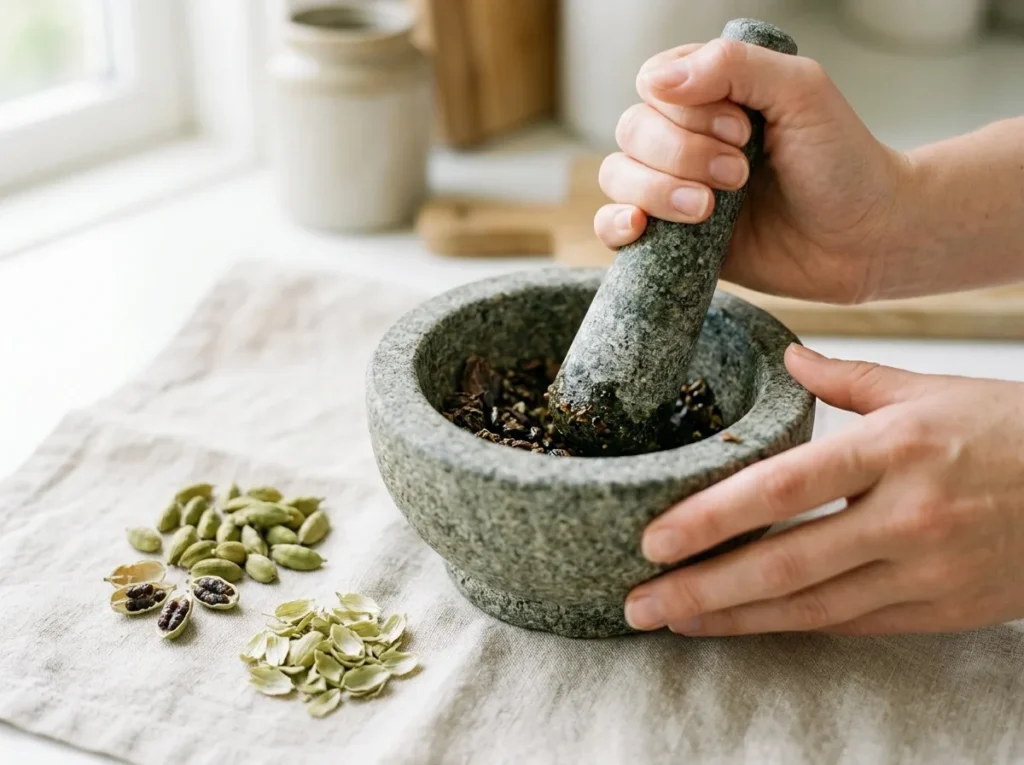
Cardamom comes in three forms, and each has its own use:
- Whole pods: lightly crush them to open them, then steep them in a liquid (milk, cream, tea, coffee, stock) or cook them in rice or a stew. Remove them before serving, as they are fibrous and unpleasant to bite into.
- Seeds: open the pods, collect the small black seeds and crush them in a mortar or grinder just before use. This is the most fragrant form.
- Ground cardamom: handy for baking, but much less fragrant.
Cardamom is powerful: a pinch or two pods is often enough. Too much gives a soapy or medicinal taste. For even more aroma, toast the pods for a few seconds in a hot dry pan before crushing them.
Ground cardamom or whole pods?
Our advice: buy cardamom in pods. Protected by their husk, the seeds keep their essential oils for one to two years. Once ground, cardamom loses much of its aroma within a few months, and shop-bought ground cardamom is often ground with the husk, which makes it less aromatic. If you need ground cardamom, grind the seeds yourself at the last minute.
As a guide: allow about 10 to 12 pods to get one level teaspoon of ground seeds. If a recipe calls for ground cardamom and you only have pods, that is the conversion to remember.
Cardamom tea recipe (chai style)
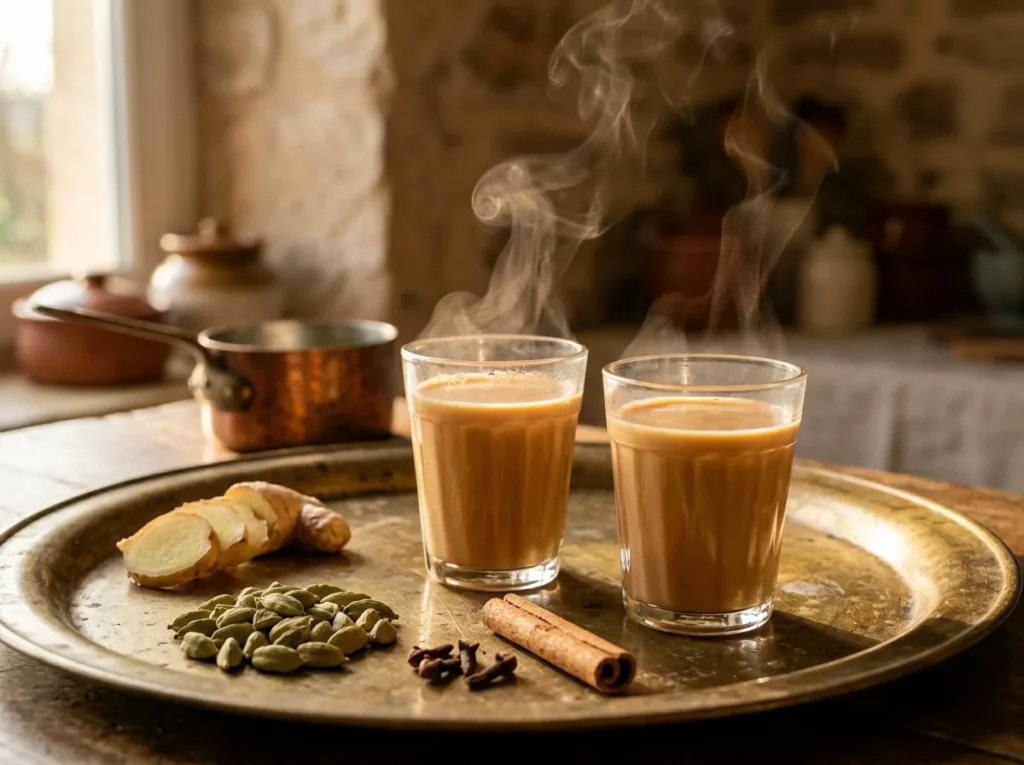
In India, masala chai is the everyday tea, and cardamom is its star ingredient. Here is a simple, fragrant version.
For 2 cups:
- 300 ml water and 200 ml milk (or plant-based milk)
- 2 teaspoons loose black tea (such as Assam)
- 4 green cardamom pods, crushed
- 2 slices of fresh ginger, 1 small cinnamon stick, 2 cloves and 2 black peppercorns
- 1 to 2 teaspoons sugar or honey
Method: simmer the water with the spices for 5 minutes. Add the tea and simmer for 2 minutes. Pour in the milk and sugar, then heat gently until it just starts to simmer, without letting it boil. Strain and serve straight away. For a simpler version, keep only the cardamom and ginger.
Cardamom coffee
In the Gulf countries, Arabic coffee (qahwa) is traditionally flavoured with cardamom, sometimes in large amounts. In Turkey and Lebanon too, people like to add a pod to their coffee. Cardamom softens the bitterness of coffee and gives it a fresh, floral note.
- With a filter coffee maker or French press: add the seeds of one crushed pod to the ground coffee for one cup.
- Turkish style: heat the water, very finely ground coffee and a cracked pod in a small pan, without letting it boil.
- As a latte: steep two crushed pods in the hot milk for 5 minutes before frothing it.
Cardamom in rice
This is a simple and very effective Indian and Persian cooking trick. Add 2 or 3 lightly crushed green cardamom pods to the cooking water of basmati rice, perhaps with a clove and a bay leaf. The rice takes on a delicate fragrance that goes perfectly with a curry, fish or our red lentil dhal with coconut milk. Cardamom is also essential in pilaf and biryani, where green and black are sometimes used together. Just remember to warn your guests, or remove the pods before serving.
Cardamom in baking
Cardamom may be an Indian spice, but it is the Nordic countries that are its biggest fans when it comes to baking. In Sweden, kardemummabullar, rolled cardamom buns, are just as popular as the famous cinnamon buns. In Finland, pulla, a braided sweet bread, is flavoured with cardamom. In the Middle East and India, it flavours rice pudding, custards, kulfi (an Indian ice cream) and syrup-soaked pastries.
A few easy ideas to get started:
- a pinch of ground cardamom in pancake, waffle or brioche dough;
- a few pods steeped in the milk for rice pudding or crème brûlée;
- apple or pear compote with a cardamom pod and a cinnamon stick;
- a pear crumble or loaf cake spiced with half a teaspoon of cardamom.
Cardamom pairs particularly well with pear, orange, apple, chocolate, vanilla, rose and pistachio.
What can you use instead of cardamom?
Run out of cardamom? No spice has exactly the same aroma, but here are some stand-ins:
- In baking: equal parts cinnamon and nutmeg, or cinnamon and ground ginger.
- In savoury dishes: a small pinch of ground cloves, used with care as they are very strong, or a little garam masala, an Indian spice blend that already contains cardamom.
- In tea or coffee: a thin slice of fresh ginger or a piece of cinnamon stick.
Use about half the amount of cardamom stated, taste, then adjust.
How to choose good cardamom
When buying, trust your eyes and your nose:
- Colour: good green cardamom is a bright, even green. Yellowed or greyish pods are often old or of lower quality.
- Size: plump, tightly closed pods contain more seeds and more essential oils.
- Seeds: open a pod if you can. The seeds should be black or dark brown, slightly sticky and very fragrant. Pale, dry seeds have lost their aroma.
- Smell: even through the packet, good-quality cardamom smells strong.
Indian and Middle Eastern grocery shops often sell cardamom in larger quantities and at better prices than supermarkets, with a fast stock turnover.
Cardamom price per kilo
After saffron and vanilla, cardamom is often described as the third most expensive spice in the world. Its price comes down to demanding cultivation, in a humid tropical climate and in the shade, and an entirely manual harvest: the pods do not all ripen at the same time, so each plant has to be picked over several times to gather the ones that are ready.
In Europe, the price of green cardamom varies widely depending on quality, pod size and packaging: as a rough guide, expect anything from a few tens of euros to more than a hundred euros per kilo loose, and considerably more in small supermarket jars. The largest, greenest pods are the most sought after. Don’t worry, though: because you use so little, a single pod costs just a few cents.
Cardamom side effects and precautions
In culinary amounts, cardamom suits almost everyone. The precautions mainly concern large amounts and supplements:
- Gallstones: as a precaution, people with gallstones should avoid large amounts of cardamom, which could trigger a painful attack. If in doubt, ask your doctor.
- Medication: if you take blood thinners or medication for high blood pressure or diabetes, talk to your doctor before taking cardamom as a supplement or in large amounts every day.
- Allergy: although rare, cardamom allergy does exist, sometimes in people who are allergic to ginger or turmeric, which belong to the same family.
- Essential oil: cardamom essential oil is highly concentrated. It should not be swallowed without advice from a healthcare professional and is not suitable for young children.
Cardamom and pregnancy
During pregnancy, cardamom in cooking, in normal amounts, poses no known problem: a pinch in a dessert or a pod in rice is safe. Some pregnant women even enjoy a light cardamom and ginger infusion for nausea, but scientific evidence on this point is lacking. However, due to a lack of data, cardamom supplements and essential oil should be avoided during pregnancy and breastfeeding. For a daily infusion, ask your doctor or midwife.
How to store cardamom
Like all spices, cardamom is sensitive to air, light, heat and moisture. Keep the pods in an airtight jar, made of tinted glass or metal, in a cool cupboard away from the hob. As pods, it stays fragrant for one to two years; ground, it is best used within six months. A pod that has lost its green colour and barely smells of anything when crushed is past its best.
Cardamom, turmeric, ginger: one family
Cardamom, ginger and turmeric are cousins: all three belong to the Zingiberaceae family, and they often come together in curries, chais and golden milk. To learn all about these spices and their neighbours, explore our guides to the health benefits of turmeric, ginger, cinnamon, black pepper, cumin, paprika and saffron. And for mulled wine, slow-cooked stews and Christmas pomanders, discover cloves. Not forgetting nutmeg, the secret of a good béchamel and mashed potatoes. And for gentle heat, discover Espelette pepper, the pride of the Basque Country. Finally, for a gentle lemony note, try coriander seeds, perfect in vegetables à la grecque.
Frequently asked questions about cardamom
What does cardamom taste like?
Green cardamom has a fresh, slightly minty and lemony taste, with floral and slightly sweet notes. Black cardamom is smoky and camphor-like.
Should you eat the cardamom husk?
No, the husk is fibrous and not very pleasant. It is used to flavour a liquid, then removed. Only the seeds are eaten or ground.
How many cardamom pods per person?
Allow one pod per person for rice, tea or coffee, and two to three pods for a dessert serving four to six people.
Does cardamom go off?
It does not become dangerous, but it gradually loses its aroma, especially when ground. If it barely smells of anything, replace it.
This article is for general information only and does not replace the advice of a doctor, midwife or pharmacist.