Skolebrød (Norwegian custard buns with coconut)
Ingredients
Method
- Make the custard: heat the milk with the split, scraped vanilla pod. Whisk the yolks, sugar and cornflour, pour the hot milk over while whisking, then return to a medium heat, whisking constantly, until the custard thickens. Cover with cling film touching the surface and chill.
- Make the dough: dissolve the yeast in the lukewarm milk. Add the sugar, salt, cardamom and nutmeg, then the flour and soft butter. Knead for 10 minutes until smooth and supple.
- Cover and leave to rise for 1 hour in a warm place, until doubled in size.
- Divide the dough into 12 balls of about 80 g. Place them on a tray lined with baking paper, cover and leave to rise for 30 minutes.
- Preheat the oven to 220 °C (425 °F). With the floured base of a small glass, press into the centre of each ball to make a wide, deep well without piercing the dough. Brush the edges with beaten egg.
- Whisk the cold custard until smooth, then fill each well with a generous spoonful, using a piping bag or a spoon. Bake for 10 to 12 minutes until golden. Cool on a wire rack.
- Mix the icing sugar with the hot water to make a thick icing. Spread it in a ring around the custard, then dip straight away into the desiccated coconut.
Notes
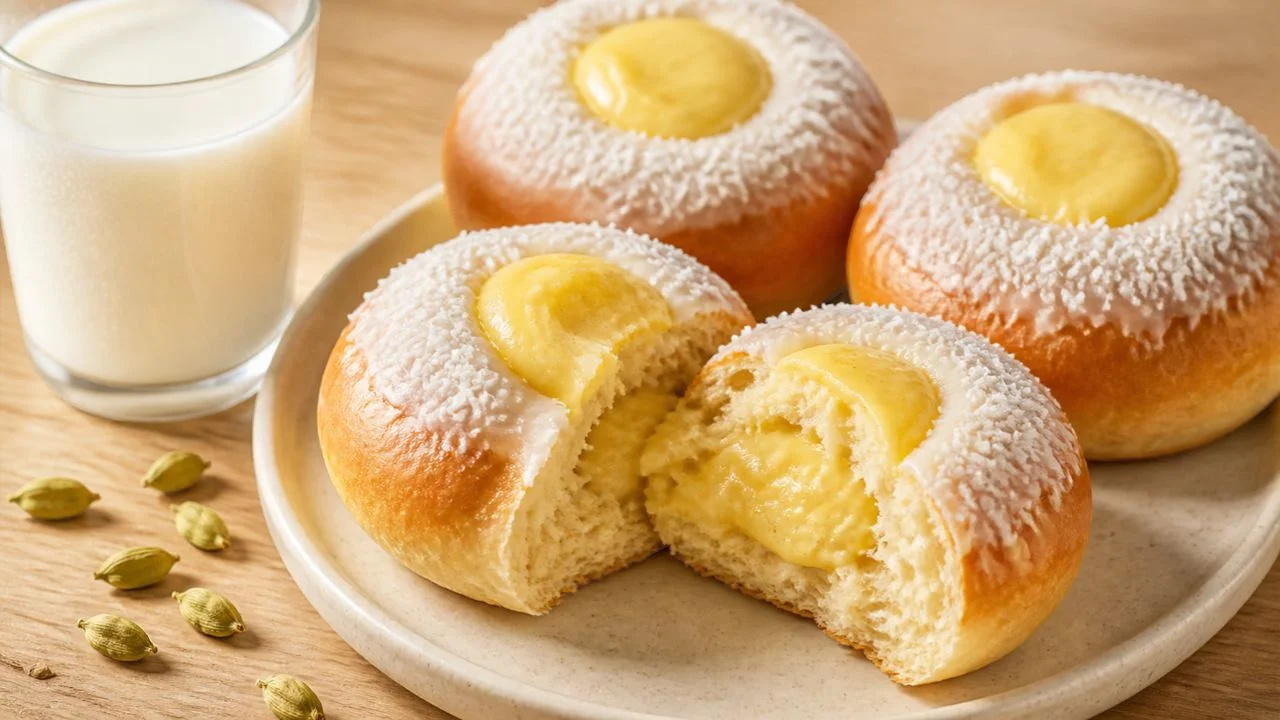
A soft bun scented with cardamom, a creamy vanilla custard centre and a ring of icing covered in coconut: skolebrød are Norway’s favourite snack. They are also called skoleboller, depending on the region. In this skolebrød recipe, we explain step by step how to make the dough, the custard, the shaping and the finish of these Norwegian custard buns, as pretty as they are delicious. It is a real bakery recipe that is easy to make at home.
Skolebrød: Norway’s school bread
In Norwegian, skolebrød literally means “school bread”, and skolebolle “school bun”. This Norwegian school bread owes its name to a simple tradition: children slipped it into their lunch box, or bought it at the bakery on the way home from school. Both names describe the same bun. Today you will find it in every bakery and petrol station in the country, and it remains a classic of birthday parties, school bake sales and family outings.
It is also a Norwegian pastry speciality that people love to make at home. It shares its cardamom dough with other Nordic buns, such as Swedish kanelbullar or Finnish korvapuusti, but stands out with its creamy filling in the centre.
A Scandinavian vanilla cream bun
Skolebrød is a Scandinavian vanilla cream bun: an enriched yeast dough with butter and milk, baked with a generous spoonful of custard in the centre. In the oven, the dough puffs up around the custard, which stays creamy and lightly golden. Once cooled, a ring of icing and coconut is added. The contrast between the airy bun, the smooth custard and the slightly crunchy coconut is what makes it so special.
A soft cardamom bun recipe
The base is a soft cardamom bun recipe. Knead the dough for 10 minutes, until it is supple and no longer sticks to your fingers. Soft butter makes the crumb tender, milk gives it sweetness. For a light, airy crumb, respect both rising times: 1 hour for the whole dough, then 30 minutes for the shaped balls. A well-risen dough gives buns as light as a cloud.
How to make skolebrød
Here is how to make skolebrød in the right order. Make the custard first, as it needs to be cold. Then knead the dough and let it rise. Divide it into 12 balls, let them puff up, then make a well in the centre of each one. Fill with custard and bake at 220 °C for 10 to 12 minutes. Once the buns have cooled, add the icing and coconut. Allow about 2 hours 30 minutes in total, with only 40 minutes of hands-on work.

Shaping skolebrød
Shaping skolebrød needs one precise gesture. After the second rise, take a small flat-bottomed glass, flour it and press firmly into the centre of each ball. You need a wide, deep well without piercing the dough down to the tray, otherwise the custard will run underneath. Make the well quite large, as the dough puffs up again in the oven. Then brush the edges with beaten egg for a lovely golden colour.
Vanilla custard for buns
The creamy centre depends on a good vanilla custard for buns. It must be thicker than a tart custard to hold during baking, which is why we use 25 g of cornflour for 300 ml of milk. Cook it while whisking constantly until it thickens, then let it bubble for 1 more minute. Cover it with cling film touching the surface and chill well. Just before filling, whisk it until smooth. A real vanilla pod gives the prettiest black specks and the best flavour.
Icing and coconut on the bun
The signature finish is the icing and coconut on the bun. Mix the icing sugar with a little hot water to make a thick icing that coats a spoon without running. Spread it in a ring around the custard, on the completely cooled bun, or it will melt. Dip the bun straight away into the desiccated coconut, icing side down: the coconut sticks to the sugar and forms a pretty white crown. Leave the custard visible in the centre, the hallmark of skolebrød.
Spices for Norwegian buns
Among the spices for Norwegian buns, the queen is cardamom. Scandinavians are among the world’s biggest consumers of it, and it flavours almost all their buns. For an intense aroma, crush the seeds of a few green pods yourself in a mortar. The vanilla in the custard brings sweetness. A small pinch of nutmeg in the dough adds a warm note, but it is optional. To discover more pairings, see our spice guide. At Christmas, cardamom also flavours krumkake, thin Norwegian wafer cookies rolled into cones.
Cardamom and coconut in baking
Pairing cardamom and coconut in baking may surprise you, but it works wonderfully. Cardamom brings a fresh, lemony and slightly peppery note. Coconut answers with its sweetness and slightly exotic side. Together they recall some Indian desserts, where these two ingredients are often combined. In skolebrød, the vanilla custard brings them together.
Our tips for perfect skolebrød
A few details make all the difference. The milk should be lukewarm, around 37 °C: too hot, it would kill the yeast. If you use dried yeast, mix it straight into the flour. Don’t add too much flour while kneading, even if the dough is a little sticky at first: it would become dry. For an even rise, place the dough near a radiator or in the switched-off oven with a bowl of hot water.
While baking, watch the colour: at 220 °C, the buns brown quickly. If your oven runs hot, lower it to 210 °C and add 2 minutes. Let them cool completely before icing. Finally, for a bakery finish, weigh the balls: buns of the same size bake evenly and look prettier on a plate.
Skolebrød variations
Some Norwegian bakeries replace the custard with a lighter cream, mixed with whipped cream after baking. Others add raisins to the dough or flavour the icing with lemon. For a less sweet version, you can skip the icing and simply sprinkle a little coconut over the egg wash before baking. The classic version, however, remains the one with vanilla custard, icing and coconut.
An easy Scandinavian snack recipe
Skolebrød is an easy Scandinavian snack recipe, perfect for the weekend. Make the custard in the morning, the dough in the early afternoon, and the buns will be ready for snack time. Children love making the wells and dipping the buns in coconut. Serve them with a glass of cold milk, as in Norway, or with coffee. They are best eaten the same day, and keep for 1 day in the fridge because of the custard.
Frequently asked questions about skolebrød
Skolebrød or skoleboller: what’s the difference?
None: they are two names for the same bun. People say skolebrød in some regions and skolebolle in others.
Can skolebrød be frozen?
Yes, baked and without icing. Thaw them in the fridge, then add the icing and coconut at the last moment.
Why did the custard run during baking?
The well was probably pierced or too small, or the custard not thick enough. Make a deep well without piercing the dough, and use a well-cooked, well-chilled custard.