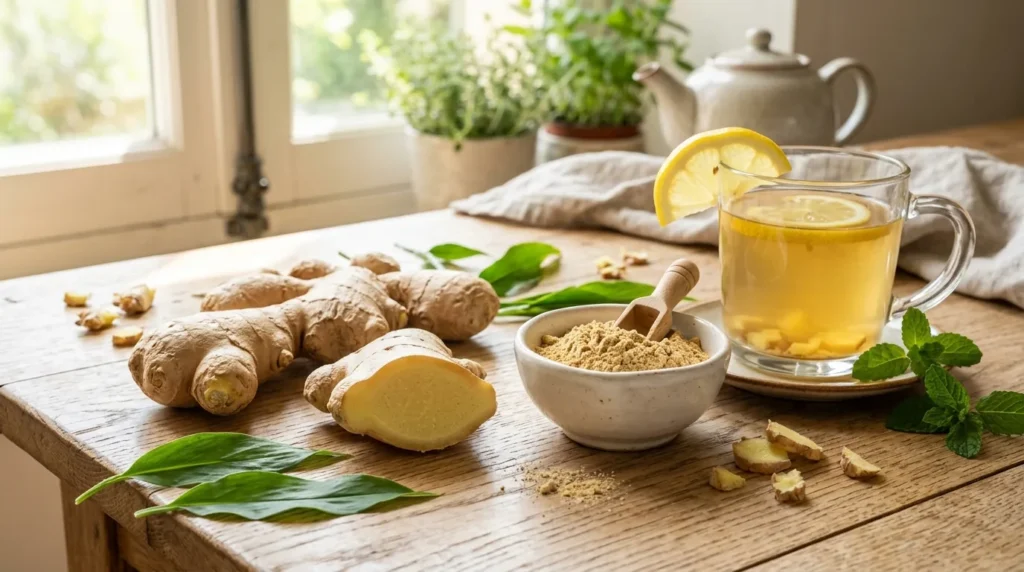
Hot, lemony and slightly peppery, ginger livens up a stir-fry, flavours a herbal tea and gives desserts real character. But this root is much more than a seasoning. Used for thousands of years in Asia, it is now being studied for its effects on nausea and digestion. In this guide, we look at the health benefits of ginger, sensible amounts and the precautions worth knowing, then head into the kitchen: how to choose it, peel it, store it, make it into a tea or a sweet treat, and even grow it at home.
What exactly is ginger?
Ginger (Zingiber officinale) is a tropical plant of the Zingiberaceae family, the same family as turmeric and cardamom. What we call the “root” is actually a rhizome: a fleshy, knobbly underground stem from which the leaves and roots grow.
Native to South-East Asia, it has been cultivated for so long that it is no longer found in the wild. The Greeks and Romans already prized it, and it was hugely popular in medieval European cooking. Today, India is the world’s leading producer, ahead of Nigeria and China.
Its distinctive flavour comes from compounds called gingerols, which are abundant in fresh ginger. When ginger is dried or heated, some of the gingerols turn into shogaols, which are hotter, and into zingerone, which is milder. That is why fresh ginger, ground ginger and cooked ginger do not taste quite the same.
Ginger health benefits
Ginger is one of the most widely studied plants. As is often the case, it is important to separate what is well supported from what still needs confirming. Bear in mind that in Europe, no health claim has been approved for ginger: a product cannot claim to treat or prevent any disease.
Ginger for nausea: its best-established use
This is the area where the evidence is most convincing. The European Medicines Agency (EMA) recognises ground ginger as having a well-established use for preventing the nausea and vomiting of motion sickness in adults. The recommended dose is 1 to 2 g of powder, around an hour before travelling. This status is only granted to plants whose effectiveness is backed by clinical studies.
Other situations have been studied, such as nausea after surgery or during chemotherapy. The results there are more mixed: ginger may offer a small extra benefit, but it never replaces prescribed treatment. For nausea during pregnancy, see the dedicated section below.
Ginger and digestion
Ginger is traditionally used for sluggish digestion, bloating and wind. A few small studies suggest it speeds up stomach emptying, which could explain that feeling of lightness after a heavy meal. The evidence remains limited, but a cup of ginger tea after a rich meal is a simple and pleasant habit.
A word of caution, though: in people prone to heartburn or reflux, large amounts can actually cause irritation.
Inflammation, pain and other avenues
In the laboratory, gingerols have shown antioxidant and anti-inflammatory effects. In humans, a few trials on osteoarthritis and period pain have produced encouraging but modest results, often with concentrated extracts rather than the ginger you cook with. Effects on blood sugar, cholesterol or weight are even less well established. Ginger will not make you lose weight on its own.
Above all, remember this: ginger is an excellent ingredient in a healthy, varied diet, not a miracle cure.
How much ginger per day?
There is no official daily intake for ginger. Even so, a few benchmarks can help:
- In cooking, the usual amounts (a grated piece in a dish, one cup of ginger tea a day) pose no problem for healthy adults.
- In studies, the amount most often used is around 1 g of dried ginger a day, and up to 2 g occasionally for motion sickness.
- Many sources cite around 4 g of dried ginger a day as the upper limit for adults.
As a rough guide, 1 g of powder corresponds to about 5 g of fresh ginger, which is a small piece roughly the size of a fingertip. Beyond a few grams, the main risks are heartburn, diarrhoea and mouth irritation. Food supplements (capsules, extracts) are far more concentrated: ask a pharmacist for advice before taking them, and do not give them to children without medical advice.
Ginger side effects and contraindications
Used in cooking, ginger is very well tolerated. In large amounts or as supplements, however, a few precautions apply. Talk to your doctor or pharmacist if any of the following applies to you:
- Anticoagulant or antiplatelet treatment (blood thinners): ginger could strengthen their effect and increase the risk of bleeding.
- Gallstones: ginger stimulates bile production, which can make symptoms worse.
- Ulcers, gastritis or reflux: it can make the burning worse.
- Planned surgery: it is generally advised to stop ginger supplements one to two weeks beforehand, because of the risk of bleeding.
- Treatment for diabetes or high blood pressure: to be on the safe side, tell your doctor if you take supplements regularly.
Ginger during pregnancy: what you need to know
Ginger is one of the most frequently mentioned remedies for morning sickness in early pregnancy. The World Health Organization (WHO) recognises this use, and several reviews of studies conclude that there is a real but modest effect. At the doses studied, generally around 1 g a day, the largest study found no increase in the risk of birth defects.
European authorities nonetheless remain cautious. The EMA does not recommend ginger-based medicines during pregnancy, as the data are not considered sufficient, and some herbal medicine references also advise against it. So what should you do?
- Ginger in cooking, in normal amounts, poses no known problem.
- If you want to use it for nausea (daily ginger tea, capsules), ask your doctor or midwife first.
- Avoid concentrated supplements without medical advice, especially late in pregnancy and if you are on anticoagulant treatment.
And if the nausea is severe or you can no longer eat or drink, seek medical help quickly: ginger is not enough in that case.
Fresh or ground ginger: which should you choose?
Both have their place in the kitchen, but they are not used in quite the same way. The table below sums up the differences.
| Fresh ginger | Ground ginger | |
|---|---|---|
| Flavour | Zingy, lemony, juicy | Warmer, earthier |
| Compounds | Rich in gingerols | More shogaols, which are hotter |
| Best for | Stir-fries, curries, marinades, teas, juices | Baking, gingerbread, spice blends |
| Equivalent | 1 tablespoon, grated | ¼ teaspoon |
| How to choose | Firm, heavy, with smooth, shiny skin; never wrinkled or soft | Bright colour, strong aroma; check the date |
| Storage | 3 weeks in the fridge, several months in the freezer | Several months in a sealed jar, away from light |
| Skin | Edible: you can leave it on if the ginger is organic | Not applicable |
How to peel ginger easily
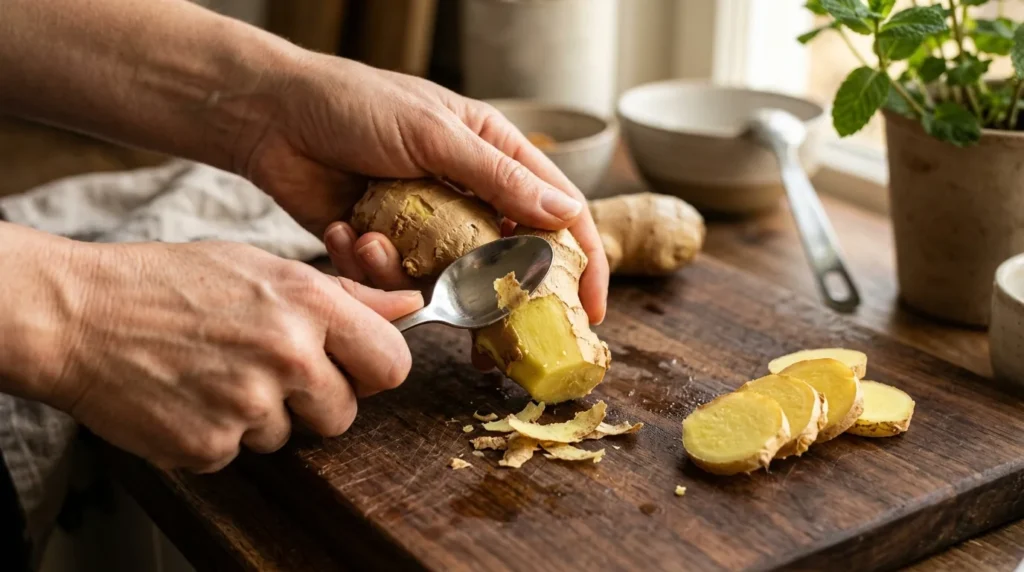
There is no need for a vegetable peeler, which wastes a lot of flesh in the nooks and crannies. The chef’s trick: an ordinary teaspoon.
- Cut off the piece you need and snap off the small knobs.
- Hold the ginger firmly and scrape the skin with the edge of a teaspoon.
- The very thin skin comes away easily, even in the hollows.
- Grate, slice or cut into matchsticks, depending on your recipe.
For a tea or a stock, you can even leave the skin on organic ginger, as long as it is well washed. For grating, a fine grater (such as a zester) gives a soft pulp; grate along the fibres to avoid stringy bits.
How to store fresh ginger
Stored properly, ginger keeps its aroma for several weeks. Here are your options, from shortest to longest:
- At room temperature: about a week, in a cool, dry place, away from light.
- In the fridge: about three weeks. Unpeeled, wrapped in kitchen paper, then placed in a bag or sealed container in the vegetable drawer.
- In the freezer: several months. Freeze it whole, sliced or ready-grated in small portions. Frozen ginger grates very well without thawing, and is actually easier to work with.
- In a jar: peeled, sliced and covered with rice vinegar, it keeps for several weeks in the fridge, much like the pickled ginger served with sushi.
Ginger that wrinkles is drying out: it is still usable, but it has lost some of its juice. If it turns soft or mouldy, throw it away.
Cooking with fresh ginger
Ginger works in both savoury and sweet dishes. A few ideas for using it every day:
- In stir-fries: together with garlic and onion, it forms the aromatic base of many Asian cuisines.
- In curries and dhals: it adds freshness, as in our red lentil dhal with coconut milk.
- In soups and stocks: a few slices are enough to liven up a creamy carrot soup or a vegetable stock.
- In marinades: grated with soy sauce, lemon and a little honey, for tofu, fish or grilled vegetables.
- In desserts: gingerbread, biscuits, fruit compotes, mango fruit salad.
- In drinks: herbal teas, juices, lemonade, or in turmeric golden milk.
Tip: added at the start of cooking, ginger becomes milder; added at the end, it keeps all its heat.
Ginger tea recipe
This is the simplest way to enjoy ginger. For one large mug:
- 2 to 3 cm of fresh ginger (about 10 to 15 g)
- 300 ml of water
- Optional: a few slices of lemon, a teaspoon of honey, a cinnamon stick or a few mint leaves
- Wash the ginger and cut it into thin slices (no need to peel it if it is organic).
- Put it in a saucepan with the cold water and bring to a simmer.
- Simmer for 10 minutes with the lid on: the longer you leave it, the spicier it gets.
- Strain, add the lemon, then the honey once the drink has cooled slightly.
For a quick version, simply pour simmering water over grated ginger and leave to steep for 5 to 10 minutes. In summer, the tea is also lovely iced, with fresh mint.
Fancy a gentler version? Add a cinnamon stick while it simmers, and find out more about this spice in our guide to cinnamon: health benefits, Ceylon vs cassia and precautions.
Ginger and lemon in the morning: a good idea?
Drinking a glass of warm water with ginger and lemon first thing has become a very popular wellness ritual. What can you honestly expect from it?
It is a pleasant way to start the day by rehydrating, with a drink that has no added sugar and plenty of flavour. The lemon provides a little vitamin C. However, the idea of a “detox” has no scientific basis: it is the liver and kidneys that remove waste from the body, and they do so very well without any help.
Two precautions: lemon is acidic and, over time, can weaken tooth enamel. Rinse your mouth with water after the drink and wait half an hour before brushing your teeth. And if you have a sensitive stomach, have this drink with breakfast rather than on an empty stomach.
Homemade candied ginger recipe
Candied ginger can be nibbled like a sweet, added to cakes and biscuits, and makes a lovely homemade gift. For one jar:
- 250 g of fresh ginger, nice and firm
- 250 g of sugar, plus a little extra for coating
- 250 ml of water
- Peel the ginger with a spoon and cut it into slices 2 to 3 mm thick.
- Cook it for 10 minutes in a pan of boiling water, then drain. Repeat once or twice to tone down its heat.
- In the pan, mix the sugar with the 250 ml of water, bring to the boil, then add the ginger.
- Simmer gently for 30 to 45 minutes, until the slices turn translucent and the syrup thickens.
- Drain (keep the syrup!), roll the slices in sugar and leave them to dry overnight on a wire rack.
Stored in an airtight jar, candied ginger keeps for several weeks. The leftover ginger syrup is delicious in a hot drink, a fruit salad or sparkling water.
What is the difference between ginger and turmeric?
They are often mixed up on market stalls, and for good reason: they are two related rhizomes from the same botanical family. Yet once cut open, they could hardly be more different.
- Colour: ginger flesh is pale yellow to beige, while turmeric is a bright orange that stains your fingers.
- Flavour: ginger is hot and lemony; turmeric is milder, earthy and slightly bitter.
- Star compounds: gingerols for ginger, curcumin for turmeric, a molecule the body absorbs poorly without black pepper.
- Health uses: ginger is mainly studied for nausea, turmeric for its anti-inflammatory properties.
The two go very well together, in a curry, a soup or a golden milk. To find out more about its orange cousin, read our article on the health benefits of turmeric.
How to grow ginger in a pot
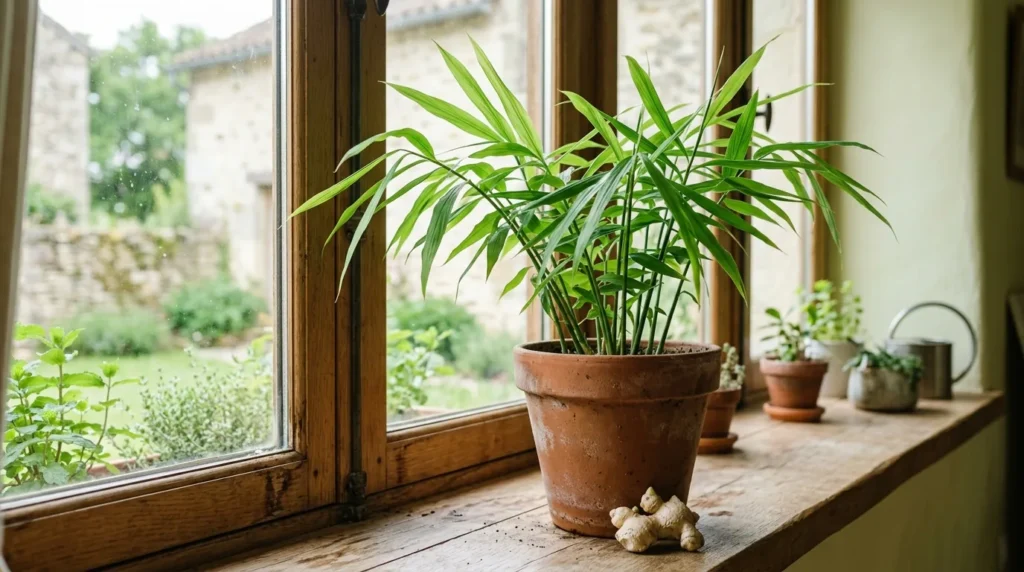
Good news: a simple piece bought at the market can grow into an attractive houseplant, with long leaves reminiscent of bamboo. Here is how.
- Choose the right rhizome: preferably organic, as conventional ginger is sometimes treated to stop it sprouting. Pick a firm piece with visible “eyes”, the small pale buds at the tips of the knobs.
- Soak it overnight in lukewarm water to wake it up.
- Plant in spring, around March or April, in a pot that is wide rather than deep, filled with light, free-draining compost. Bury the rhizome 3 to 5 cm deep, with the eyes facing up.
- Keep the pot somewhere warm, ideally between 20 and 25 °C, in good light but out of harsh direct sun.
- Water moderately: the compost should stay slightly moist, never waterlogged, or the rhizome will rot.
Be patient: the first shoots appear after three to eight weeks. In summer, the pot can go out on a sheltered balcony as long as night-time temperatures stay above about 15 °C. Harvest after eight to ten months, when the leaves turn yellow: take the plant out of its pot, help yourself to your ginger and replant a piece for the next season.
Want to pair this spice with pepper? Discover the different varieties, piperine and our homemade peppercorn sauce in our guide to pepper.
Read next: our complete guides to cumin, the go-to spice for digestion, and paprika, sweet, hot or smoked. And for special occasions, discover saffron, the red gold of spices. And to flavour tea, coffee and buns, discover cardamom, the queen of spices. And for mulled wine, slow-cooked stews and Christmas pomanders, discover cloves. Not forgetting nutmeg, the secret of a good béchamel and mashed potatoes. And for gentle heat, discover Espelette pepper, the pride of the Basque Country. Finally, for a gentle lemony note, try coriander seeds, perfect in vegetables à la grecque.
Frequently asked questions about ginger
Can you eat ginger every day?
Yes, in culinary amounts, ginger can be eaten every day by healthy adults. Stay below a few grams of dried ginger (or the fresh equivalent) and ask for advice if you are on any medication.
Do you need to peel ginger?
It is not essential. The skin is edible: for a tea or a stock, well-washed organic ginger can be used as it is. For raw dishes or a fine texture, it is better to peel it with a spoon.
Is ginger good for a sore throat?
A hot ginger tea with lemon and honey soothes the throat and warms you up, which makes it pleasant when you have a cold. It does not cure an infection: if the pain persists or comes with a fever, see a doctor.
Does ginger help you lose weight?
No serious study shows that ginger makes you lose weight on its own. It does, however, help you cook tasty food with less salt, sugar and fat, which is already a real plus.
This article is for general information only and does not replace the advice of a doctor, midwife or pharmacist.