A single pinch is enough to make a whole kitchen smell of Morocco, India or Mexico. Cumin is one of the most widely used spices in the world: you’ll find it in couscous, curries, chili, falafel and hummus. It also has a solid reputation as the “digestion seed”. In this guide, we take a close look at the health benefits of cumin, separating what’s proven from what comes from tradition, and then head into the kitchen: whole seeds or ground, toasting, storage, cumin tea and recipe ideas. We also clear up a very common mix-up between cumin, caraway and nigella.
What exactly is cumin?
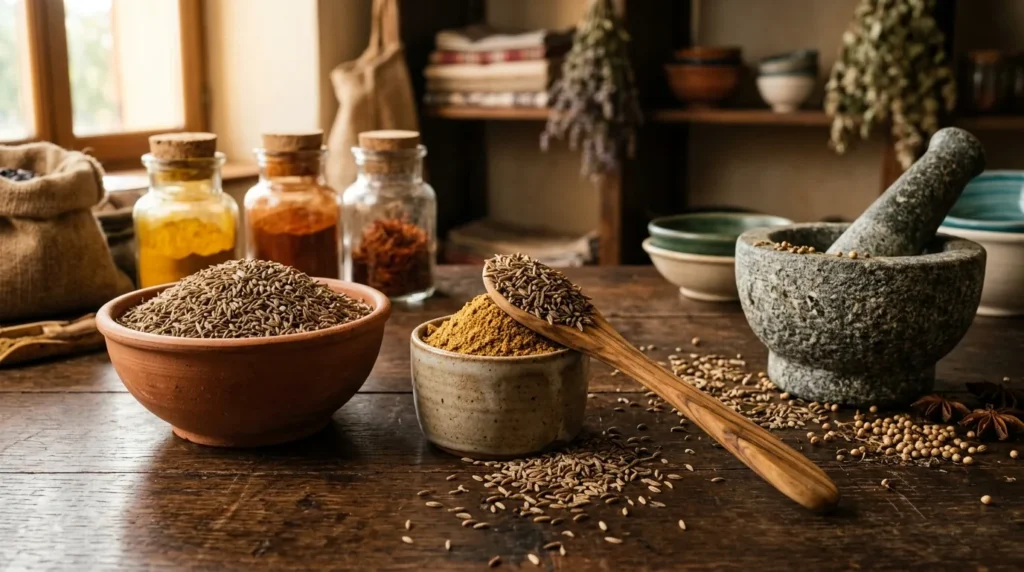
Cumin (Cuminum cyminum) is a small annual plant from the Apiaceae family, the same family as carrots, parsley, fennel and coriander. Native to the Near and Middle East, it grows in hot, dry regions. What we call “cumin seeds” are actually its fruits: small, elongated, ridged grains, light brown in colour and 4 to 6 millimetres long.
Its history goes back a long way. The Egyptians were already using it more than 4,000 years ago, both in cooking and in their medicinal preparations, and the Romans used it much the way we use pepper today. Today, India is by far the world’s largest producer and consumer, ahead of Syria, Turkey and Iran.
Its warm, earthy, slightly bitter aroma comes from its essential oil, which is rich in cuminaldehyde. This is the molecule that gives cumin its unmistakable smell, and it’s also the one that slowly evaporates as ground cumin gets older.
Cumin benefits: what does the science say?
Cumin has been used for centuries in traditional medicine, especially in India (Ayurveda) and Iran. Modern research is interested in it too, but it’s worth keeping a cool head: most studies are done in the lab or on animals, and human trials are still few and small. In fact, no health claim is authorised for cumin in the European Union.
Here’s what we can honestly say:
- A surprising source of iron: cumin seeds are among the most iron-rich spices, with around 60 mg per 100 g. But we only eat a few grams: a teaspoon (about 2 g) provides just over 1 mg, which is a small boost at best.
- Antioxidants: like many spices, cumin contains phenolic compounds and flavonoids with antioxidant properties, shown mainly in the lab.
- Blood sugar and cholesterol: a handful of small trials, mostly carried out in Iran, suggest a slight effect on blood sugar and blood fats. The results are encouraging but too limited to base any advice on.
- A helping hand for cutting salt: this is probably its most practical benefit. Its strong flavour means you can use less salt in pulses, roasted vegetables and soups.
Cumin for digestion
This is cumin’s best-known use. In traditional medicine, it’s classed as a “carminative” plant, meaning one that helps expel gas and eases heavy digestion. It’s no coincidence that it so often goes with chickpeas, lentils and beans, foods known for being hard to digest.
A few studies point in this direction. Trials in Iran with people suffering from irritable bowel syndrome showed less pain and bloating with cumin essential oil, but without a placebo group or with small numbers of participants. Animal studies also suggest that cumin stimulates the production of digestive enzymes and bile. So cumin may have a place in making digestion more comfortable, without being a treatment.
Cumin for bloating
For bloating, the simplest move happens in the kitchen: add cumin when cooking pulses, cabbage or onions. A cup of cumin tea after a big meal is also a very common habit in India and North Africa. It works well combined with fennel or mint. If bloating is frequent or painful, or comes with other symptoms (weight loss, blood in the stool, changes in bowel habits), see a doctor: a spice should never delay a diagnosis.
Cumin tea recipe (jeera water)

In India, it’s called jeera water, “cumin water”. It’s ready in just a few minutes.
For 1 cup:
- 1 teaspoon cumin seeds (about 2 to 3 g)
- 250 ml (1 cup) water
- Optional: a slice of lemon, a few mint leaves, a thin slice of ginger or a teaspoon of honey
Method:
- Lightly crush the seeds in a mortar or with the flat of a knife to release their aroma.
- Bring the water to the boil, add the seeds and let them simmer for 5 minutes.
- Cover, leave to steep for another 5 minutes off the heat, then strain.
- Add lemon, mint or honey to taste and drink it warm, ideally after a meal.
The “cold” version: soak a teaspoon of seeds in a glass of water overnight, then warm it up in the morning and strain. The flavour is gentler. For a comforting drink from a different family, try our turmeric golden milk too.
How much cumin per day?
There’s no official dose for cumin: no European health authority has set a limit, and there’s no EMA monograph for this plant. In practice:
- In cooking, people generally use between 1 and 3 g a day (half a teaspoon to one and a half teaspoons), which is no problem at all for a healthy adult.
- In studies, the doses tested are usually around 3 g of powder a day, over a few weeks.
- Supplements and essential oil are far more concentrated: don’t use them without advice from a healthcare professional.
Cumin side effects and precautions
In culinary amounts, cumin is safe for the vast majority of people. There are a few precautions, though, mainly for concentrated doses:
- Allergy: cumin belongs to the same family as celery, carrots and fennel. People who are allergic to celery, especially as part of the “celery-mugwort-spice syndrome”, may also react to cumin.
- Diabetes: since cumin might slightly lower blood sugar, be careful with supplements if you’re taking diabetes medication.
- Blood thinners and surgery: as a precaution, avoid cumin supplements if you’re on blood-thinning medication, and stop them two weeks before an operation.
- Essential oil: cumin essential oil is photosensitising. Applied to the skin before sun exposure, it can cause burns or dark spots. Don’t swallow it without medical advice.
Cumin during pregnancy
During pregnancy, cumin in cooking is not a problem: it’s part of the everyday diet of millions of pregnant women in India, North Africa and the Middle East. Concentrated doses, on the other hand, are best avoided. In some traditional medicines, high doses of cumin were believed to bring on periods, and there isn’t enough safety data for supplements or essential oil. The sensible approach: enjoy it in your meals, and ask your doctor or midwife before drinking cumin tea every day or taking any supplement. The same rule applies while breastfeeding.
Cumin for weight loss: fact or myth?
Cumin is often marketed as a “fat burner”. The reality is more nuanced. An Iranian trial published in 2014 followed overweight women who added 3 g of ground cumin to their yogurt every day for three months, on top of a diet: they lost a little more weight and body fat than the group without cumin. A review of several studies published in 2018 also found a slight effect on weight. But these studies involve few people, always alongside a diet, and the effect remains modest.
In short, cumin won’t make you lose weight on its own. Its real strength lies elsewhere: it adds lots of flavour to vegetables, soups and pulses without adding fat, which makes eating healthily a real pleasure.
Cumin vs caraway vs nigella (black seed): how to tell them apart
The names of these seeds are a real source of confusion. Caraway is sometimes called “meadow cumin” or “Persian cumin”; nigella is often sold as “black cumin” or “black seed”, even though it’s a completely different plant. And there’s also a true black cumin, which is much rarer. The table below sums it all up.
| Seed | Plant | Look and flavour | Uses |
|---|---|---|---|
| Cumin | Cuminum cyminum, carrot family | Light brown, elongated; warm, earthy, slightly bitter | Couscous, curries, chili, falafel, hummus |
| Caraway (“meadow cumin”) | Carum carvi, carrot family | Dark brown, curved; aniseedy, milder | Rye bread, sauerkraut, cabbage, cheeses such as Munster |
| Nigella (“black cumin”, “black seed”) | Nigella sativa, buttercup family | Black, angular; peppery, slightly oniony | Naan, Middle Eastern breads, cheeses, salads |
| True black cumin (kala jeera) | Bunium persicum, carrot family | Very dark brown, thin; more delicate and smoky than cumin | Cooking from northern India, Iran and Afghanistan |
Cumin vs caraway: what’s the difference?
Cumin and caraway are cousins and look alike, hence the confusion, which isn’t helped by German, where caraway is Kümmel and cumin is Kreuzkümmel. Yet they taste nothing alike: caraway is mild and aniseedy, typical of Central and Northern European cooking, while cumin is warm and powerful, typical of North Africa, India and Mexico. You can’t swap one for the other in a recipe.
Black cumin vs nigella: what’s the difference?
What you’ll most often find sold as “black cumin” or “black seed”, especially as an oil or a supplement, is actually nigella (Nigella sativa), a plant from the buttercup family with no connection to cumin at all. Its small, angular black seeds have a slightly peppery taste. True black cumin (Bunium persicum), on the other hand, looks like a thinner, darker cumin. So before you buy, check the Latin name on the label.
Cumin and turmeric: a classic Indian cooking duo
Cumin and turmeric are the two pillars of many curries and spice blends, such as garam masala or ras el hanout. They complement each other nicely: cumin brings warmth and depth, turmeric its golden colour and its mild, slightly bitter note. In a dhal, cumin seeds are often sizzled in hot oil first, then the ground turmeric goes in. That’s exactly what we do in our red lentil dhal with coconut milk. To learn more, check out the health benefits of turmeric as well.
Cumin seeds or ground cumin?
Both forms deserve a spot in your cupboard. It all depends on how you use them:
- Seeds keep their aroma much longer. You fry them whole in oil at the start of cooking (that’s the Indian tadka), or add them to breads, roasted vegetables and marinades. They also bring a light crunch.
- Ground cumin blends more easily into sauces, soups, hummus, meatballs and seasonings. It’s convenient, but loses its aroma within a few months.
Our tip: buy whole seeds, and grind a small amount in a coffee grinder or mortar when you need it. The difference in aroma is spectacular. Allow about 1 teaspoon of seeds for a little over 1 teaspoon of ground cumin.
How to toast cumin seeds
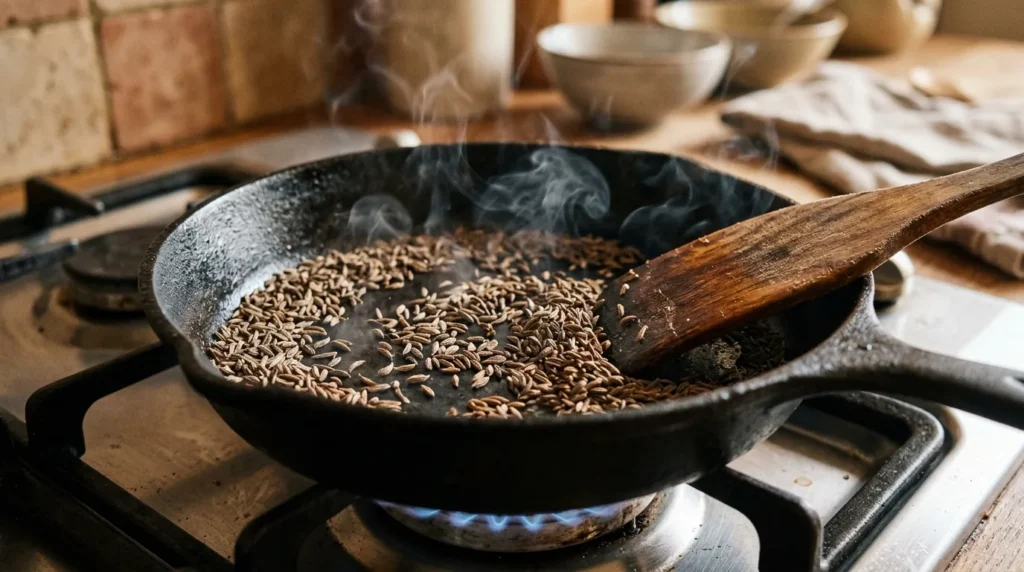
Toasting cumin means dry-roasting it for a few moments. This simple chef’s trick brings out rounder, toastier, almost nutty flavours.
- Heat a heavy-based pan over medium heat, with no oil.
- Add the seeds in a single layer and stir constantly.
- After 1 to 2 minutes, they darken slightly and give off an intense aroma: they’re ready.
- Tip them straight onto a cold plate to stop the cooking, then grind them once cooled if needed.
Careful: cumin goes from toasted to burnt very quickly, and burnt cumin turns bitter. If in doubt, take the pan off the heat. Ground toasted cumin is delicious sprinkled over yogurt, a carrot salad or roasted vegetables.
How to store cumin
Cumin doesn’t like light, heat, air or moisture, which make its essential oil evaporate. To keep it fragrant:
- Store it in a tightly sealed jar, glass or metal, away from light.
- Keep it away from the hob and oven: the cupboard above the stove is the worst possible spot.
- Whole seeds keep for about 2 to 3 years, ground cumin for about 6 months to 1 year.
- Do the smell test: rub a little cumin between your fingers. If it barely smells of anything, it’s time to replace it. It isn’t harmful, but it won’t add any flavour.
Cumin recipes: our ideas
Cumin shows up in kitchens all over the world. Here are a few ideas for using it every day:
- Pulses: it’s the best friend of chickpeas, lentils and beans. Try our baked chickpea falafel or our split pea and cumin dip.
- Carrots: roasted with cumin and a drizzle of honey, or grated into a Moroccan-style salad with orange juice.
- Couscous and tagines: cumin is one of the core spices of North African cooking, along with ginger, cinnamon and paprika.
- Chili and Tex-Mex dishes: with paprika, oregano and a little chilli.
- Curries and dhals: as whole seeds sizzled in oil at the start of cooking.
- Hummus: half a teaspoon of ground cumin makes all the difference.
- Cheese and bread: cumin Gouda, a Dutch speciality, or a few seeds in your bread dough.
Cumin, ginger, cinnamon, pepper: everyday spices
Together with a few other spices, cumin forms the heart of a well-stocked spice cupboard. In a tagine, it teams up with ginger and cinnamon; in a marinade or a curry, it never goes without a twist of the pepper mill. To find out all about these spices, read our guides to ginger, cinnamon and black pepper.
Read next: our complete guide to paprika, sweet, hot or smoked, cumin’s perfect partner. And for special occasions, discover saffron, the red gold of spices. And to flavour tea, coffee and buns, discover cardamom, the queen of spices. And for mulled wine, slow-cooked stews and Christmas pomanders, discover cloves. Not forgetting nutmeg, the secret of a good béchamel and mashed potatoes. And for gentle heat, discover Espelette pepper, the pride of the Basque Country. Finally, for a gentle lemony note, try coriander seeds, perfect in vegetables à la grecque.
Cumin FAQ
Is cumin good for you?
Yes, in cooking, cumin is part of a healthy diet: it’s rich in iron for a spice, helps you use less salt and is traditionally used for digestion. That said, its health effects in humans are still not well studied.
Can you drink cumin tea every day?
For a healthy adult, one cup a day made with a teaspoon of seeds has no known issues. Ask a doctor if you’re pregnant or breastfeeding or taking any medication.
Does cumin cause bloating?
No, it’s more the opposite: it’s traditionally used to reduce gas, especially with pulses. However, someone allergic to plants in the Apiaceae family (celery, carrot) may not tolerate it well.
What can I use instead of cumin?
No spice tastes exactly like it. Depending on the recipe, you can use a little ground coriander seed, caraway or curry powder, bearing in mind the result will be different.
This article is for general information only and does not replace advice from a doctor, midwife or pharmacist.