Pão de queijo (Brazilian cheese bread)
Ingredients
Method
- Put both cassava starches in a large bowl. Bring the milk, oil and salt to the boil in a saucepan.
- Pour the boiling liquid straight onto the starch and stir quickly with a wooden spoon: the dough turns lumpy, then sticky. Leave to cool for 10 minutes.
- Add the eggs one at a time, kneading by hand or with a mixer, until the dough is smooth and supple.
- Work in the grated cheese and knead for 2 more minutes. Preheat the oven to 200 °C.
- With oiled hands, shape about 30 balls of 3 cm and place them on a tray lined with baking paper, well spaced.
- Bake for 20 to 25 minutes at 180 °C, until the pão de queijo are puffed and golden. Serve warm.
Notes
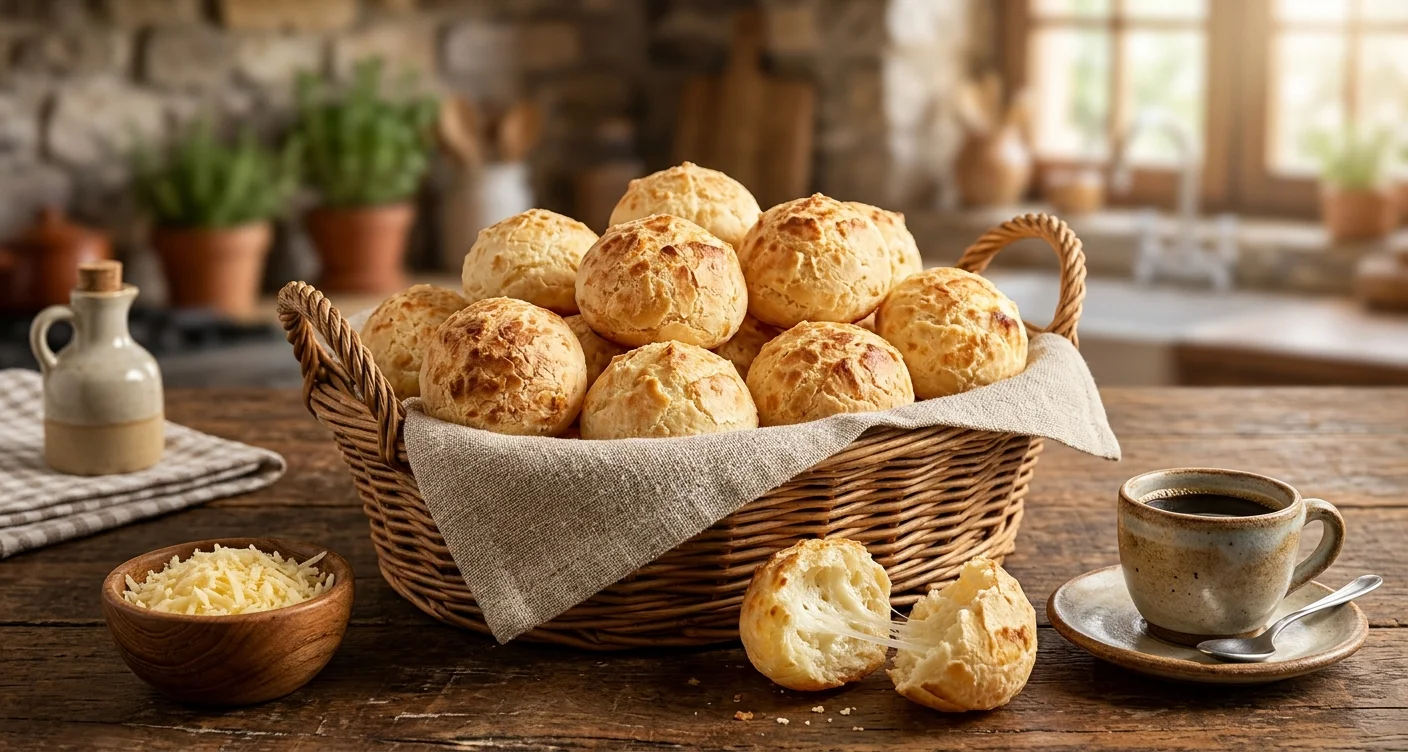
Crisp outside, soft and chewy inside, with a lovely cheesy flavour: pão de queijo is the little bread Brazilians eat at breakfast, as an afternoon snack or with drinks. Here is our traditional pão de queijo recipe, made with cassava starch and naturally gluten-free.
The origins of pão de queijo in Minas Gerais
Pão de queijo comes from Minas Gerais, a cattle and cheese region in south-eastern Brazil. According to tradition, it was born on farms in the 18th century, using the starch that settles at the bottom of the water when grated cassava is washed. Cheese and eggs came later. It spread across the country in the 20th century and today you will find it in every bakery and café.
Brazilian cheese bread, a dough like no other
This Brazilian cheese bread recipe contains no wheat flour. All the texture comes from cassava starch scalded with boiling milk: it turns sticky and elastic, then puffs up in the oven. You get a thin golden crust and a hollow, stretchy crumb, a little like a gougère but softer.
Polvilho azedo or doce?
In Brazil, two cassava starches are used. Polvilho doce is sweet starch, the same as tapioca starch. Polvilho azedo is fermented and sun-dried, with a slightly tangy taste: it makes the breads rise more and gives a crunchier crust. A half-and-half mix is the most balanced. With polvilho doce alone, the breads are more tender and a little less puffed. You will find both in Brazilian, Portuguese or world food shops, and online.
Which cheese to use?
In Brazil, cooks use queijo minas meia cura, a semi-aged cow’s milk cheese. Elsewhere, a mix of Parmesan for flavour and Emmental for stretch works very well. Gruyère, Comté or aged Mimolette are good too. Avoid very fatty or moist cheeses, which make the dough too soft.
How to make pão de queijo
The secret is scalding: the milk, oil and salt must be boiling when you pour them over the starch. Stir quickly, leave to cool, then add the eggs one by one. The dough should be supple and slightly sticky. Shape the balls with oiled hands and leave space between them, as they puff up a lot.

Easy pão de queijo in a blender
For an easy version, there is a method without scalding. Blend 250 g polvilho doce, 200 ml milk, 100 ml oil, 1 egg, 150 g grated cheese and a pinch of salt. Pour the runny batter into oiled mini muffin tins and bake for 20 minutes at 200 °C. The result is closer to a little soufflé and less chewy, but it is ready in 5 minutes.
Soft or crispy pão de queijo?
For soft pão de queijo with a very tender crumb, add 2 to 3 tablespoons of milk and take them out as soon as they are golden. For a crispier result, use more polvilho azedo, a very dry cheese and bake for 5 minutes longer.
Gluten-free pão de queijo
Gluten-free pão de queijo is gluten-free by nature: cassava starch contains no gluten. If you have coeliac disease, just check that your starch is certified gluten-free, as some is packed in facilities that also handle wheat.
Pão de queijo in a Thermomix
In a Thermomix, heat the milk, oil and salt for 6 minutes at 100 °C, speed 1. Add the starch and mix for 30 seconds on speed 4, then leave to cool for 10 minutes. Add the eggs and cheese and knead for 1 minute on dough mode. Shape and bake as in the recipe.
Pão de queijo in an air fryer
Preheat the air fryer to 180 °C. Place the balls in the basket without touching and cook for 12 to 15 minutes, until well browned. It is the perfect way to bake a few frozen balls on demand.
Pão de queijo recheado: the filled version
Pão de queijo recheado is filled before shaping or after baking. In Brazil, it is filled with catupiry, a creamy processed cheese, with requeijão, doce de leite or small cubes of bacon. For the baked version, press a spoonful of filling into the centre of each raw ball and seal the dough well.
How to freeze pão de queijo
Shape the balls, place them on a tray and freeze for 2 hours. Then transfer them to a freezer bag: they keep for 3 months. Bake from frozen and allow 5 more minutes. This is how they are sold in Brazilian supermarkets.
Pão de queijo calories
One pão de queijo of about 30 g provides roughly 125 kcal. Cheese and oil supply most of the calories, and cassava starch the carbohydrates. Three or four with a coffee make a complete breakfast.
What to serve with pão de queijo
In Brazil, it is served warm with a small black coffee or a milky coffee. With drinks, it goes very well with our bolinhos de bacalhau, the salt cod fritters loved in Portugal and Brazil. If you like melted cheese, also try our Welsh rarebit, and for another Portuguese-speaking speciality, our pastéis de nata. For a bread buffet, our rosemary focaccia is a great match. Our spice guide gives you ideas for flavouring the dough, with a little pepper or paprika. To end a Brazilian snack on a sweet note, also serve our brigadeiros, the little chocolate truffles of Brazilian birthday parties.
Frequently asked questions
Why do my pão de queijo go flat?
The dough is too runny, or the milk was not hot enough when scalding. Add a little more starch to firm up the dough, and bake in a well-preheated oven.
Can I make them ahead?
Yes. The dough keeps for 24 hours in the fridge, tightly covered, and the raw balls can be frozen. Once baked, pão de queijo reheat in 5 minutes in the oven.