They call it “red gold”, and that’s no exaggeration: gram for gram, saffron costs more than almost any other spice in the world. Yet a few threads are all it takes to flavour and colour a paella, a risotto or a bouillabaisse. Saffron is also intriguing for its reputation as a mood and sleep booster, a subject researchers have been studying seriously for about twenty years. In this guide, we look at the health benefits of saffron, the precautions to take, why it’s so expensive and how to avoid fakes, before heading into the kitchen and the garden.
What exactly is saffron?
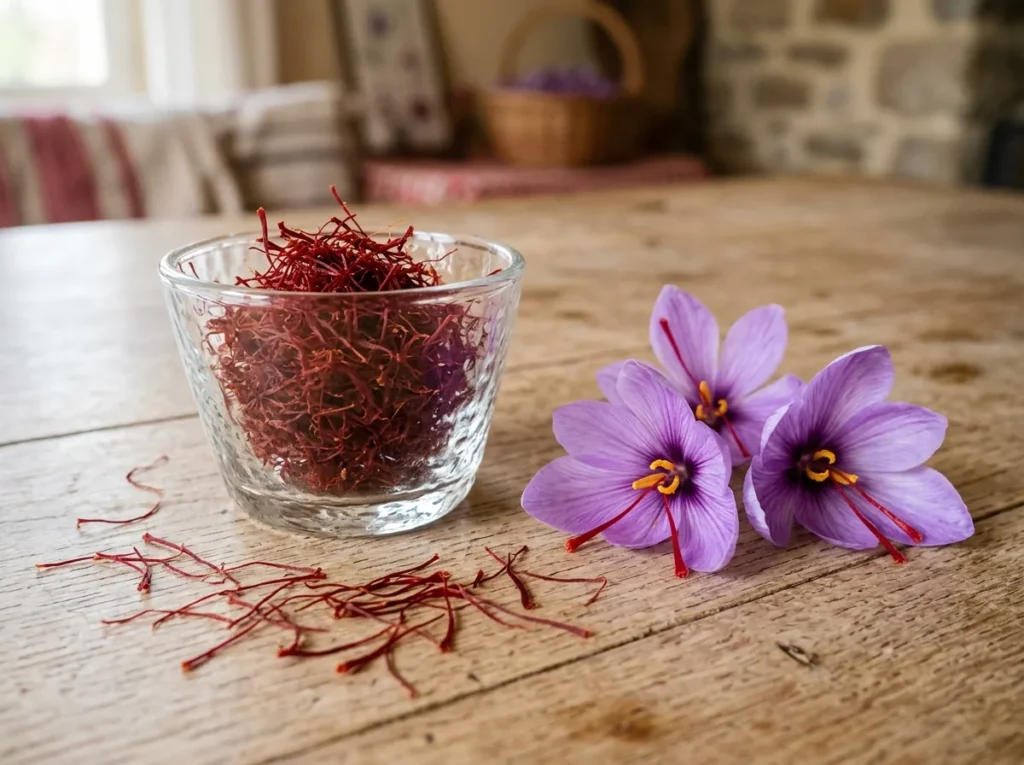
Saffron comes from a flower, the saffron crocus (Crocus sativus), a small purple crocus that blooms in autumn. At the heart of each flower are three red stigmas, the threads cooks sometimes call “pistils”. Once dried, these threads, and only these, become the spice.
The plant doesn’t grow in the wild: it’s sterile and can only reproduce through its bulbs, known as corms, which people have been replanting for thousands of years. Saffron was already being grown in ancient Greece and Persia. Today, Iran alone produces the vast majority of the world’s saffron. It’s also harvested in India (Kashmir), Afghanistan, Greece, Spain, Italy, Morocco and, in small quantities, France.
Three compounds work the magic. Crocin gives saffron its golden-yellow colouring power, picrocrocin its gentle bitterness, and safranal its unique aroma, somewhere between honey, hay and flowers.
Why is saffron so expensive?
The price of saffron comes down to work done entirely by hand and tiny yields:
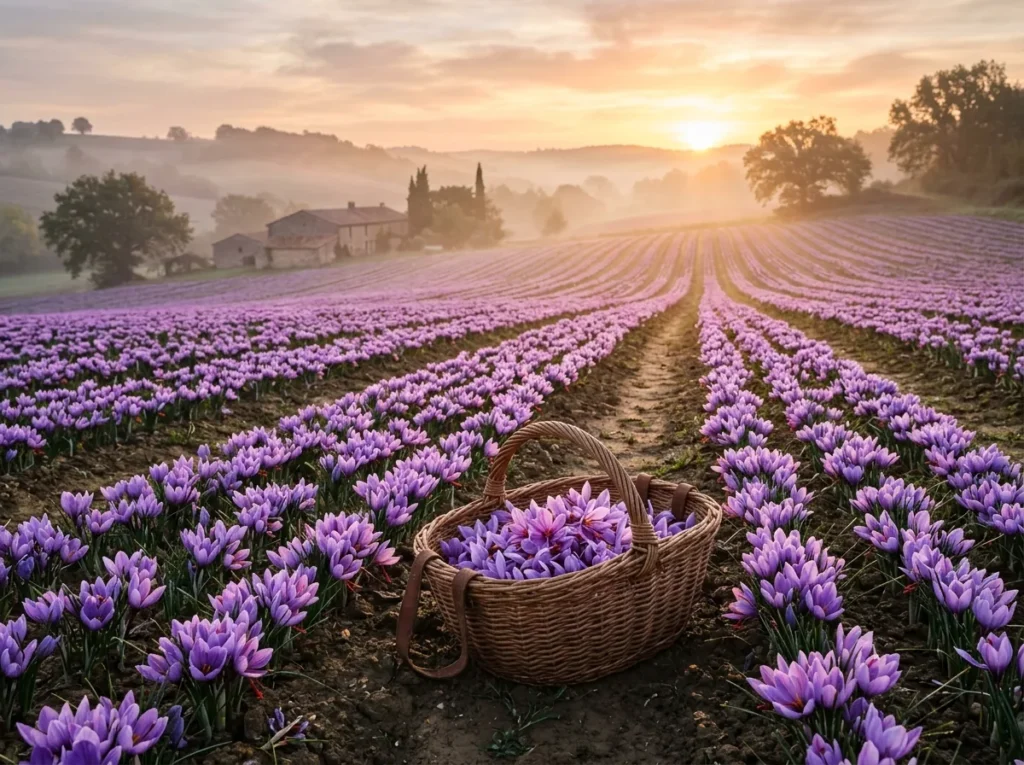
- It takes around 150,000 flowers to make 1 kg of dried saffron. Each flower gives just three threads.
- The flowers are picked by hand, one by one, early in the morning, during the few weeks of flowering in October and November, because they wilt quickly.
- Separating the stigmas from the rest of the flower is also done by hand, on the same day.
- Drying removes about four fifths of the weight.
The result: saffron is sold by the gram, often for more than 10 euros, and much more for French saffron produced in small batches. Luckily, you only need a tiny amount: a 0.1 g dose is enough to flavour a dish for four to six people, which brings the cost per plate down to a few tens of cents.
How to tell real saffron from fake
Its high price makes saffron one of the most adulterated spices in the world. Cheaper flowers, dyed threads or powder “cut” with other spices are sometimes sold under its name. The table below compares real saffron with its most common imitations.
| Product | What it is | Appearance | Taste and price |
|---|---|---|---|
| Real saffron | Dried stigmas of the saffron crocus | Dark red threads shaped like tiny trumpets, often joined in threes | Honey and hay aroma, slightly bitter; very expensive |
| Turmeric (“Indian saffron”) | Ground root of a plant from the ginger family | Orange-yellow powder | Earthy, slightly bitter; cheap |
| Safflower (“bastard saffron”) | Dried petals of an oil plant | Small orange threads, finer and straighter | Almost tasteless; cheap |
| Marigold (calendula) | Dried petals of the pot marigold | Flat yellow or orange petals | Almost tasteless; cheap |
A few simple tests to check your saffron:
- The water test: drop a thread into a glass of lukewarm water. Real saffron slowly releases a golden-yellow colour over a few minutes, and the thread stays red. A fake often turns the water red, or colours it very quickly, or loses its own colour.
- The shape: a real thread widens at one end, like a little trumpet. Threads that look too uniform, or that are mixed with lots of yellow strands, are suspicious.
- The smell and taste: real saffron smells strongly of honey and hay, and tastes slightly bitter, never sweet.
- The price: very cheap saffron is almost never the real thing.
Saffron threads or powder?
Our advice: whenever you can, buy saffron as threads. You can check how they look, they keep their aroma better, and they’re much harder to fake. Powder is handy because it colours quickly and evenly, but it’s easy to bulk out with turmeric, paprika or safflower. If you do buy powder, choose a trusted brand, ideally one with a designation of origin. In Europe, La Mancha saffron (Spain), Kozani saffron (Greece) and Sardinian saffron (Italy) all carry a Protected Designation of Origin.
Saffron vs turmeric: what’s the difference?
Turmeric is sometimes nicknamed “Indian saffron” because both spices turn food yellow. Yet they have almost nothing in common:
- The plant: saffron comes from the stigmas of a flower, turmeric from a root (a rhizome) in the ginger family.
- The taste: saffron is floral, honeyed and delicate; turmeric is earthy, warm and slightly bitter.
- The colour: saffron’s pigment, crocin, dissolves in water; turmeric’s, curcumin, dissolves mainly in fat. That’s why you steep saffron in a liquid, but fry turmeric gently in oil.
- The price: there’s simply no comparison between red gold and yellow gold.
So turmeric can stand in for saffron’s colour, but never for its flavour. To learn all about yellow gold, read our article on the health benefits of turmeric.
Saffron health benefits
Saffron has been used in traditional medicine since ancient times, especially in Persia. Unlike many spices, it has been tested in numerous human clinical trials over the past twenty years, mostly using standardised extracts in supplement form, at doses of around 30 mg a day. So it’s important to tell the difference between saffron in cooking, eaten in tiny amounts, and these supplements. It’s also worth remembering that in Europe, no health claims are authorised for saffron.
Saffron and mood
This is the best-studied area. Several reviews of clinical trials conclude that a saffron extract improves symptoms of mild to moderate depression better than a placebo, sometimes with results comparable to certain antidepressants in small trials. These findings are encouraging, but the studies are often short, small and mostly carried out in Iran. Above all, depression is a real illness: saffron is no substitute for medical care, and you should never stop or change a treatment without talking to your doctor.
Saffron and sleep
A few recent trials, notably in Australia, suggest that a saffron extract taken for a few weeks might slightly improve sleep quality in adults who sleep poorly. The evidence is still limited. A cup of saffron tea in the evening doesn’t contain the doses studied, but it can be part of a soothing bedtime ritual.
Saffron for weight loss and appetite
A French study published in 2010 followed mildly overweight women who took a saffron extract for eight weeks: they snacked less and lost slightly more weight than the placebo group. That’s where saffron’s reputation as an “appetite suppressant” comes from. But it was a small trial, using a concentrated extract, and the effect was modest. Saffron in your cooking won’t make you lose weight; what it will do is bring plenty of flavour to simple dishes like rice, fish or vegetables.
How much saffron per day?
There’s no official recommended dose for saffron. Here are some useful benchmarks:
- In cooking, you use about 0.1 g for four to six people, or a few tens of milligrams per person. These amounts are perfectly safe.
- In studies, extracts are usually dosed at around 30 mg a day, for six to twelve weeks.
- At high doses, saffron becomes toxic: scientific literature puts the first serious adverse effects at around 5 g a day. That’s an amount you could never reach in cooking, but it’s a reminder not to play around with supplements.
Saffron side effects and precautions
In culinary amounts, saffron suits almost everyone. The precautions mainly apply to supplements:
- Mood medication: don’t take saffron supplements alongside antidepressants, or if you have bipolar disorder, without medical advice.
- Blood thinners and blood pressure: as a precaution, ask your doctor first if you take medication that thins the blood or treats high blood pressure.
- Allergy: saffron allergy is rare but does exist, sometimes linked to an allergy to certain pollens.
- Children: supplements are not intended for children.
Saffron and pregnancy
During pregnancy, saffron in cooking, in normal amounts, poses no known problem. At high doses, however, saffron can stimulate contractions of the uterus: in the past it was even used to induce miscarriage. Saffron supplements should therefore be avoided during pregnancy and breastfeeding. If you’d like to drink saffron tea regularly, check with your doctor or midwife first.
How to use saffron in cooking
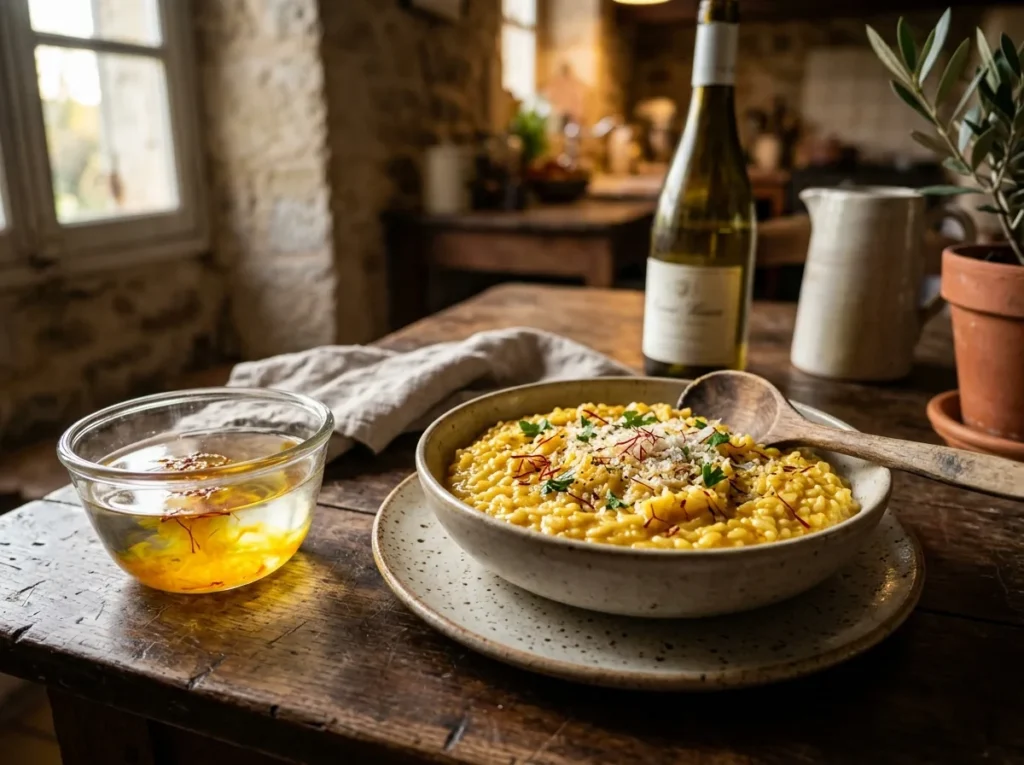
The secret of saffron comes down to one word: steeping. Its aroma and colour need liquid and a little time to come out.
- Lightly crush the threads between your fingers or in a small mortar.
- Soak them in two or three tablespoons of hot but not boiling liquid: water, milk, stock or white wine.
- Leave to steep for at least 15 to 20 minutes, or even several hours for a more intense flavour.
- Add the liquid and the threads to your dish, ideally towards the end of cooking, to preserve the aroma.
A few golden rules: don’t overdo it, because too much tastes bitter, almost medicinal; avoid frying it in hot oil; and pair it with mild flavours that let it shine, such as rice, cream, fish, seafood, poultry or pears.
Saffron tea recipe
For 1 cup:
- 3 to 5 saffron threads
- 250 ml water
- Optional: a teaspoon of honey, a thin slice of lemon, two cardamom seeds or a thin slice of ginger
Method: heat the water without letting it boil, pour it over the threads, cover and leave to steep for 10 minutes. Add the honey or lemon and drink it warm. You can leave the threads in the cup: they’ll keep tinting your tea a lovely golden yellow.
Saffron recipe ideas
- Paella: saffron gives the rice its colour and aroma, with a hint of smoked paprika.
- Risotto alla milanese: the great Italian classic, creamy and golden.
- Bouillabaisse and rouille: in Marseille, nobody could imagine them without saffron.
- Saffron rice: basmati rice cooked with saffron water, perfect with fish or a curry.
- Tagines: in Morocco, saffron joins ginger and cinnamon in chicken or lamb tagines.
- Desserts: saffron-poached pears, crème brûlée or saffron rice pudding. In Sweden, people even bake saffron buns for St Lucia’s Day in December, and Cornwall has its own traditional saffron cake.
Growing saffron at home (and in France)
Good news: saffron grows well in temperate climates, and it has a long history in France. In the 18th century, the Gâtinais region, south of Paris, was famous for its saffron. Today, many small producers are growing it again, from the Quercy to Provence and Brittany. England has its own saffron past too: the town of Saffron Walden in Essex is named after the crop. And you can grow it in your garden or in a pot:
- When to plant: the bulbs are planted in summer, from July to early September.
- Where: in full sun, in light and above all well-drained soil, as the bulbs rot in damp ground.
- How: bury them 10 to 15 cm deep, about ten centimetres apart.
- Flowering: the flowers appear in October and November. Pick them in the morning, remove the three red stigmas and dry them for a few days in a warm, dry place, away from the light.
- Afterwards: the leaves stay green all winter, then die back in spring. The bulbs multiply every year; dig them up and divide them every three or four years.
Allow around a hundred bulbs to harvest about one gram of saffron a year, once the planting is well established: enough to flavour a dozen or so home-cooked dishes.
How to store saffron
Saffron dislikes light, moisture and air. Keep it in a small airtight container, made of tinted glass or metal, in a cool cupboard. As threads, it keeps its aroma well for two to three years; as powder, it’s best used within a year.
Saffron, cumin, paprika: everyday spices
Saffron is the spice for special occasions, but it pairs beautifully with everyday ones. In a paella, it meets paprika; in a tagine, it joins ginger, cinnamon and cumin. To learn all about these spices, explore our guides to paprika, cumin, ginger, cinnamon and black pepper. And to flavour tea, coffee and buns, discover cardamom, the queen of spices. And for mulled wine, slow-cooked stews and Christmas pomanders, discover cloves. Not forgetting nutmeg, the secret of a good béchamel and mashed potatoes. And for gentle heat, discover Espelette pepper, the pride of the Basque Country. Finally, for a gentle lemony note, try coriander seeds, perfect in vegetables à la grecque.
Saffron FAQ
Is saffron good for you?
In cooking, saffron is part of a healthy diet and brings lots of flavour to simple dishes. Its effects on mood, sleep and appetite have been studied using concentrated extracts, with encouraging but still limited results.
How many saffron threads for one dish?
Allow a 0.1 g dose, or roughly fifty threads, for a dish serving four to six people. For a cup of tea, three to five threads are enough.
Does saffron go off?
It doesn’t become dangerous, but it gradually loses its aroma and colouring power. Try the water test: if it barely colours the water any more, it’s time to replace it.
Can I use turmeric instead of saffron?
For colour, yes, with a small pinch. For flavour, no: turmeric has neither the floral aroma nor the finesse of saffron.
This article is for general information only and is not a substitute for advice from a doctor, midwife or pharmacist.