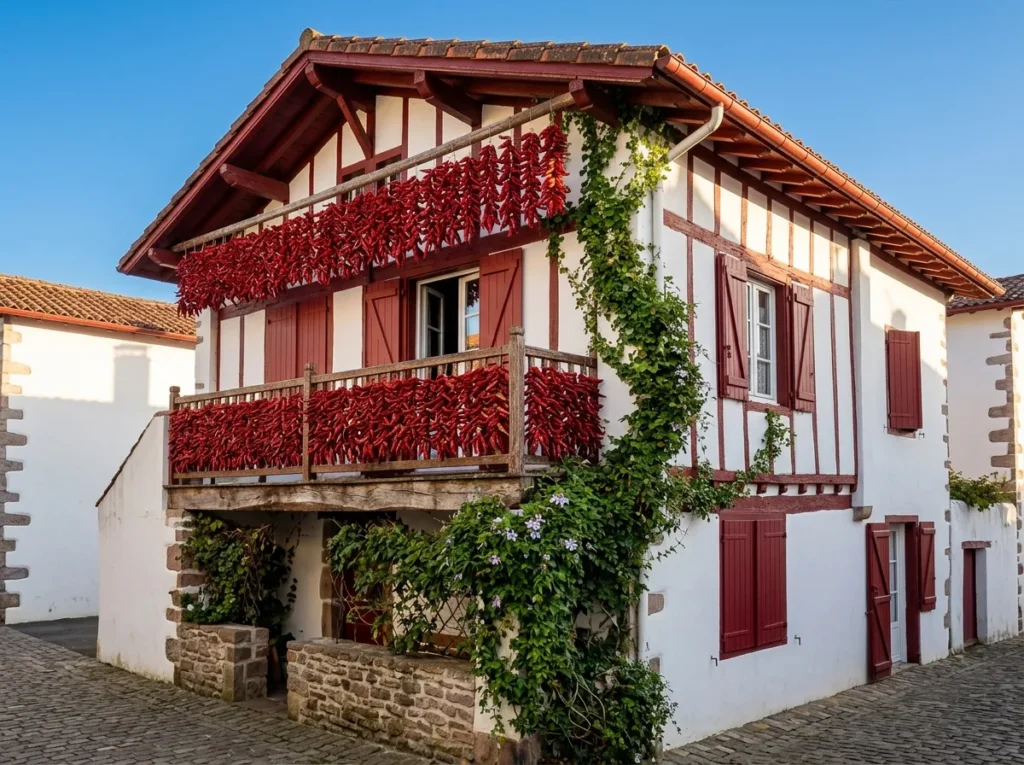
In autumn, in the little village of Espelette in the French Basque Country, the white house fronts with their red shutters disappear behind long strings of chillies drying in the sun. Espelette pepper (piment d’Espelette) has become one of the symbols of French gastronomy: mild, fruity and gently hot, it takes the place of black pepper in many Basque kitchens. In this guide, we look at the health benefits of Espelette pepper, how spicy it really is, its protected designation of origin and its price, then head into the kitchen for poulet basquaise (Basque chicken with peppers) and piperade (a Basque pepper and tomato dish), and out into the garden to grow it.
What exactly is Espelette pepper?
Espelette pepper is a chilli variety (Capsicum annuum) called Gorria, which means “red” in Basque. Like all chillies, it comes from the Americas: it is said to have reached the Basque Country in the 16th century, in the luggage of sailors returning from the New World. First used as a remedy, then to cure hams, it gradually found its way into every kitchen in the region.
The peppers are picked when red and ripe, then dried. Traditionally, they are threaded onto string to make long strings (cordes) that are hung from house fronts and balconies, where they finish drying in the autumn sun. The peppers are then baked in an oven and ground to produce the familiar orange-red powder. In season you can also find fresh peppers, as well as purée, jelly and whole dried peppers.
Piment d’Espelette AOP (PDO)
Espelette pepper is protected by a designation of origin: an AOC since 2000, then an AOP (Protected Designation of Origin) at European level since 2002. To bear the name, it must be grown, dried and processed within an area of ten communes around Espelette, in the Pyrénées-Atlantiques department: Ainhoa, Cambo-les-Bains, Espelette, Halsou, Itxassou, Jatxou, Larressore, Saint-Pée-sur-Nivelle, Souraïde and Ustaritz.
The specification is strict: Gorria variety only, hand harvesting, natural drying followed by a spell in the oven, and checks on the colour, aroma and heat of the pepper. On the jar, look for the words “Piment d’Espelette AOP” or “Ezpeletako Biperra”, its Basque name. Beware of products that are merely “with Espelette pepper” or “Espelette-style”: they may contain very little genuine AOP pepper, or even chillies from somewhere else entirely.
Is Espelette pepper spicy?
Don’t worry: Espelette pepper is a mild to medium-hot chilli. You can feel its heat, but it builds gently and doesn’t burn your mouth. What stands out is its fruity aroma, with notes of roasted red pepper, sun-dried tomato and sometimes hay. That is exactly what makes it such an easy seasoning to use: you can sprinkle it on almost anything without masking the flavour of the food.
Of course, how hot it feels depends on the person and the amount. A pinch on a fried egg adds a gentle warmth; a teaspoon in a sauce will be far more noticeable. If you are sensitive to heat, start small and taste as you go.
Espelette pepper on the Scoville scale
The Scoville scale measures the heat of chillies according to their content of capsaicin, the compound that makes them hot. Espelette pepper is usually rated at around 4,000 Scoville heat units, according to commonly cited sources, with variations from one harvest to the next. The appellation itself describes it as medium-hot, around 4 on a scale of 10. Here is how it compares with other chillies and powders:
| Chilli | Origin | Heat (Scoville) | Flavour and uses |
|---|---|---|---|
| Sweet paprika | Hungary, Spain | 0 to about 500 | Mild, sweet; colour, goulash, chorizo |
| Espelette pepper | Basque Country (AOP) | About 4,000 | Fruity, slightly hot; instead of pepper, Basque dishes |
| Aleppo pepper | Syria, Turkey | About 10,000 | Fruity, slightly oily; grilled meats, salads, Middle Eastern cooking |
| Cayenne pepper | Americas, Africa, Asia | 30,000 to 50,000 | Very hot; use just a tiny pinch |
For comparison, a jalapeño often sits between 2,500 and 8,000 units, and the world’s hottest chillies exceed one million. Espelette pepper therefore stays firmly in the mild to moderate category.
The health benefits of Espelette pepper
Espelette pepper contains capsaicin, carotenoids (the pigments that give it its red colour) and, when fresh, vitamin C. Capsaicin is being studied for several effects: it creates a feeling of warmth, mildly stimulates salivation and digestion, and may slightly increase energy expenditure after a meal. Studies on chillies in general also suggest antioxidant and anti-inflammatory effects.
Let’s be honest: these effects were observed with amounts of chilli or capsaicin far greater than a pinch of Espelette pepper on a dish, often using extracts. In the kitchen, its main benefit lies elsewhere: it adds plenty of flavour with no fat or calories, and lets you liven up simple vegetables, eggs or fish while using less salt. Note that in Europe, no health claims are authorised for Espelette pepper.
How to use Espelette pepper
In the Basque Country, it is often used instead of black pepper, just before serving. Its aroma is delicate and long cooking dulls it, so ideally sprinkle it on at the end of cooking or straight onto the plate. A few ideas:
- Eggs: fried, scrambled, in an omelette or soft-boiled, a pinch is enough to transform them.
- Vegetables: peppers, tomatoes, courgettes, green beans, sautéed potatoes, homemade chips.
- Fish and seafood: hake, tuna, baby squid, prawns, mussels.
- Meat: chicken, pork, lamb, grilled meats, terrines.
- Dairy: sheep’s cheese, soft fresh cheese, butter, cream, mayonnaise.
- Sweet dishes: surprising but delicious on dark chocolate, black cherry jam or roast pineapple.
Mixed into soft butter or olive oil, it also makes a ready-made condiment to spread on toast or drizzle over vegetables.
Espelette pepper or paprika?
The two powders look alike in colour, but not in taste. Sweet paprika is mainly sweet and barely hot; it is used to add colour and round out dishes such as goulash or chorizo. Smoked paprika also brings a wood-fire note. Espelette pepper is more fruity and hotter, with a gentle heat that replaces black pepper.
In practice: use paprika when you want colour and mellowness during cooking; choose Espelette pepper when you want to lift a dish at the end, with aroma. The two can also happily share the same recipe, for example in a tomato sauce or a marinade.
Fresh or ground Espelette pepper?
Powder is the most common and practical form: it keeps for months and can be sprinkled on anything. Strings of dried peppers are both a decoration and a store cupboard: you take a pepper, crumble it or let it infuse in a sauce. Fresh peppers, available from late summer into autumn, are cooked like small sweet peppers: pan-fried, grilled or in a piperade. They are less hot than the powder, because drying concentrates their aromas and capsaicin. You can also buy pepper purée, ideal in sauces, and pepper jelly, delicious with sheep’s cheese.
Poulet basquaise recipe
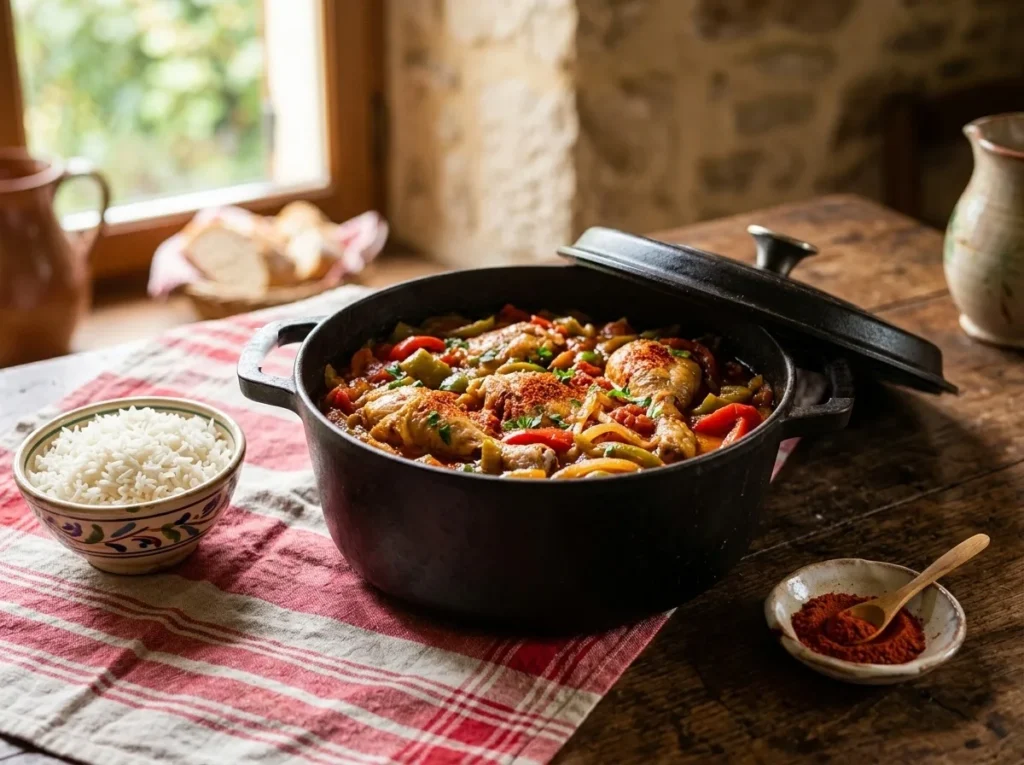
This is the signature dish of the Basque Country: poulet basquaise, or Basque-style chicken, simmered in a sauce of peppers and tomatoes and seasoned with Espelette pepper.
Serves 4:
- 1 free-range chicken cut into 8 pieces (or 4 chicken legs)
- 2 red peppers and 2 green peppers (or local mild chillies)
- 4 very ripe tomatoes (or a tin of chopped tomatoes)
- 2 onions and 3 garlic cloves
- 100 ml dry white wine
- Olive oil, salt, 1 bay leaf, a few sprigs of thyme
- 1 teaspoon Espelette pepper
Method: brown the chicken pieces in a casserole dish with a drizzle of olive oil, then set them aside. In the same pan, soften the sliced onions and the peppers cut into strips for 10 minutes. Add the garlic, tomatoes, white wine, bay leaf and thyme, season with salt, then return the chicken to the pan. Cover and simmer gently for 45 minutes. Add the Espelette pepper 5 minutes before the end, taste, and serve with rice or potatoes.
Piperade recipe
Piperade is a slow-cooked mixture of peppers, tomatoes and onions, typical of the Basque Country. It is served as a side dish, with eggs or a pan-fried slice of Bayonne ham. For a vegetarian version, simply keep the eggs.
Serves 4:
- 2 green peppers and 1 red pepper
- 4 ripe tomatoes
- 2 onions and 2 garlic cloves
- 3 tablespoons olive oil
- 1/2 teaspoon Espelette pepper, salt
- Optional: 4 eggs
Method: gently fry the sliced onions and peppers in the olive oil for 15 minutes, until very tender. Add the chopped garlic and the peeled, chopped tomatoes, season with salt, and leave to cook down for 20 to 30 minutes over a low heat, uncovered, so the liquid evaporates. Add the Espelette pepper at the end of cooking. For the version with eggs, crack them straight into the piperade and let them cook with the lid on, or scramble them lightly.
Espelette pepper: price per kilo
Piment d’Espelette AOP is an expensive product, and with good reason: it is grown in a small area, harvested by hand and dried slowly. It takes a lot of fresh peppers to make a kilo of powder, because drying removes most of their weight. As a rough guide, in France, bought in small 40 to 50 g jars, it often works out at 150 to 300 euros per kilo, sometimes more depending on the producer and the shop. Bought directly from producers or in larger sizes, it is a little cheaper.
The good news: a pinch is enough to flavour a dish, and a 40 g jar lasts several months in a family kitchen. Be wary of very cheap “Espelette-style” powders: without the AOP label, there is no guarantee of where the pepper comes from.
What can you substitute for Espelette pepper?
Run out of Espelette pepper? Here are the best alternatives:
- Sweet paprika + a touch of cayenne pepper: the simplest blend. Use three parts sweet paprika to one part cayenne, then adjust.
- Aleppo pepper: fruity and slightly oily, it is the closest substitute, a little hotter. Use slightly less.
- Hot paprika: it brings colour and heat, but less fruity aroma.
- Cayenne pepper on its own: as a last resort, and in very small amounts, because it is much hotter.
Growing Espelette pepper
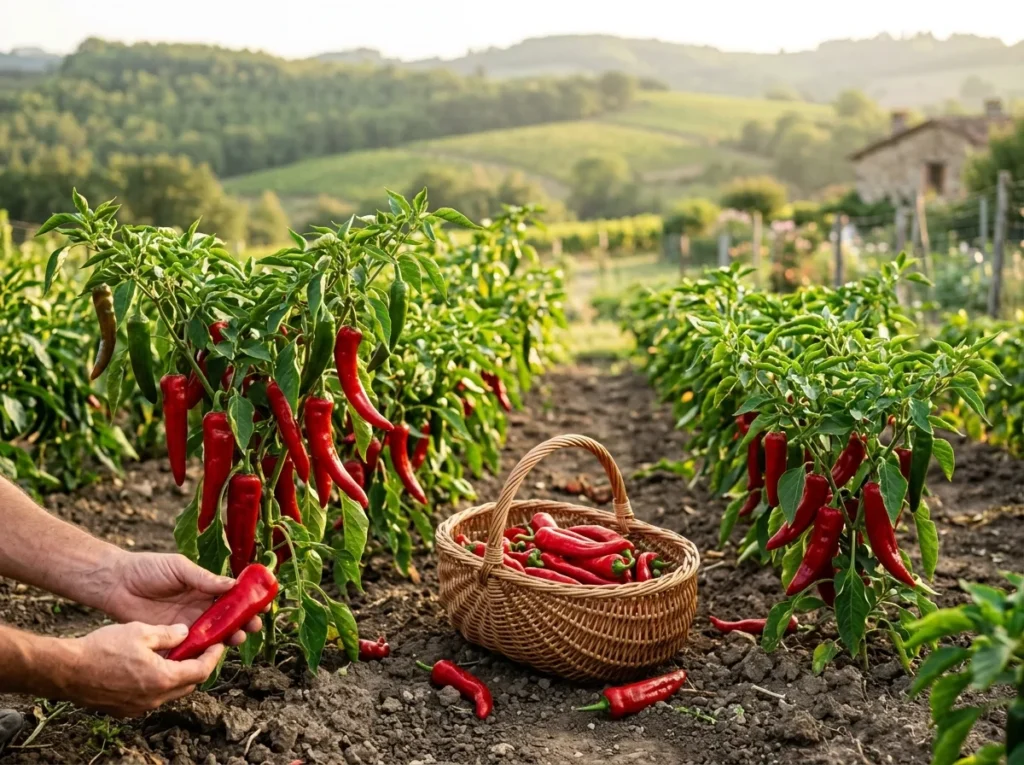
Good news: you can grow Gorria peppers in your vegetable patch or in a pot on a sunny balcony. They can’t be called Piment d’Espelette AOP, a name reserved for the appellation area, but they will give you beautiful, aromatic peppers.
- Sowing: February to March, somewhere warm (20 to 25 °C), in small pots, indoors or in a greenhouse. The seeds take one to three weeks to germinate.
- Planting out: in open ground from mid-May, once there is no more risk of frost, in full sun, in rich, well-drained soil. Space the plants about 40 cm apart.
- Care: water regularly without waterlogging, mulch around the base and stake the plants, which can reach 60 to 80 cm.
- Harvest: from late summer until the first frosts, when the peppers are fully red.
- Drying: thread the peppers onto string with a needle, through the stalk, and hang the string in a dry, warm, airy place for several weeks. Once completely dry, put them in a low oven for a few hours before grinding them.
The Espelette pepper festival
Every year, on the last weekend of October, the village of Espelette celebrates its pepper with a big festival that draws visitors from all over France and Spain. On the programme: a producers’ market, tastings, a parade by the pepper brotherhood, a mass, induction ceremonies, music, Basque dancing and pelota. It is also the time to see the village at its finest, with its house fronts covered in strings of red peppers. Try to arrive early, as the village is small and the festival very busy. The rest of the year, several producers open their doors so visitors can discover their fields and drying rooms.
Espelette pepper: contraindications and precautions
Espelette pepper is mild and suits most people, but capsaicin can bother some:
- Sensitive stomach: if you have reflux, heartburn or an ulcer, chilli can make symptoms worse. Go easy.
- Irritable bowel and haemorrhoids: in some people, chillies, even mild ones, increase discomfort.
- Young children: introduce it in very small amounts, as their palate is more sensitive.
- Eyes and mucous membranes: wash your hands after handling fresh peppers or the powder, and avoid rubbing your eyes.
- Pregnancy: in cooking, Espelette pepper poses no known problem; it may simply make heartburn worse, which is common in late pregnancy.
How to store Espelette pepper
Espelette pepper powder dislikes light, heat and moisture, which dull its lovely red colour and flatten its aroma. Keep it in its tightly closed jar, in a cool, dark cupboard, away from the hob. It stays at its best for about a year; some producers even recommend keeping the opened jar in the fridge to preserve its colour. A powder that has turned brown and lost its smell has lost most of its appeal. Strings of dried peppers keep in a dry, airy place, away from damp. Fresh peppers keep for a week in the fridge, or can be frozen whole.
Espelette pepper and other spices
Espelette pepper has plenty of cousins in our guides: paprika, its closest relative, black pepper, which it so often replaces in the Basque Country, and saffron, which it partners in rice and fish dishes. Also discover our guides to cumin, ginger, cinnamon, cardamom, cloves, nutmeg and the health benefits of turmeric. Finally, for a gentle lemony note, try coriander seeds, perfect in vegetables à la grecque.
Frequently asked questions about Espelette pepper
Is Espelette pepper too spicy for children?
It is mild, but children are more sensitive to heat. A small pinch in a family dish usually goes down very well.
Can you cook with Espelette pepper?
Yes, but long cooking dulls its aroma. Ideally add it at the end of cooking or just before serving.
How much Espelette pepper should you use in a dish?
Allow half a teaspoon to one teaspoon for a dish serving four, and a pinch per plate to season just before serving.
Does Espelette pepper go off?
It doesn’t become dangerous, but it loses its colour and aroma over time. Ideally use it within a year.
This article is for general information only and is not a substitute for advice from a doctor or other healthcare professional.