One or two cloves are all it takes to recognise a French pot-au-feu, a mulled wine or a gingerbread. This little nail-shaped spice also has a long reputation in the medicine cabinet: our grandmothers used to bite on one to ease a raging toothache. In this guide, we look at the health benefits of cloves, what science says about eugenol, clove essential oil and its precautions, then we head to the kitchen, from pot-au-feu to mulled wine, not forgetting the famous Christmas clove orange.
What exactly are cloves?
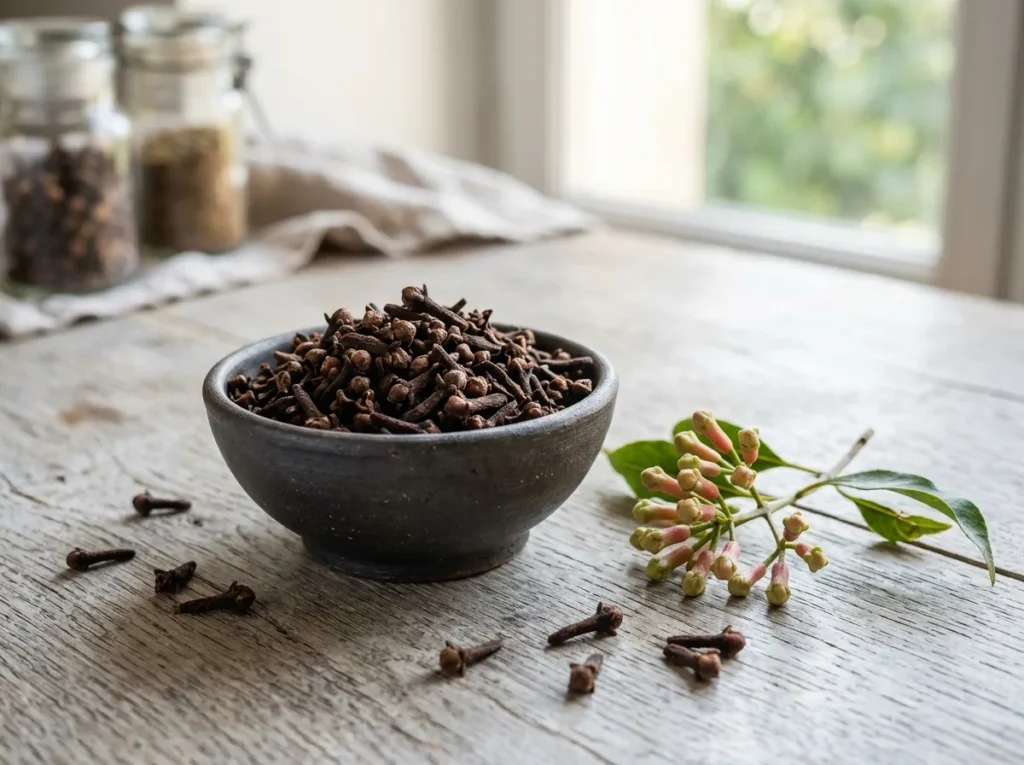
A clove is the dried flower bud of the clove tree (Syzygium aromaticum), a tropical evergreen of the myrtle family (Myrtaceae), like eucalyptus and guava. The buds are picked by hand just before they open, when they turn from green to pink, then dried in the sun: they become dark brown and take on their small nail shape, with a stem and a round head. Its name actually comes from the Latin clavus, “nail”.
The clove tree is native to the Moluccas in Indonesia, the famous “Spice Islands” fought over by the Portuguese and the Dutch. In the 18th century, the Frenchman Pierre Poivre managed to smuggle out seedlings and acclimatise them in Mauritius, then on Réunion. Today, Indonesia is still the world’s largest producer, but it consumes almost its entire harvest, notably in its clove cigarettes. Madagascar is the leading exporter, ahead of the Comoros and Tanzania (Zanzibar).
Eugenol, the key compound in cloves
Cloves are one of the spices richest in essential oil: it can make up 15 to 20% of their weight. This oil consists mostly of eugenol, a compound with a warm, pungent scent that gives cloves their unmistakable taste.
Eugenol has several properties that are well documented in the laboratory: it is a local anaesthetic, meaning it slightly numbs nerves on contact, it is antiseptic, as it slows the growth of many bacteria and fungi, and it is an antioxidant. Dentists have used it for more than a century: it is still found in some temporary dental fillings, mixed with zinc oxide. Cloves also top the list of foods richest in polyphenols, natural antioxidants, according to the scientific database Phenol-Explorer. A word of caution, though: eugenol becomes toxic in high doses, as we explain further down.
The health benefits of cloves
Cloves have been used for centuries in traditional Chinese, Indian and European medicine. Modern research mainly confirms their local effects in the mouth, thanks to eugenol. For other uses, studies have mostly been carried out in the laboratory or on animals, and evidence in humans remains limited. Remember that in Europe, no health claim is authorised for cloves.
Cloves and digestion
Like cardamom, ginger and cumin, cloves are traditionally considered a carminative spice: they are said to help reduce bloating and wind, and to soothe mild cramps after a heavy meal. It is no coincidence that they flavour long-cooked, rich dishes such as pot-au-feu, choucroute (Alsatian sauerkraut) and stews. Clinical evidence is thin, but a cup of clove tea after a meal remains a pleasant habit for most people.
An antioxidant spice
Their exceptionally high polyphenol content makes cloves a subject of research for their antioxidant and anti-inflammatory effects. These effects have mainly been observed in the laboratory, with concentrated extracts. On the plate, we eat very small amounts: cloves are part of a varied, spice-rich diet, without being a remedy on their own.
Cloves for toothache
This is the most famous grandmother’s remedy, and it has a real scientific basis: eugenol slightly numbs the painful area and limits the growth of bacteria. Here is how to use cloves as a stopgap:
- With a whole clove: place a clove against the painful tooth, between the cheek and the gum, and let it soften for a few minutes, chewing gently to release its oil. A slight numbing sensation appears.
- With essential oil: dilute one drop of clove essential oil in a few drops of vegetable oil (olive oil, for example), soak a cotton bud and dab the gum around the tooth, without swallowing.
- As a mouthwash: steep 3 or 4 cloves in a cup of hot water, let it cool until lukewarm and rinse your mouth.
These tips bring relief for a few hours while you wait for your dental appointment. They do not treat the cause: tooth pain often signals a cavity, an infection or an abscess, which needs to be treated. Never apply undiluted essential oil to the gum: it can cause a burn.
Clove tea and its benefits
Clove tea is warm, fragrant and slightly spicy. People enjoy it after a meal for its digestive reputation, or in winter as a comforting drink.
For 1 cup:
- 3 cloves
- 250 ml of water
- Optional: a slice of orange or lemon, a thin slice of ginger, a piece of cinnamon stick, a teaspoon of honey
Method: lightly crush the cloves with the flat of a knife. Bring the water to a simmer, pour it over the cloves, cover and leave to steep for 10 minutes. Strain, add the honey or citrus and drink hot. Keep it reasonable: one or two cups a day is plenty.
How to use cloves
Cloves are one of the most powerful spices. The golden rule: use just a little. One or two cloves are enough to flavour a dish for four to six people; any more and they overpower everything else and give a bitter, almost medicinal taste.
- Whole, they flavour stocks, slow-cooked dishes, marinades, syrups, rice and hot drinks. As they are hard and unpleasant to bite into, they are often stuck into an onion or tied in a piece of muslin so they can easily be removed before serving.
- Ground, they go into baking (gingerbread, Christmas biscuits, carrot cake), spice blends such as quatre-épices (the French four-spice mix), garam masala or Chinese five-spice, and terrines.
They pair particularly well with cinnamon, nutmeg, ginger, orange, apple, ham, pork, game and red cabbage.
Ground or whole cloves?
Our advice: buy whole cloves. They keep their essential oil, and therefore their aroma, for one to two years. Ground, they lose much of their aroma within a few months. For baking, grind a few cloves yourself in a coffee grinder or with a mortar and pestle, just before use. The table below sums up the three forms you can find in shops.
| Form | Uses | Shelf life | Precautions |
|---|---|---|---|
| Whole clove | Stocks, slow-cooked dishes, mulled wine, clove tea, toothache | 1 to 2 years in a closed jar | Remove before serving; 1 or 2 cloves are enough |
| Ground | Baking, gingerbread, spice blends, terrines | About 6 months | A knife tip is enough, very potent |
| Essential oil | Occasional dental care, diffusion, insect repellent | Several years, away from light | Never undiluted on the skin; do not swallow; not for children or during pregnancy |
A quick test to check how fresh your cloves are: press the head of a clove with your fingernail. A good-quality clove releases a little oil and smells strong. You can also drop a few into a glass of water: fresh cloves, rich in oil, sink or float head up, while old, dry cloves float flat.
Cloves in pot-au-feu
This is the most classic move in French cooking: the clove-studded onion. You peel an onion, push two or three cloves into it and drop it into the broth with the bouquet garni. The cloves gently flavour the broth during the long hours of cooking, and you can easily remove them at the end along with the onion, with no risk of biting into a clove.
Pot-au-feu, France’s beloved beef and vegetable stew, is the classic example, but the trick works just as well for blanquette de veau, poule au pot (chicken in the pot), beef bourguignon, potée, choucroute or a simple vegetable soup, and for a pot roast, a ham hock or a stock at home. In everyday cooking, you can also add a clove to the cooking water for rice, an apple compote or a pumpkin purée.
Mulled wine recipe with cloves

It is impossible to imagine a Christmas market without the smell of mulled wine, and cloves are one of its pillars, along with cinnamon and orange.
For 6 glasses:
- 1 bottle of red wine (75 cl), preferably fruity and low in tannins
- 1 organic orange and 1 organic lemon
- 4 cloves
- 2 cinnamon sticks and 1 star anise
- 2 crushed cardamom pods and 1 pinch of grated nutmeg (optional)
- 80 to 100 g of sugar or honey, to taste
Method: slice the orange and lemon into rounds. Stud a few orange slices with the cloves so they are easy to find. Put the wine, sugar, citrus and spices in a saucepan and heat gently, never letting it boil, for 15 to 20 minutes. Leave to rest off the heat for 10 minutes, strain and serve piping hot. For an alcohol-free version, replace the wine with red grape juice or a mix of apple juice and tea.
The clove-studded orange (pomander)

This traditional Christmas decoration scents the house for weeks. It descends from the pomanders of the Middle Ages, small scented balls people carried on them to protect themselves from bad smells.
- Choose a nice firm orange, preferably organic, and a good handful of cloves.
- Push the cloves into the peel, in rows, spirals or patterns. To make the job easier, make the holes first with a toothpick.
- If you like, roll the orange in a mix of ground cinnamon and nutmeg.
- Tie a pretty ribbon around the orange to hang it up, or place it in a bowl.
- Leave it to dry in a dry, well-ventilated place. Within a few weeks, it hardens, shrinks and then keeps for a very long time.
The more the orange is covered with cloves, the better it dries without going mouldy. Cloves and orange give off a warm, pleasant scent, but a clove orange is no substitute for good ventilation to freshen the air in your home.
Cloves for mosquitoes
The tip goes around every summer: stick cloves into half a lemon and put it on the patio table. Does it really work? Laboratory studies have shown that clove essential oil has a real repellent effect on mosquitoes, sometimes comparable to some conventional repellents, but only for a short time, around one to two hours. A lemon studded with cloves, however, releases much less eugenol: its effect is weak and very localised.
Our view: the clove-studded lemon is a nice extra touch for drinks on the patio, but it does not protect you effectively. If you are travelling to an area where mosquitoes transmit diseases (dengue, malaria, chikungunya), use a repellent recommended by health authorities. And never apply undiluted essential oil to the skin.
Clove essential oil
Obtained by distilling cloves, clove essential oil contains up to 80% eugenol, or even more. It is one of the most potent essential oils, and also one of the most irritating. Its common uses:
- Occasional dental care, always diluted in a vegetable oil, as explained above.
- Diffusion into the air, in small amounts and blended with gentler oils such as sweet orange, for a cosy atmosphere in winter.
- Insect repellent, diluted, on a diffuser or a piece of fabric, but not directly on the skin.
It should not be swallowed without the advice of a doctor or a pharmacist trained in aromatherapy, and it must be kept out of the reach of children: in young children, swallowing a few millilitres of clove essential oil can cause serious liver damage and seizures.
Cloves: side effects, contraindications and precautions
In culinary amounts, cloves are suitable for almost everyone. The precautions mainly concern repeated cups of clove tea, supplements and essential oil:
- Dose: WHO and FAO experts have set an acceptable daily intake of eugenol of 2.5 mg per kilo of body weight. The amounts used in cooking are far below this, but you should not keep drinking strong clove tea all day long.
- Blood thinners and surgery: eugenol can thin the blood. If you take anticoagulant or antiplatelet medication, or if you have an operation coming up, ask your doctor before any regular use outside cooking.
- Liver: in high doses, eugenol is toxic to the liver. People with liver disease should avoid repeated cups of clove tea and essential oil.
- Diabetes: cloves may slightly lower blood sugar; as a precaution, talk to your doctor if you are on treatment.
- Children: no essential oil for children, and never self-medicate toddlers with cloves.
- Mouth and skin: undiluted essential oil can burn the gum and irritate the skin. Always dilute it.
Cloves and pregnancy
During pregnancy, cloves in cooking, in normal amounts, pose no known problem: a clove in a stew or a pinch in a gingerbread is safe. However, clove essential oil is not recommended throughout pregnancy and breastfeeding, whether taken by mouth or applied to the skin, and the same goes for supplements. For regular clove tea or toothache during pregnancy, ask your doctor, midwife or dentist for advice.
What can I use instead of cloves?
Run out of cloves? Here are the best alternatives:
- Allspice (also called Jamaica pepper): this is the best substitute, as its taste is reminiscent of cloves, cinnamon and nutmeg all at once. Replace one clove with one or two berries.
- Nutmeg: a small pinch of grated nutmeg in a stock, a béchamel sauce or a slow-cooked dish.
- Cinnamon: ideal in desserts, compotes and mulled wine.
- Quatre-épices: this French four-spice mix already contains cloves, along with pepper, nutmeg and cinnamon or ginger; it is a great stand-in for baking and terrines.
How to store cloves
Cloves do not like light, heat or moisture. Keep them in an airtight jar, made of tinted glass or metal, in a cool cupboard away from the hob. Whole, they stay fragrant for one to two years; ground, they are best within six months. A clove that hardly smells of anything when crushed has had its day.
Cloves and their partner spices
Cloves love company. In mulled wine, they meet cinnamon and cardamom; in chai or gingerbread, they team up with ginger; in garam masala, with cumin and black pepper. To learn all about these spices, also explore our guides to paprika, saffron and the health benefits of turmeric. Not forgetting nutmeg, the secret of a good béchamel and mashed potatoes. And for gentle heat, discover Espelette pepper, the pride of the Basque Country. Finally, for a gentle lemony note, try coriander seeds, perfect in vegetables à la grecque.
Frequently asked questions about cloves
Can you eat a whole clove?
It is not dangerous, but it is very strong and unpleasant to bite into. Most of the time, it is removed from the dish before serving.
How many cloves should you use in a dish?
One or two cloves for a dish serving four to six people, three for a large pot-au-feu. For clove tea, three cloves per cup are enough.
Are cloves good for bad breath?
Chewing a clove freshens your breath for a while, thanks to its powerful scent and the antibacterial effect of eugenol. It is a handy extra, but it is no substitute for brushing your teeth.
Do cloves go off?
They do not become dangerous, but they gradually lose their oil and aroma. Try the fingernail test: if no oil comes out, replace them.
This article is for general information only and does not replace the advice of a doctor, dentist, midwife or pharmacist.