With its pretty eight-pointed star shape and its powerful scent of aniseed and liquorice, star anise, also known as badian, is probably the most photogenic spice in the kitchen. You will find it in mulled wine, gingerbread, poached pears, the broth of Vietnamese pho and the famous Chinese five-spice blend. In this guide, we look at the health benefits of star anise, particularly for digestion, as well as star anise tea, the difference from green anise and its uses in cooking. We also cover the essential precautions, because star anise has a toxic cousin that you must never confuse it with.
What exactly is star anise?
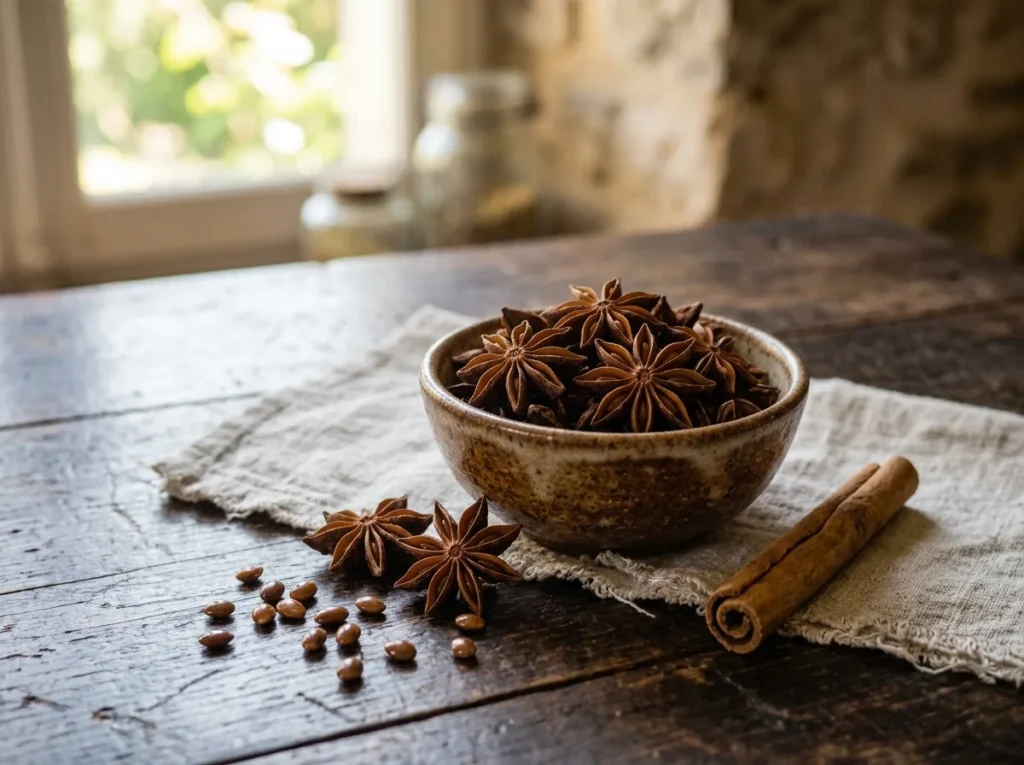
Star anise (Illicium verum) is the fruit of a small evergreen tree native to southern China and northern Vietnam. What we call a “star” is in fact a compound fruit made up of eight small boat-shaped pods arranged in a circle. Each one holds a shiny brown seed. The fruits are harvested while still green, then dried in the sun, where they take on their reddish-brown colour.
China, especially the Guangxi region, and Vietnam produce most of the star anise consumed worldwide. The spice reached Europe in the 16th century via the maritime trade routes. Its other name, badian, comes from the Persian badian, which referred to fennel and anise.
What does star anise taste like?
Star anise has an intense aniseed flavour, warm and slightly sweet, with notes of liquorice and wood. Its aroma comes mainly from anethole, the same aromatic molecule found in green anise and fennel. But star anise is stronger, rounder and a little woodier. A single star is often enough to flavour a whole dish.
It goes particularly well with cinnamon, cloves, ginger, orange, vanilla, pears, apples, pork, duck, slow-cooked beef and soy-based sauces.
Star anise vs anise: what is the difference?
They are often confused because they taste almost the same, but star anise and green anise (aniseed) are two very different plants:
| Star anise (badian) | Green anise (aniseed) | |
|---|---|---|
| Plant | Tree (Illicium verum) | Annual plant in the Apiaceae family (Pimpinella anisum) |
| Origin | Southern China and Vietnam | Mediterranean basin |
| Shape | Brown eight-pointed star | Small grey-green seeds |
| Taste | Strong aniseed, warm, liquorice-like | Milder and fresher aniseed |
| Uses | Stews, broths, mulled wine, desserts | Breads, biscuits, herbal teas, liqueurs |
Both owe their flavour to anethole. This is why star anise often replaces green anise in industry, notably in French pastis and some anise-flavoured liqueurs. In cooking, allow one star anise for about half a teaspoon of aniseed.
The health benefits of star anise
Star anise has been used for centuries in traditional Chinese medicine, mainly for digestion and to warm the body. It contains an essential oil rich in anethole, antioxidant compounds and shikimic acid. In the laboratory, its extracts have shown antioxidant, antibacterial and antifungal effects. In humans, however, clinical studies are almost non-existent.
A word of clarification is needed about the “antiviral” properties often mentioned. Shikimic acid extracted from star anise was long used as a raw material for the industrial manufacture of a flu medicine. But that does not mean that drinking star anise tea protects you from flu: the amount is tiny, and the molecule has to be chemically transformed to become active. Finally, remember that in Europe, no health claim is authorised for star anise.
Star anise for digestion
This is its most common traditional use. Like green anise, fennel and cumin, star anise is considered a carminative spice: it is said to help reduce bloating, wind and swallowed air, and its antispasmodic effects are said to ease mild cramps after a heavy meal. These effects are known mainly from traditional use and from studies on anethole, not from clinical trials on star anise itself. A cup of tea after a meal remains a pleasant habit for most adults, provided you stick to sensible amounts.
Star anise tea
Star anise tea is mild, comforting and naturally sweet. Drink it after a meal or in the evening.
For 1 cup:
- 1 whole star anise
- 250 ml water
- Optional: half a teaspoon of fennel seeds, a thin slice of ginger, a cinnamon stick or a little honey
Method: lightly break the star between your fingers. Pour simmering water over it, cover and leave to infuse for 10 minutes, then strain. For a healthy adult, do not exceed two cups a day, and not over a long period. This tea is not suitable for babies or young children (see below), and it is not recommended during pregnancy.
Cooking with star anise
Star anise is a key spice in Asian cooking and a classic of winter desserts in Europe:
- Chinese five-spice: star anise, cinnamon, cloves, fennel seeds and Sichuan pepper.
- Vietnamese pho: star anise, charred with onion and ginger, flavours the beef broth.
- Chinese braised dishes, such as pork braised in soy sauce, where a few stars simmer for hours.
- Indian curries and biryanis, where it sometimes goes into garam masala.
- Desserts: poached pears, apple compotes, jams, gingerbread, custards and syrups.
- Drinks: mulled wine, hot chocolate, chai tea, cocktail syrups.
Use it sparingly: one or two stars are enough for a dish serving four to six. Add it whole at the start of cooking and remove it before serving, as it is hard to chew. When ground, a small pinch is enough: it quickly becomes overpowering.
Star anise and mulled wine
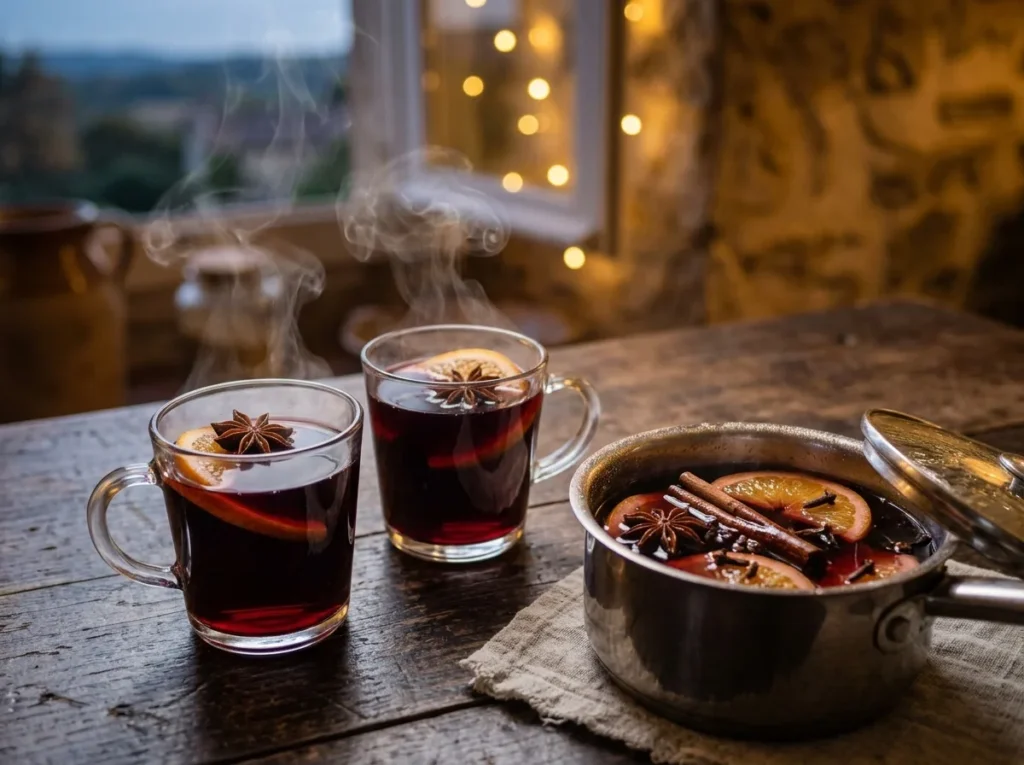
It is impossible to imagine a Christmas market without the scent of mulled wine, and star anise is one of its star spices.
Mulled wine, for 6 glasses:
- 1 bottle of red wine (75 cl), preferably fruity
- 1 unwaxed orange, sliced into rounds
- 2 star anise
- 1 cinnamon stick
- 3 cloves
- 60 to 80 g sugar or honey
- Optional: a grating of nutmeg, a few slices of ginger
Method: pour the wine into a saucepan with the orange, spices and sugar. Heat gently, stirring, for 15 to 20 minutes, without ever letting it boil. Cover and leave to infuse for another 10 minutes off the heat, then strain and serve piping hot. Please drink responsibly. For an alcohol-free version, replace the wine with a mixture of grape juice and apple juice.
Star anise recipe ideas
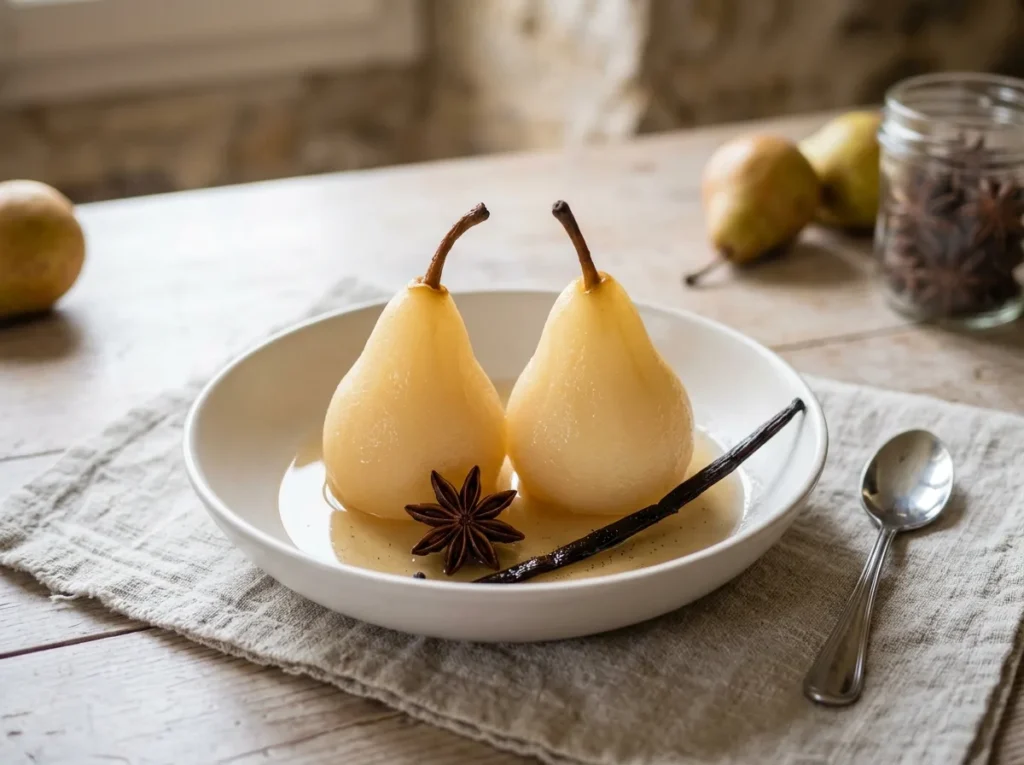
Star anise poached pears, serves 4: in a saucepan, heat 1 litre of water with 150 g sugar, 2 star anise, a split vanilla pod and a strip of lemon zest. Peel 4 pears, keeping the stalks, lower them into the simmering syrup and poach for 20 to 25 minutes, until a knife slides through them easily. Leave them to cool in the syrup, then serve warm or cold, with a little reduced syrup.
Other ideas:
- Apple compote: one star in the pan during cooking transforms an ordinary compote.
- Gingerbread: a pinch of ground star anise with the cinnamon, ginger and cloves.
- Caramelised pork or duck: one star in the soy sauce and caramelised sugar.
- Vegetable broth: one star with ginger, lemongrass and soy sauce for a fragrant noodle soup.
- Fig or plum jam: one star during cooking, removed before potting.
- Cocktail syrup: sugar, water and star anise, to flavour a cocktail or homemade lemonade.
Chinese star anise and Japanese star anise: a real danger
This is the most important point in this guide. Star anise has a close cousin, Japanese star anise (Illicium anisatum), whose fruit looks very much like true star anise. It is toxic: it contains neurotoxic substances, such as anisatin, which can cause vomiting, tremors and seizures. It is not edible.
Poisonings have already occurred, in Europe as well as in the United States, because of batches of star anise or herbal teas contaminated with Japanese star anise. The two fruits are hard to tell apart with the naked eye: Japanese star anise is often smaller, with more irregular points, and its smell is closer to camphor or turpentine than to aniseed. But only a laboratory test can be certain. Hence a simple rule: always buy your star anise from the food aisle, from reputable sellers, and never loose from an unknown source or sold as “wild star anise”.
Star anise side effects
In cooking, at normal amounts, true star anise is well tolerated by adults. At high doses, it too can become toxic to the nervous system. Possible effects include:
- nausea, vomiting, digestive upsets;
- agitation, tremors and, in serious cases, seizures, especially in young children;
- allergic reactions, rare but possible, particularly in people allergic to anise, fennel or celery.
Star anise essential oil is particularly concentrated: it must not be swallowed without medical advice and is not suitable for children or people with epilepsy. If you have symptoms after drinking star anise tea or eating star anise, contact a poison centre or call 999 or 112.
Star anise contraindications
In culinary amounts, star anise is suitable for most adults. However, repeated cups of tea, extracts and essential oil are not recommended in several cases:
- Babies and young children: never give star anise tea (see below).
- Pregnancy and breastfeeding: no concentrated teas or essential oil.
- Epilepsy: avoid the essential oil and high doses.
- Hormone-sensitive cancers, such as some breast cancers: anethole has a mild oestrogen-like action. As a precaution, avoid medicinal doses and talk to your doctor.
- Allergy to anise, fennel, celery or other plants in the Apiaceae family.
Star anise in pregnancy
During pregnancy, one star in a compote, a stew or a broth poses no known problem. However, it is best to avoid star anise tea, especially in large amounts, as well as the essential oil, during pregnancy and breastfeeding. Safety data are lacking, and anethole has a mild hormonal action. The risk of contamination with Japanese star anise is another reason for caution. If in doubt, ask your doctor or midwife.
Star anise and babies: a clear rule
In some traditions, star anise tea was given to infants to soothe colic. This practice is dangerous and strongly advised against by health authorities. Several babies have been admitted to hospital after drinking star anise tea, either contaminated with Japanese star anise or simply too concentrated: irritability, vomiting, abnormal movements and seizures. Infants are far more sensitive than adults.
So the rule is simple: never give star anise tea to a baby or young child. For colic, talk to your paediatrician or GP.
Where to buy star anise
Star anise is easy to find:
- In the spice aisle of supermarkets, in small jars or packets of whole stars.
- In Asian grocery shops, often in larger bags and at low prices.
- In health food shops and zero-waste stores.
- In herbalists and pharmacies, for teas, with better quality control.
- From specialist spice shops and online.
Choose whole, well-formed stars of an even reddish-brown colour with a very clear aniseed scent. Avoid products without clear labelling or origin.
How to store star anise
Keep star anise in an airtight glass jar, away from light, heat and moisture. Whole stars keep their aroma for two to three years. Ground star anise loses its aroma much faster and keeps for about six months to a year. To check freshness, break off a point: it should smell of aniseed straight away. Stars that have been used in a syrup or compote can be rinsed, dried and reused once, although their aroma will be weaker.
Star anise and its fellow spices
In mulled wine and gingerbread, star anise joins cinnamon, cloves, nutmeg and ginger. In chai tea, it pairs with cardamom and black pepper, and in curries with turmeric, cumin, coriander seeds and fenugreek. Also discover our guides to paprika, saffron and Espelette pepper.
Frequently asked questions about star anise
Are star anise and badian the same thing?
Yes, they are two names for the same spice, the fruit of Illicium verum. Not to be confused with green anise (aniseed), a different plant, or with Japanese star anise, which is toxic.
How many star anise should I put in a dish?
One or two stars for a dish serving four to six, and two stars for a bottle of mulled wine. One star for a cup of tea.
Can you eat star anise?
You can, but it is hard and very strong. It is mostly used to flavour a liquid, then removed before serving.
Does star anise go off?
It does not become dangerous over time, but it loses its aroma. If a broken point barely smells of aniseed any more, replace it.
This article is for general information only and is not a substitute for advice from a doctor, midwife or pharmacist.