Ruisleipä (Finnish sourdough rye bread)
Ingredients
Method
- Day 1, in the evening: in a large bowl, dissolve the starter in the lukewarm water. Add 300 g of rye flour and stir with a wooden spoon to a thick, smooth paste, like porridge. Cover and leave to ferment for 12 to 18 hours at room temperature: the mixture should be bubbly and smell pleasantly sour.
- Day 2: take out 100 g of this mixture and put it in a jar in the fridge for your next loaf. Add the salt and 350 g of rye flour, then mix with a wet hand or a spoon for 5 minutes. The dough is very sticky, which is normal: only add more flour if it is really runny.
- Cover and leave to rise for 2 to 3 hours in a warm place, until the dough has grown by about half.
- Flour the work surface generously with the remaining flour. Divide the dough in two and, with floured hands, shape two flat round loaves about 3 cm (1¼ in) thick. Place them on a baking sheet lined with baking paper and make a 4 to 5 cm (2 in) hole in the centre of each one. Prick the surface with a fork.
- Leave to rise for another 45 minutes to 1 hour, until small cracks appear on the floured surface. Preheat the oven to 225 °C / 440 °F (fan 210 °C).
- Bake for 40 to 45 minutes. The bread is done when it sounds hollow when tapped underneath. As soon as it comes out of the oven, brush the crust with a little hot water, then leave to cool completely on a rack, under a tea towel, before slicing.
Notes
Dense, dark, slightly tangy and wonderfully fragrant: ruisleipä is the bread Finns eat every day, for breakfast, lunch and as a snack. This Finnish rye bread contains only four ingredients: rye flour, water, salt and sourdough. No yeast, no wheat flour, no sugar. In this ruisleipä recipe, we explain step by step how to make it at home, how to shape it into a ring with a hole and how to enjoy it the Finnish way.
Ruisleipä, a Finnish black sourdough bread
In Finnish, ruis means “rye” and leipä means “bread”. Ruisleipä is a Finnish black sourdough bread, part of the big family of Nordic and Baltic rye breads. Rye grows well in Finland’s cold climate, where wheat struggles. For centuries, it was therefore the country’s staple grain. Unlike white bread, ruisleipä has a compact, moist, dark brown crumb and a thick crust. Its flavour is bold, with a pleasant sourness that comes from the long sourdough fermentation.
Finland’s national bread
Ruisleipä is much more than a bread in Finland. In 2017, to celebrate 100 years of the country’s independence, Finns voted to choose their national food, and rye bread won. This national Finnish bread is served at every meal: in school canteens, hotels, restaurants and every home. Many Finns living abroad admit it is the food they miss the most.
A traditional dark rye bread
Ruisleipä is a true traditional dark rye bread. Its recipe has barely changed in centuries. In the past, every farm carefully kept a piece of dough from one batch to the next: this is the juuri, the “root”, in other words the sourdough starter. Some families passed their starter down from generation to generation. Our recipe follows the same principle: before adding the salt, you set aside a little dough to keep in the fridge for your next loaf.
Reikäleipä, the bread with a hole
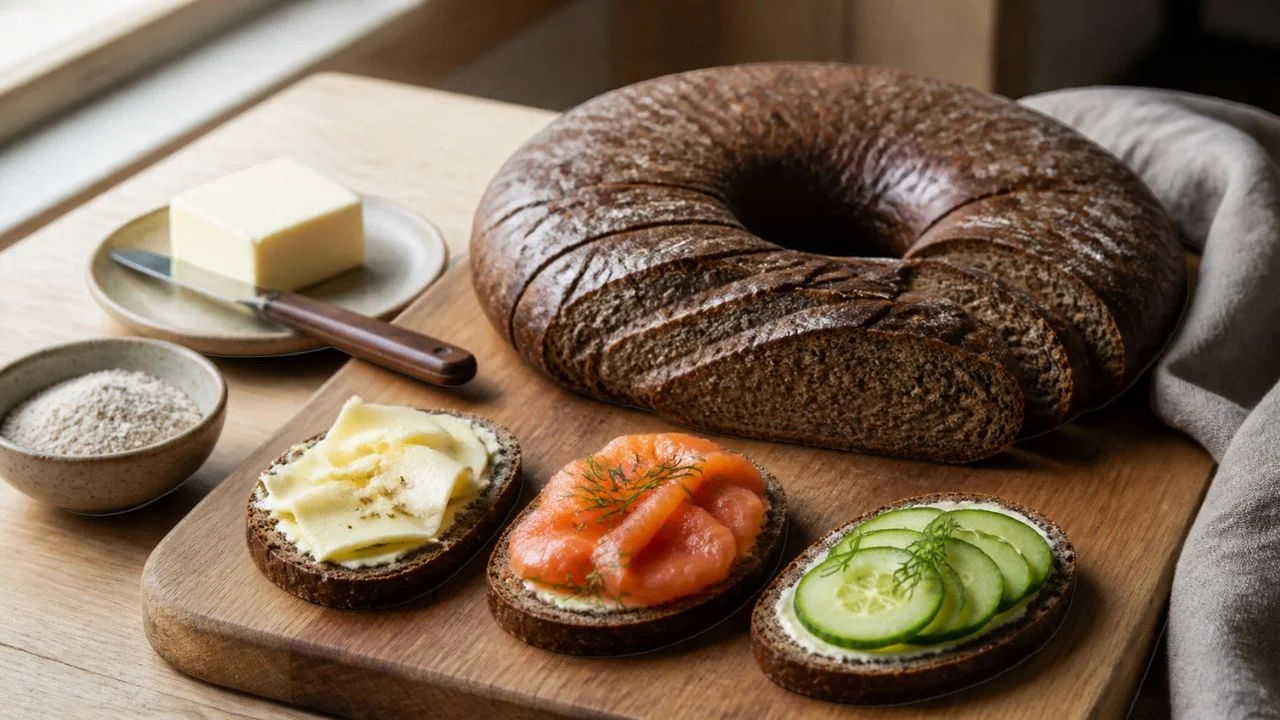
The most famous shape of ruisleipä is reikäleipä, literally “bread with a hole”: a flat round ring with a hole in the centre. The hole had a very practical purpose. In western Finland, bread was baked only a few times a year. The loaves were threaded onto long wooden poles hung under the ceiling of the house, where they dried slowly and kept for months. In eastern Finland, people baked more often and preferred soft, round loaves. Today, reikäleipä remains the symbol of Finnish bread, and it is very easy to shape at home.
How to make ruisleipä: step by step
Wondering how to make ruisleipä? The recipe mostly takes time, not technique. It is made over two days. On the first evening, you mix the starter with lukewarm water and rye flour and leave it to ferment overnight. The next day, you add the salt and the rest of the flour, let the dough rise, shape it into flat loaves with a hole, then let them rise a little more before baking. The actual hands-on time is no more than half an hour.
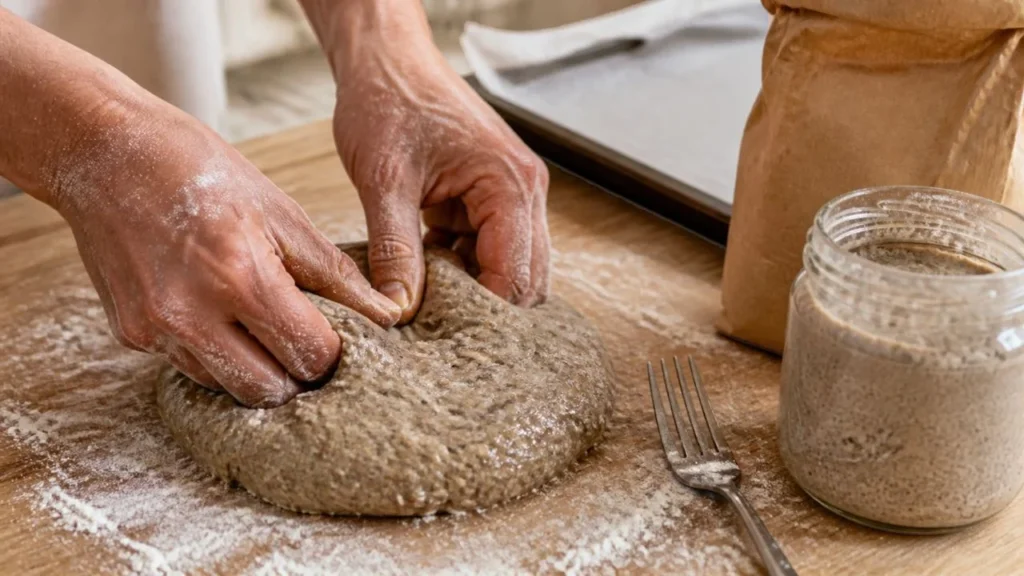
Don’t be surprised by the dough: rye dough is not kneaded like regular bread dough. Rye contains very little gluten, so the dough is sticky and heavy and never becomes elastic. Work it with a wooden spoon or wet hands, and flour the work surface generously when shaping. The sign that the bread is ready to bake: small cracks appear on the floured surface.
Which rye flour to choose?
For an authentic ruisleipä, use wholemeal rye flour, also sold as dark rye or whole rye flour. It contains the whole grain and is closest to Finnish rye flour, which is almost always wholemeal. It gives a darker, denser bread that is richer in fibre. Light rye flour, which is more refined, gives a slightly softer crumb. Use wholemeal rye at least for the day 1 sponge. For the day 2 dough, you can use part light rye flour if you prefer a slightly less compact loaf.
A homemade 100% rye sourdough bread
Making your own 100% rye sourdough bread has many advantages. Wholemeal rye is rich in fibre, which helps you feel full for longer. Sourdough fermentation also makes the bread easier to digest and gives it a lower glycaemic index than white bread. Finally, this bread contains no added sugar, no added fat and no additives. Please note, however, that rye contains gluten, so ruisleipä is not suitable for people who need to avoid it.
Scandinavian rye and malt bread: what’s the difference?
When looking for a Scandinavian rye and malt bread, you will often come across very dark, almost black, slightly sweet breads. These are not ruisleipä. In Finland, malt bread is called saaristolaisleipä, “archipelago bread”: malt, molasses and often buttermilk are added, which gives it a very dark colour and a sweet taste. In Denmark, rugbrød often contains malt and seeds. Ruisleipä doesn’t need malt: its colour and flavour come only from wholemeal rye and fermentation.
Spices for rye bread
Traditional ruisleipä contains no spices. But if you like to vary things, there are many spices for rye bread in neighbouring countries. In Germany and the Baltic countries, rye bread is often flavoured with caraway, fennel or coriander seeds. One teaspoon of seeds is enough for the whole dough. Be careful not to confuse caraway with cumin: the two seeds look alike, but cumin has a much warmer, stronger taste that doesn’t really suit this bread. To discover other spices and their uses, see our spice guide.
How to store rye bread
One of the great advantages of this Nordic sourdough bread recipe is how well it keeps. To store dark rye bread, wrap it in a clean tea towel or paper bag, then in a plastic bag: it stays moist for 5 to 7 days. Ruisleipä also freezes very well, sliced, and thaws in a few minutes in a toaster. And if you let it dry out, you rediscover the taste of the old reikäleipä, which were crunched like crispbread. A final tip: wait until the day after baking to slice your bread. Rye crumb needs a few hours to set, and it will be much less sticky.
The Finnish open sandwich on dark bread
In Finland, ruisleipä is mostly eaten as an open sandwich. The simplest Finnish open sandwich on dark bread: a thin slice of ruisleipä, a layer of butter and a few slices of cheese. Cucumber, tomato or bell pepper are often added. For a more festive version, top it with smoked salmon and dill, or hard-boiled eggs. Ruisleipä also goes with every meal: it is essential with lohikeitto, the Finnish salmon soup. And its rye dough is used for karjalanpiirakka, the Karelian rice pies. Discover all our Finnish cuisine recipes.
Frequently asked questions about ruisleipä
How do I make a rye sourdough starter?
Mix 50 g of wholemeal rye flour and 50 ml of lukewarm water in a jar, cover loosely and leave at room temperature. Every day for 5 days, discard half of the mixture and add 50 g of flour and 50 ml of water. When the starter doubles in volume a few hours after feeding and smells pleasantly sour, it is ready.
Why is my rye bread sticky inside?
Either it was underbaked or it was sliced too early. Extend the baking time by 5 to 10 minutes if needed, and wait until it is completely cold, ideally the next day, before slicing.
Can I make ruisleipä with yeast?
Some quick recipes add baker’s yeast, but the result doesn’t taste the same. It is the sourdough fermentation that gives ruisleipä its sourness, its moist crumb and its long shelf life.