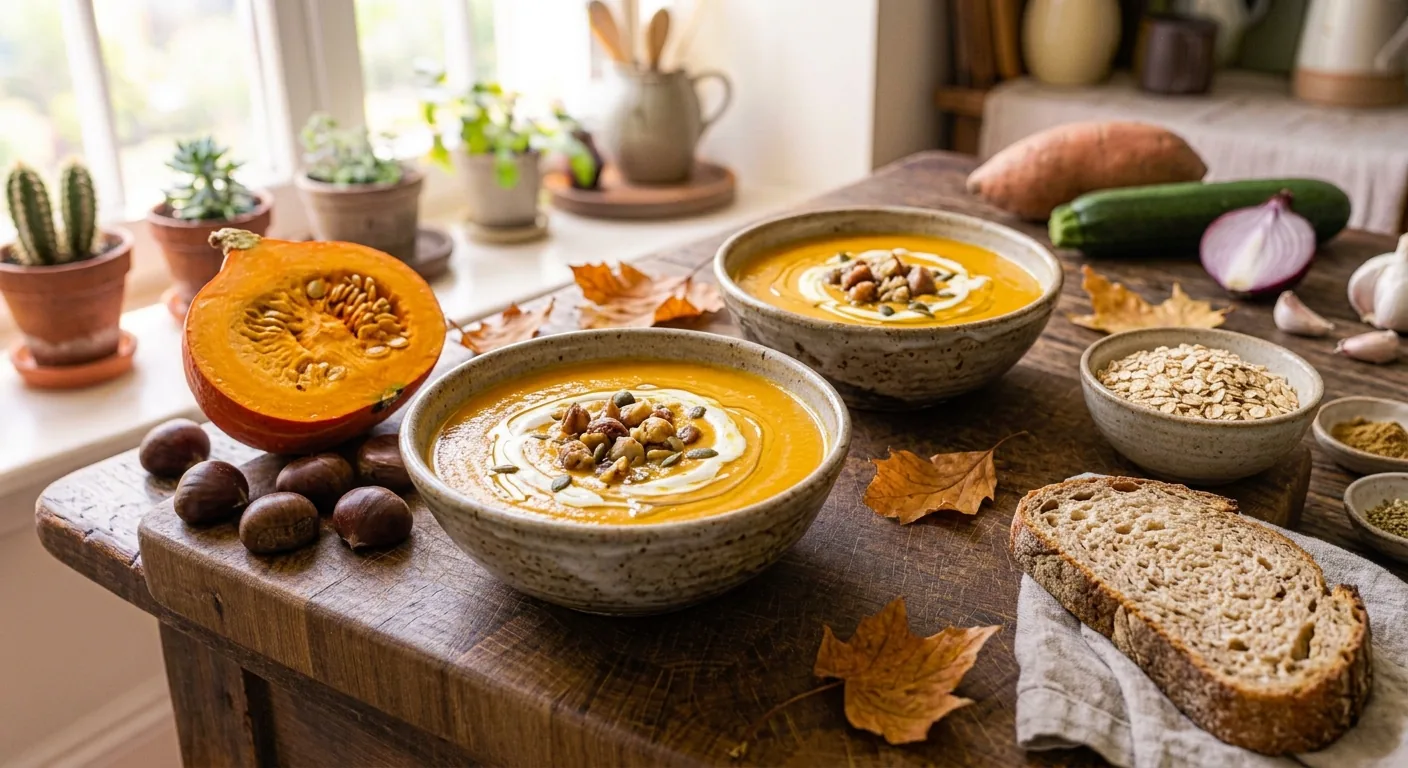
Red kuri squash and chestnut soup
Ingredients
Method
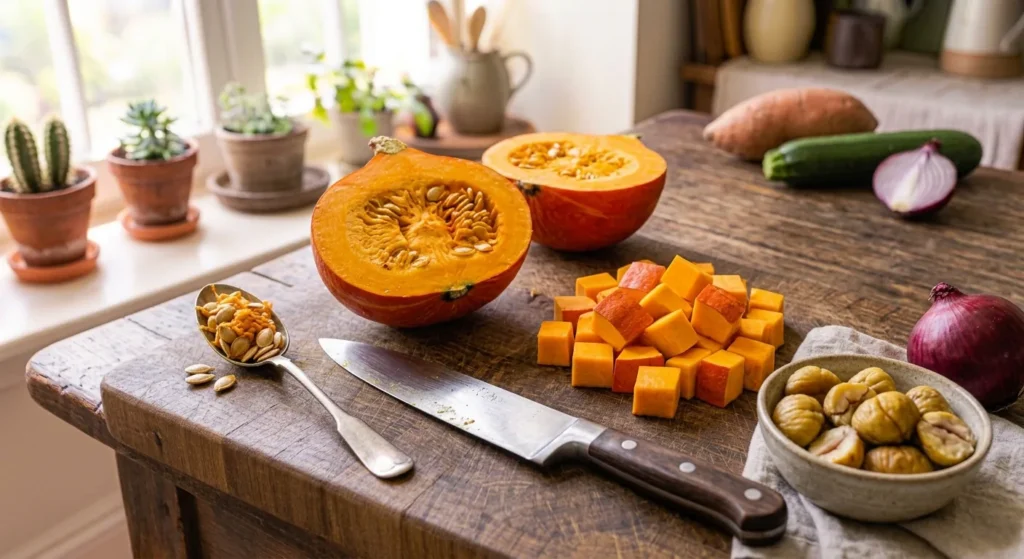
- Wash the squash, cut it in half, scoop out the seeds and cut the flesh into cubes, without peeling it.
- Slice the onion and soften it gently in the oil for 5 minutes, without letting it colour. Add the turmeric and nutmeg.
- Add the squash and 170 g of the chestnuts (keep a few back for garnishing).
- Pour in enough stock to just cover, bring to the boil and simmer gently for 25 minutes.
- Blend thoroughly until very smooth. Stir in the cream, season with salt and pepper and thin with a little stock if needed.
- Serve topped with the remaining chestnuts, crumbled and toasted in a frying pan.
Notes
When the days draw in and the first leaves begin to fall, nothing warms you up quite like a red kuri squash and chestnut soup. Mellow and velvety, with a naturally sweet, slightly woody flavour, it is autumn in a bowl. And the best part: you don’t need to peel the squash. Here is our recipe, ready in 45 minutes, with our tips for a perfectly smooth soup and our ideas for serving it restaurant-style.
Red kuri squash, the busy cook’s favourite
Red kuri squash, also sold as onion squash in the UK, is a small squash with bright orange skin and a teardrop shape. Like all squashes, its species comes from South America, but the variety we know today was developed in Japan, where it is called kuri kabocha. The name means “chestnut squash”: its flesh has a pronounced nutty, chestnut-like flavour. That is why squash and chestnut work so well together. Its French name, potimarron, also comes from potiron (pumpkin) and marron (chestnut).
Its great advantage in the kitchen: its skin is thin and edible. Once cooked and blended, it disappears completely into the soup and even gives it a deeper colour. So there is no need to peel it; just wash it well, cut it in half and scoop out the seeds.
Red kuri squash is rich in carotenoids, the orange pigments that the body can convert into vitamin A, and in fibre. Its flesh is dense and not very watery, which makes for velvety soups without needing much cream.
How to cut a red kuri squash
The skin is hard when raw. Place the squash firmly on a chopping board, push a large, sturdy knife into the centre and cut it in half, pressing down with all your weight. Scoop out the seeds and stringy fibres with a spoon, then cut each half into wedges and then cubes. Tip: microwave it whole for 3 minutes and the skin will be easier to cut.
Chestnuts: fresh, in a jar or vacuum-packed?
The fresh chestnut season in France runs from October to December. Preparing them takes time: you have to score them, cook them, then peel them one by one, removing the brown shell and the thin, bitter inner skin.
For a soup, we wholeheartedly recommend ready-cooked, peeled chestnuts, sold in jars or vacuum packs. They are ready to use, available all year round and give excellent results. Keep a few back for garnishing: crumbled and toasted in a frying pan, they add a delicious crunch.
Châtaigne or marron: what’s the difference?
Botanically, they are the same fruit, from the sweet chestnut tree, and in English both are simply called chestnuts. In French cooking and shops, a marron is a large chestnut whose kernel is not divided inside, sold whole, notably for marrons glacés (candied chestnuts). Not to be confused with the horse chestnut, the conker, which is not edible.
Our tips for a perfect squash and chestnut soup
Soften the onion gently
Sweat the onion in olive oil or butter over a low heat, without letting it colour. It should become soft and translucent. It provides the sweet, fragrant base of the soup.
Just enough liquid
Pour in enough stock to just cover the vegetables, no more. You can always thin the soup when you blend it, but a soup that is too runny is hard to rescue.
Blend for a long time
For a really silky soup, blend for at least 2 minutes in a jug blender, or a little longer with a stick blender. The chestnuts, which are floury, need thorough blending to become perfectly smooth.
A touch of cream, or not
Squash and chestnuts are naturally creamy. A little cream or coconut milk at the end adds richness, but it is not essential. For a lighter version, simply use a little milk instead.
A pinch of spice
Red kuri squash goes beautifully with warm, mild spices: nutmeg, cinnamon, ginger and turmeric. In our recipe, half a teaspoon of turmeric deepens the orange colour and adds a warm note. With a grind of black pepper and a hint of nutmeg, the soup gains depth without losing its gentleness. To find out more about turmeric, read our article on its health benefits.
How to serve the soup
- With pan-toasted chestnuts, crumbled over the top.
- With a swirl of cream and a few toasted pumpkin seeds.
- With crispy bacon lardons or diced cured ham, for fans of sweet and savoury.
- With a few drops of hazelnut oil, which echoes the nutty flavour of the squash.
- With croutons and a little soft goat’s cheese.
- In small glasses, as a canapé for festive drinks parties.
Variations
Squash, chestnut and coconut milk soup
Replace the cream with coconut milk and add a piece of fresh ginger with the onion. The soup becomes mellow and slightly exotic, and entirely plant-based.
Squash, chestnut and carrot soup
Replace 200 grams of the squash with carrots. The flavour will be a little sweeter and the colour even brighter.
Squash, chestnut and mushroom soup
Fry a few button mushrooms or ceps (porcini) with the onion for a soup with a woodland flavour.
Storage
The soup keeps for 3 days in the fridge and freezes very well for 3 months. If you plan to freeze it, add the cream when you reheat it rather than before.
An easy festive starter
Served in small glasses or cups, with a spoonful of cream, golden chestnuts and a few drops of hazelnut oil, this soup becomes an elegant festive starter. It can be made the day before, which leaves you free on the big day. For a Christmas meal, you can even add a few shavings of foie gras or crispy cured ham just before serving: the contrast between the mellow soup and these salty touches is delicious.
Frequently asked questions
Can I use pumpkin or butternut squash?
Yes. Butternut squash makes a very mellow soup; pumpkin, which is more watery, needs less stock. Both of these squashes need peeling, unlike red kuri squash.
When is red kuri squash in season?
Red kuri squash is harvested from September to November and keeps all winter in a cool, dry place. So you can find it from autumn until around February.
Can I make the soup ahead?
Yes, it is often even better the next day. Reheat it gently, adding a little milk or stock if it has thickened.