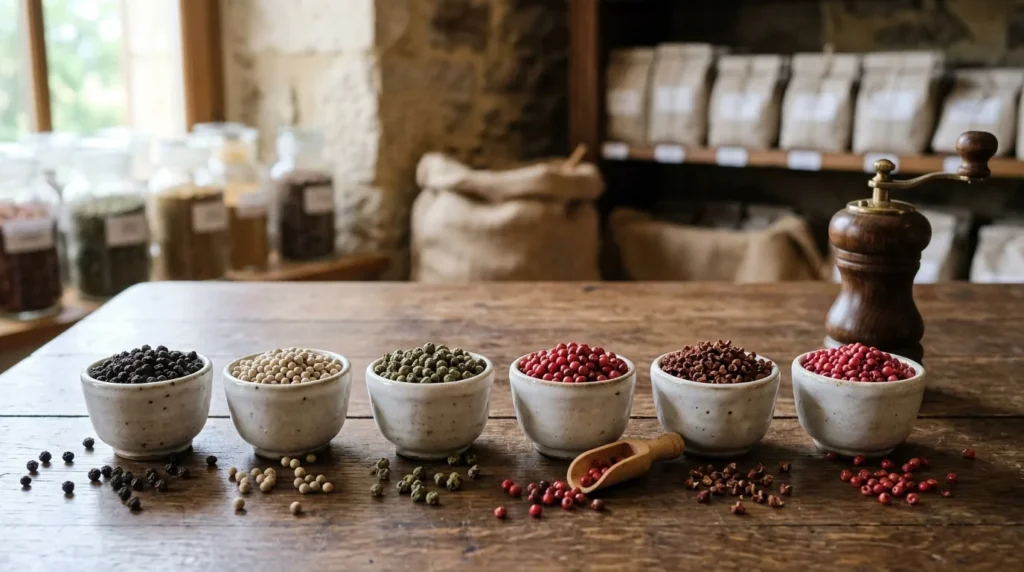
It sits on every table next to the salt, so much so that we forget it was once the most precious spice in the world. Pepper lifts a dish with a single twist of the mill, yet it hides remarkable variety: black, white, green, red, long, Kampot… not to mention the “false peppers” such as Sichuan pepper and pink peppercorns. In this guide, we look at the health benefits of pepper, its star compound piperine and its partnership with turmeric, then head into the kitchen: how to choose it, store it, know when to season, and make a proper homemade peppercorn sauce.
What exactly is pepper?
True pepper is the fruit of the pepper vine (Piper nigrum), a tropical climbing plant native to the Malabar Coast in south-western India. Its fruits grow in small clusters, a bit like redcurrants. Depending on when they are harvested and how they are processed, they become green, black, white or red pepper: it is the same plant.
Pepper has a long history. The Romans imported huge quantities from India, and in the Middle Ages it was sometimes used as currency: people spoke of paying “in pepper”. The quest for it even drove Portuguese navigators to look for the sea route to the Indies. Today the main producers are Vietnam, by far the largest, followed by Brazil, Indonesia and India.
Its heat comes mainly from piperine, a compound that makes up a few per cent of the peppercorn’s weight. Its aroma, on the other hand, comes from highly volatile essential oils, which is why ground pepper loses its fragrance so quickly.
Black, white, green and red pepper: what’s the difference?
All four colours come from the same fruit, harvested at different stages and processed differently. The table below sums it all up, along with the “false peppers” you often come across in shops.
| Pepper | How it’s made | Flavour | Best for |
|---|---|---|---|
| Green | Berries picked while still green, kept in brine or freeze-dried | Fresh, fruity, mildly hot | Peppercorn sauce, fish, terrines |
| Black | Green berries dried in the sun until they turn black and wrinkled | Hot, warm, woody | Almost everything, the most versatile |
| White | Fully ripe berries, soaked and then stripped of their skin | Hot, more delicate, less aromatic | White sauces, mash, pale dishes |
| Red | Berries left to ripen fully, dried with their skin on | Fruity, mild, slightly sweet | Poultry and pork, desserts, fruit |
| Long | A different species (Piper longum), in small spikes | Hot and sweet, with hints of cinnamon | Slow-cooked dishes, chocolate |
| Sichuan | False pepper: husks of berries from a shrub in the citrus family | Lemony, tingles on the tongue | Chinese cooking, stir-fries, duck |
| Pink peppercorns | False pepper: fruit of a South American tree | Mild, sweet, barely hot | Salads, fish, desserts |
Long pepper and Kampot pepper: two exceptional peppers
Long pepper (Piper longum) is a cousin of black pepper that looks like a small, elongated spike. Highly prized by the Romans, it was later overshadowed by black pepper. Its flavour is both hot and sweet. You can grate it or pound it, and it works wonders in a stew or a chocolate ganache.
Kampot pepper comes from the provinces of Kampot and Kep in Cambodia. It is a true Piper nigrum, but grown using traditional know-how that gives it a very delicate fragrance. Since 2016 it has been protected in the European Union by a protected geographical indication (PGI): only pepper from this region can bear the name. You will find it in black, red and white. It is more expensive, so save it for dishes where you can really taste it, such as grilled meat or strawberries.
False peppers: Sichuan pepper and pink peppercorns
Sichuan pepper
Despite its name, Sichuan pepper has nothing to do with the pepper vine. It is the dried husk of the small berries of shrubs in the genus Zanthoxylum, part of the same family as citrus fruits. What makes it special is the surprising tingling on the tongue it causes, almost a slight numbness, due to a molecule called sanshool. Its aromas are lemony and woody.
It is the signature spice of cooking from Sichuan, in China, where it is paired with chilli. To make the most of it, toast it for a few seconds in a dry frying pan, then crush it. Remove any small black seeds, which are hard and tasteless.
Pink peppercorns
Pink peppercorns, sometimes called “pink pepper”, are the fruit of South American trees in the genus Schinus. They belong to the same botanical family as mango, pistachio and cashew. Mild, slightly sweet and barely hot, they add colour and a fruity note to salads, fish, foie gras or desserts.
A word of caution: people who are allergic to cashews, pistachios or mango should be careful, as cross-reactions are possible. Use them in moderation too, in small amounts, as you would a spice.
Black pepper health benefits
Pepper is above all a condiment: we eat it in very small amounts. It is worth remembering that in Europe, no health claim has been authorised for pepper. Here is what we do know, though.
What is piperine?
Piperine is the molecule that gives pepper its heat. It has been studied extensively in the laboratory, where it shows antioxidant and anti-inflammatory effects. In humans, studies remain few and usually involve concentrated supplements, not the pepper in your kitchen.
Its best-known property is something else: piperine slows down certain enzymes in the liver and gut that are responsible for clearing foreign substances. As a result, it increases the absorption of certain molecules… including medicines. That is an advantage with turmeric, but also a reason to be careful with supplements.
Pepper and digestion
The heat of pepper stimulates saliva and digestive juices, which explains its traditional use to aid the digestion of rich meals. The evidence remains limited, but a pinch of freshly ground pepper whets the appetite and adds flavour without adding salt. That alone is a real plus for health.
On the other hand, in sensitive people, large amounts of pepper can irritate the stomach and make heartburn or reflux worse.
Black pepper and turmeric: a winning duo
This is pepper’s most famous pairing, and it rests on solid ground. Curcumin, the key compound in turmeric, is very poorly absorbed by the body. A small study from 1998 showed that adding piperine could increase its absorption roughly twentyfold. That figure comes from a single small study, but the principle is well accepted.
In practice, a simple pinch of black pepper in a turmeric dish is enough, together with a little fat, as curcumin dissolves in fat. That is exactly what we do in turmeric golden milk. To find out more, read our article on the health benefits of turmeric.
Pepper side effects and precautions
On the plate, pepper is very well tolerated. The precautions mainly concern large amounts and piperine supplements, which are often sold with turmeric. Talk to your doctor or pharmacist if any of the following applies to you:
- You take regular medication: concentrated piperine can alter the absorption of certain medicines (anti-epileptics, anti-inflammatories, heart medicines, etc.) and increase their effect.
- Reflux, gastritis or an ulcer: pepper can make heartburn worse.
- Haemorrhoids or irritable bowel syndrome: some people don’t tolerate very peppery dishes well.
- Planned surgery: to be safe, stop piperine supplements for a while beforehand, as with any supplement that may interact with medicines.
Be careful with inhalation too: ground pepper makes you sneeze, and you should never put it in a young child’s nose or mouth.
Pepper during pregnancy
During pregnancy, pepper used in cooking, in normal amounts, poses no known problem. You can carry on seasoning your food as usual.
Two caveats:
- avoid piperine supplements or turmeric supplements combined with pepper, as there is not enough data on their safety during pregnancy;
- if you suffer from heartburn, which is common in late pregnancy, cut back on very spicy dishes.
Pepper for weight loss: fact or myth?
You sometimes read that piperine “burns fat” or “speeds up your metabolism”. These claims are based mainly on animal or laboratory studies. In humans, there is no solid evidence that pepper helps you lose weight.
Its real value is in the kitchen: used well, pepper gives dishes depth and helps you cut down on salt, which is useful for blood pressure. Be wary, however, of piperine-based “slimming” capsules, which can interact with medicines.
Whole or ground pepper?
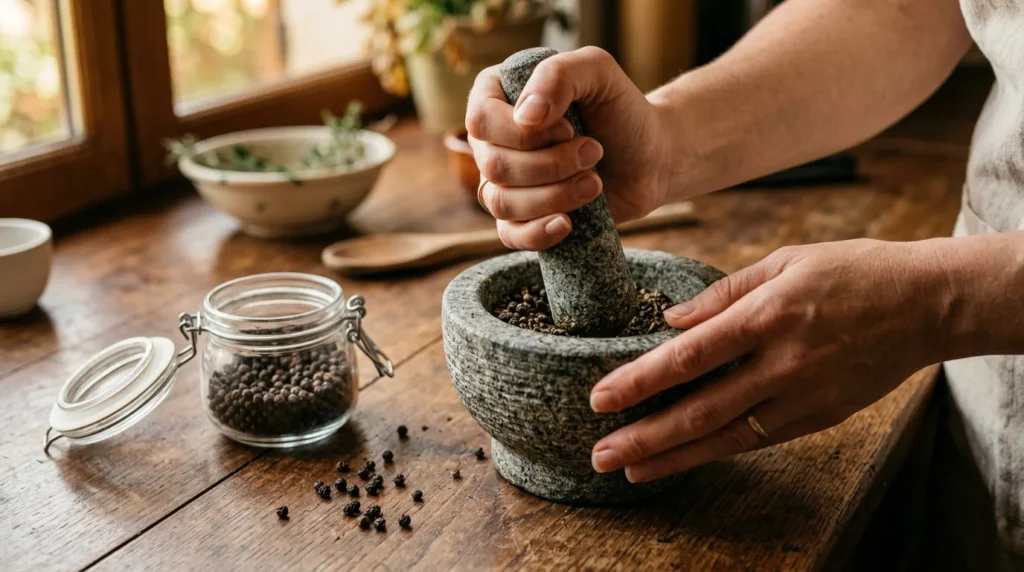
The answer is simple: whole, ground at the last moment. Pepper’s aromas are highly volatile, and pre-ground pepper loses much of its fragrance within a few weeks. It keeps its heat but becomes flat.
- Invest in a good pepper mill with an adjustable ceramic or steel mechanism.
- For sauces and marinades, crush the peppercorns in a mortar or with the base of a saucepan.
- You might keep a little ground white pepper for pale dishes, where black specks would show.
How to store pepper
Pepper keeps for a long time, as long as you protect it from its enemies: air, light, heat and moisture.
- Store the peppercorns in an airtight jar, ideally opaque, in a cool cupboard.
- Whole peppercorns keep their fragrance for two to three years.
- Ground pepper loses its aroma within a few months: buy it in small amounts.
- Green peppercorns in brine keep in the fridge for a few weeks once opened, covered in their liquid.
- Avoid keeping the pepper mill right above the hob.
When to season with pepper: before or after cooking?
It is an age-old debate among cooks. The answer depends on what you are making:
- High-heat cooking (seared meat, stir-fries): add pepper at the end of cooking or just before serving. At very high temperatures, ground pepper can burn, turn bitter and lose its aroma.
- Slow-cooked dishes (stews, stocks, sauces): add whole peppercorns at the start so they gently infuse, then adjust with ground pepper at the end.
- Marinades and roasts: crushed pepper can go on beforehand to form a fragrant crust, as long as you cook without burning it.
- Raw vegetables, salads, cold dishes: a twist of the mill just before serving, for maximum fragrance.
Remember the golden rule: a twist of the mill at the end never hurts, as that is when pepper is at its most fragrant.
Homemade peppercorn sauce recipe
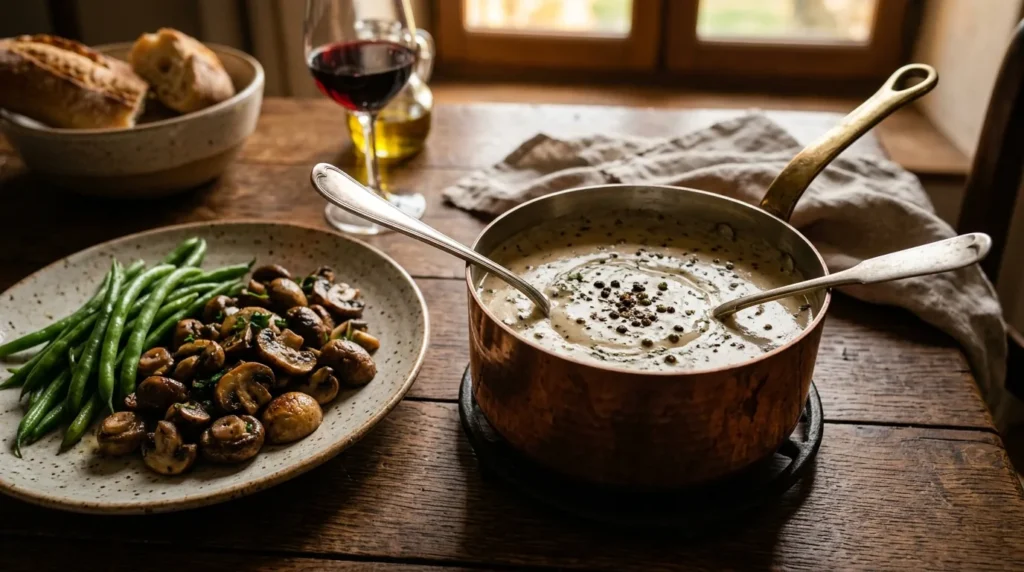
Peppercorn sauce is the classic partner for steak, but it is just as delicious with a plant-based steak, pan-fried mushrooms, grilled tofu or roasted vegetables. Serves 4:
- 2 tablespoons black peppercorns (or 1 of black and 1 of green peppercorns in brine)
- 1 shallot
- 1 knob of butter or 1 tablespoon oil
- 3 tablespoons cognac or brandy (optional)
- 150 ml beef or vegetable stock
- 200 ml double cream (or plant-based cream)
- 1 pinch of salt
- Coarsely crush the pepper in a mortar. Finely chop the shallot.
- Melt the butter in a frying pan over a medium heat, add the shallot and sweat it for 2 minutes without letting it colour.
- Add the pepper and let it heat for 30 seconds to release its aromas.
- Pour in the cognac and let it bubble off for 1 minute (only flambé if you are used to doing it, with the extractor fan switched off).
- Add the stock and reduce by half, about 5 minutes.
- Pour in the cream and let it thicken for 3 to 5 minutes over a low heat, until the sauce coats the back of a spoon. Season lightly with salt.
Tip: if you are cooking meat, make the sauce in the same pan afterwards: the pan juices will add even more flavour. For a milder version, replace some of the black pepper with green peppercorns.
Pepper, cinnamon, ginger: everyday spices
Pepper goes with almost every spice. It brings out the sweetness of cinnamon in mulled wine or gingerbread, and it partners ginger in curries and marinades. To learn all about these two spices, explore our guides to cinnamon and ginger.
Read next: our complete guides to cumin, the go-to spice for digestion, and paprika, sweet, hot or smoked. And for special occasions, discover saffron, the red gold of spices. And to flavour tea, coffee and buns, discover cardamom, the queen of spices. And for mulled wine, slow-cooked stews and Christmas pomanders, discover cloves. Not forgetting nutmeg, the secret of a good béchamel and mashed potatoes. And for gentle heat, discover Espelette pepper, the pride of the Basque Country. Finally, for a gentle lemony note, try coriander seeds, perfect in vegetables à la grecque.
Frequently asked questions about pepper
Is pepper good for you?
Eaten normally, pepper is part of a healthy diet: it adds flavour without calories and helps you cut down on salt. Its own health effects have not yet been well demonstrated in humans.
Is white pepper milder than black pepper?
No, it is often just as hot, but less aromatic, because its skin, which holds much of the fragrance, has been removed. It is mainly used because it stays discreet in pale dishes.
Can you use pink peppercorns like pepper?
Yes, in small amounts, as a spice. They are milder than pepper and barely hot at all. Take care if you are allergic to cashews, pistachios or mango.
Does ground pepper go off?
It doesn’t become dangerous, but it loses its fragrance within a few months. Trust your nose: if it barely smells of anything, replace it.
This article is for general information only and does not replace the advice of a doctor, midwife or pharmacist.