Today it is hailed as an essential superfood, yet turmeric is anything but a passing trend. It is one of the oldest culinary and medicinal plants in the world. But where does this brilliantly coloured spice really come from? Between ancient traditions, the spice routes and sacred rituals, dive into the fascinating history of turmeric and its origins, and discover how this root, once nicknamed “Indian saffron”, became a star of our kitchens.
The botanical and geographical origins of turmeric
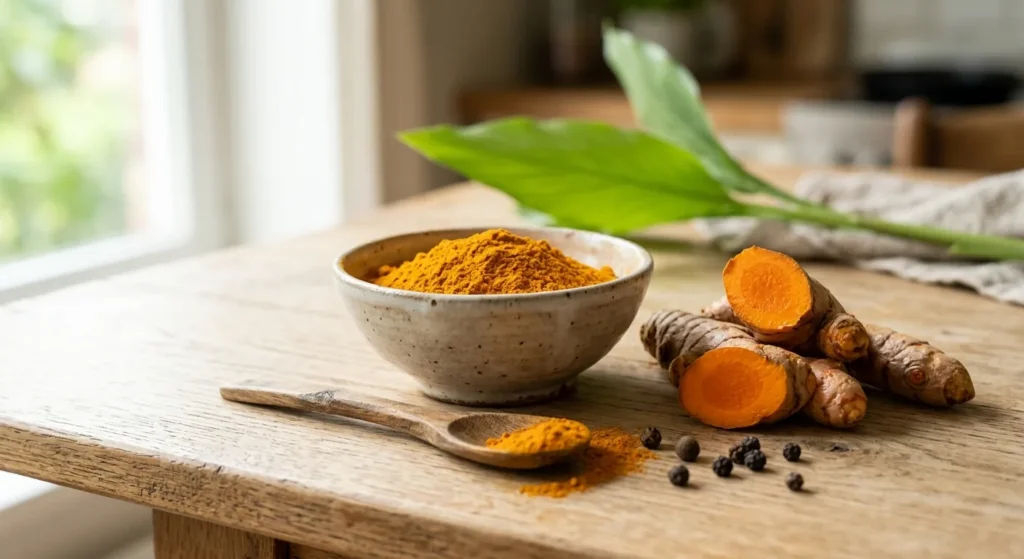
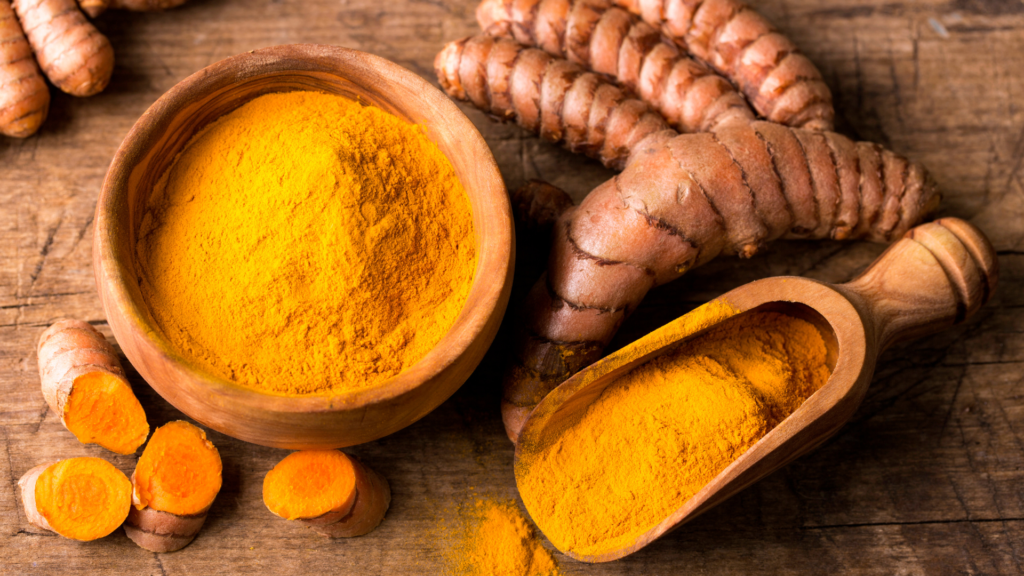
Turmeric (Curcuma longa) is a perennial plant of the Zingiberaceae family, the same family as ginger and cardamom. The part we use is not strictly speaking a root but a rhizome: a fleshy underground stem, bright orange inside, from which the famous golden-yellow powder is made.
Which country does turmeric originally come from?
Turmeric is native to South and Southeast Asia, and more precisely to the Indian subcontinent. It has been grown and domesticated in India for at least 4,000 years. Archaeologists have even found traces of turmeric in pottery from the Indus Valley civilisation, around 4,500 years old.
Surprisingly, no wild form of Curcuma longa is known. The plant we grow almost never produces fertile seeds. It is propagated only by replanting pieces of rhizome. Botanists therefore believe it is the result of centuries of selection and crossing by humans, starting from closely related wild species.
Growing the rhizome through the centuries
Turmeric needs heat, humidity and plenty of rain. It has therefore thrived throughout Asia’s tropical belt, from southern India to the islands of Indonesia. Farmers plant it in spring, harvest it about nine months later, then boil, dry and grind the rhizomes: a method that has changed very little since ancient times.
Even today, India is by far the world’s largest turmeric producer, with around three quarters of global production, and it consumes most of it itself. Other producing countries include China, Myanmar, Bangladesh, Indonesia, Sri Lanka and Vietnam.
Turmeric in ancient times: Ayurvedic medicine and sacred rituals
From the very beginning, the story of turmeric went far beyond the kitchen. In India, it is at once a food, a remedy, a dye and a religious symbol.
Turmeric in the history of Ayurvedic medicine
Known as Haridra in Sanskrit (“the yellow one”), turmeric holds a central place in Ayurveda, India’s traditional medicine. The great Ayurvedic texts, such as those of Charaka and Sushruta, written around 2,000 years ago, recommend it to support digestion, care for the skin and “purify the blood”. It also features in traditional Chinese medicine, where it has been used for centuries.
These traditional uses of turmeric were based on observation and experience passed down from generation to generation, long before modern science took an interest.
Rituals, purification and the Haldi ceremony
In Hindu tradition, turmeric symbolises purity, prosperity and fertility. It is offered to the gods, used to draw sacred marks and to purify places of worship.
- The Haldi ceremony: a few days before an Indian wedding, the family applies a turmeric paste (haldi in Hindi) to the faces and bodies of the bride and groom. This joyful ritual is meant to bring them luck, protect them and give them glowing skin on the big day. It is still widely practised today.
- The sacred thread: in southern India, the wedding necklace worn by the bride is often a thread dyed with turmeric.
Conquering the world along the spice routes
How did the golden spice leave India and find its way onto tables all over the world? Thanks to merchants, monks and seafarers.
A slow spread to Asia, Africa and Europe
Turmeric is thought to have reached China around the 7th century AD, then East Africa via the sea routes of the Indian Ocean. Arab merchants later introduced it to the Middle East and North Africa, before it arrived in Europe in the Middle Ages, alongside the other precious spices from the East.
Why is turmeric called “Indian saffron”?
The nickname comes from its intense orange-yellow colour, reminiscent of saffron. Saffron, made from the hand-picked stigmas of a crocus flower, was already the most expensive spice in the world. Turmeric offered the same golden colour at a far more affordable price. It was therefore often used as “poor man’s saffron” to colour food, and sometimes even to imitate, or adulterate, real saffron. In medieval Europe it was also known by the Latin name terra merita, “deserving earth”.
The first mentions in the Western world
Did you know? Around 1280, during his journey to China, Marco Polo described a plant “that has all the properties of true saffron, as well as the smell and the colour, and yet it is not really saffron”. It is one of the earliest descriptions of turmeric by a European.
Turmeric was also a valuable natural dye. In Asia, it was long used, along with other plants, to dye fabrics yellow and orange, including the robes of monks. In Europe, it was used to colour cloth, leather and wood. Its colour is brilliant but fragile: it fades in the light.
A culinary history and traditional drinks
If turmeric has stood the test of time, it is above all because it won over kitchens, from the plate to the glass.
The history of turmeric in cooking
Turmeric is the base ingredient of many spice blends: Indian masalas, curry powder (a blend created by the British in the 18th century to recreate the flavours of India at home, with turmeric as its main source of colour) and some recipes for North African ras el hanout.
Turmeric rice is another great tradition. In Indonesia, nasi kuning (“yellow rice”), cooked with turmeric and coconut milk, is served at festivals and celebrations: its golden colour symbolises wealth and good fortune. In India, yellow rice also accompanies many festive meals.
The history of golden milk and ancestral drinks
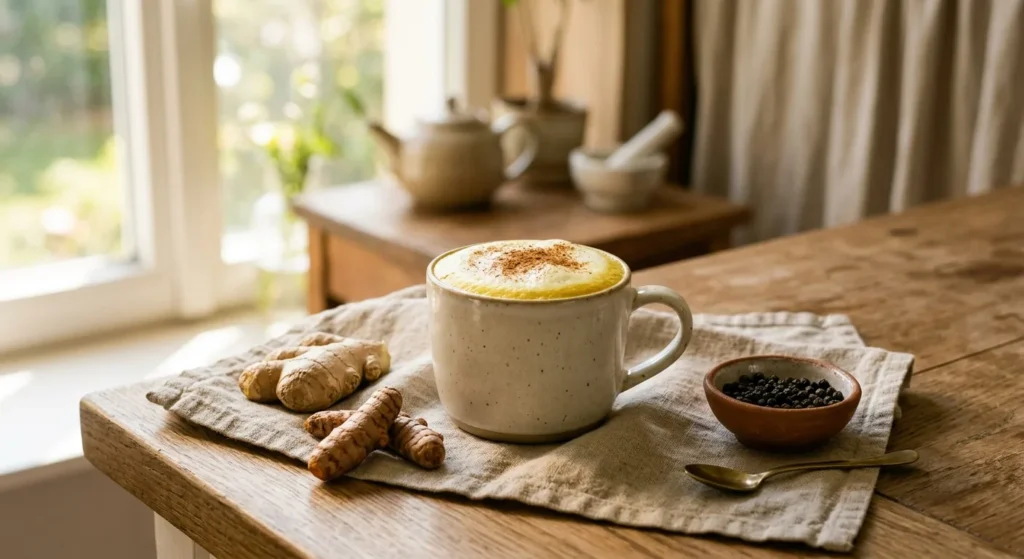
Long before it became fashionable in Western cafés, turmeric milk existed in India as haldi doodh (literally “turmeric milk”). Made by Indian mothers and grandmothers, this hot milk, sometimes spiced with pepper, ginger or honey, was served for colds or before bedtime.
In the early 2010s, this ancestral drink won over Western wellness culture under the name golden milk, or the “turmeric latte”, and it now appears on coffee shop menus around the world.
From tradition to science: the discovery of curcumin
In 1815, the chemists Heinrich August Vogel and Pierre-Joseph Pelletier isolated the rhizome’s colouring matter for the first time: curcumin. It was not until 1910 that Polish chemists described its exact chemical structure.
From the late 20th century onwards, curcumin became one of the most studied natural molecules in the world, with thousands of scientific papers on its antioxidant and anti-inflammatory properties. Researchers remain cautious, however: curcumin is poorly absorbed by the body (hence the traditional habit of pairing it with black pepper), and many promising laboratory results still need to be confirmed in humans. Modern science is thus rediscovering, with its own tools, a plant that traditions have used for thousands of years.
Key dates in the history of turmeric
| When | Where | What happened |
|---|---|---|
| Around 2500 BC | Indus Valley | Earliest traces of turmeric in pottery |
| Over 2,000 years ago | India | Turmeric appears in the great Ayurvedic texts |
| Around the 7th century | China | Turmeric arrives in China |
| Middle Ages | Middle East, Europe | Spread by Arab merchants and the spice routes |
| Around 1280 | China (Marco Polo’s account) | Marco Polo compares turmeric to saffron |
| 1815 | Europe | Vogel and Pelletier isolate curcumin |
| 2010s | The West | Golden milk becomes a trendy drink |
Frequently asked questions about the history of turmeric
Which country does turmeric come from?
Turmeric comes from South Asia, mainly India, where it has been grown for at least 4,000 years. India is still the world’s largest producer today.
Why is turmeric called “Indian saffron”?
Because its orange-yellow colour is reminiscent of saffron, at a much lower price. For a long time it was used to colour food instead of saffron.
Who discovered curcumin?
The chemists Vogel and Pelletier, who first isolated it in 1815.
Conclusion: an ancient heritage that is still alive
The history of turmeric is the story of a plant that has come through the ages without losing any of its value, whether culinary, spiritual or medicinal. From its native India to wedding rituals, from the spice routes to modern laboratories, the golden rhizome has never stopped fascinating us.
Today, using it in your cooking means carrying on a tradition of flavour that is thousands of years old. Want to go further? Discover our guide to the health benefits of turmeric and our authentic golden milk recipe.