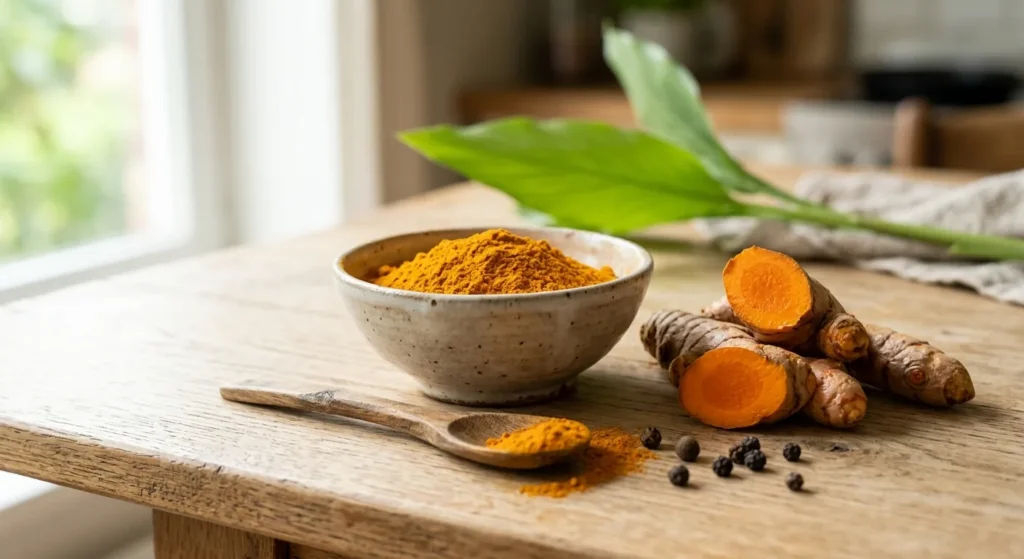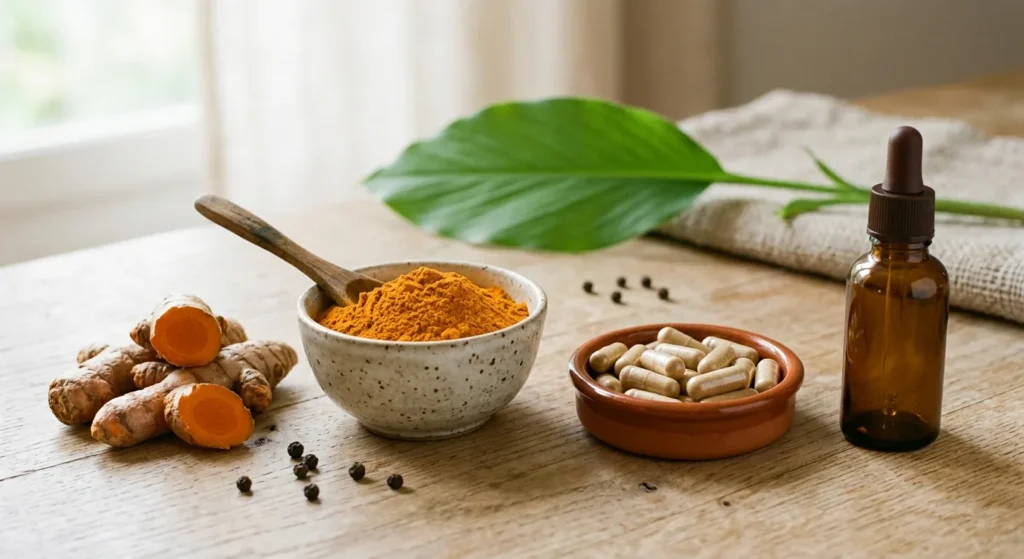
Fresh roots in the vegetable aisle, ground spice at the supermarket, capsules at the chemist or health food shop: turmeric now comes in many forms, and it is easy to get lost. Should you choose fresh turmeric or powder? Are capsules worth it? And above all, how much turmeric per day can you safely have? Here is a practical, balanced guide to choosing the right form for you, getting the amount right and avoiding the most common mistakes.
Fresh turmeric or powder: what’s the difference?
Fresh turmeric root
What we call turmeric “root” is actually a rhizome, an underground stem. Fresh, it looks like a small piece of ginger with light brown skin and bright orange flesh. It tastes livelier than the powder: peppery, slightly lemony and musky, with a hint of bitterness.
How to choose it: pick pieces that are firm, heavy and free of mould, with smooth skin. Avoid any that are soft or wrinkled, a sign they have dried out.
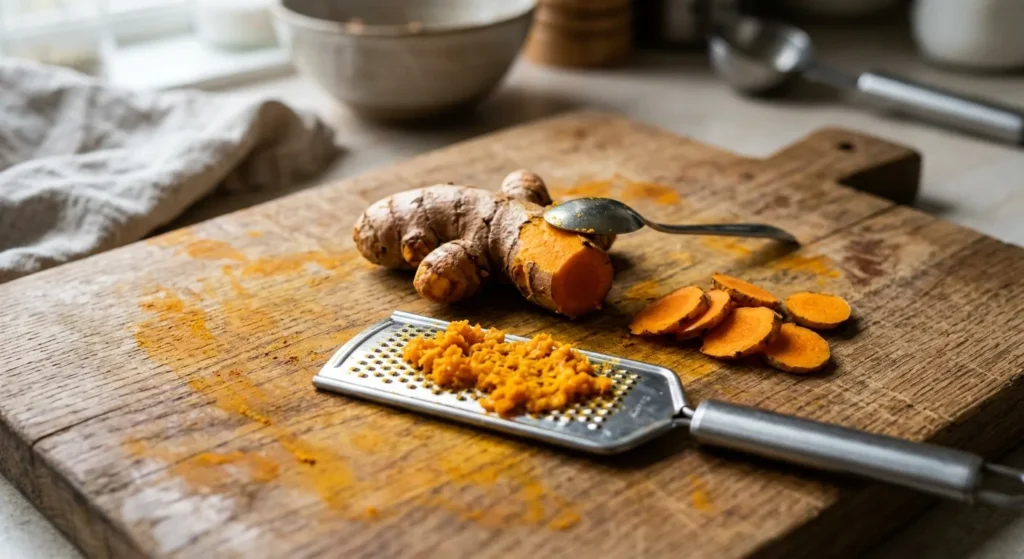
How to use turmeric root:
- Peel it with the edge of a teaspoon, as you would ginger, or keep the skin on if it is thin and well washed.
- Grate it finely into a sauce, curry, soup, dressing or smoothie.
- Cut it into thin slices for an infusion or a golden milk.
- Blend it with garlic, ginger and oil to make a seasoning paste.
Storage: 2 to 3 weeks in the fridge, in a paper bag or a closed container. Fresh turmeric freezes very well: you can then grate it straight from frozen.
Be careful: fresh turmeric stains fingers, plastic chopping boards and clothes badly. Wear thin gloves and use a glass or wooden board kept just for this purpose.
Ground turmeric
The powder is made by boiling, drying and then grinding the rhizomes. It is the most convenient form: it keeps for a long time, is easy to measure and goes straight into hot dishes, sauces, marinades, rice or roasted vegetables.
How to choose it well:
- A deep orange-yellow colour and a strong aroma, both signs of freshness.
- A stated origin and a brand you trust. Cases of adulterated turmeric, coloured with lead-based pigments, have been documented in some South Asian countries: it is best to avoid loose powder of unknown origin.
- An organic label (such as the EU organic leaf or the Soil Association logo), which rules out irradiation and limits pesticide residues.
Storage: in an airtight jar, away from light and heat. Light breaks down curcumin: a clear glass jar sitting next to the hob quickly loses its colour and flavour. Ground turmeric keeps for about one to two years, but it is at its best in the first six months after opening.
Comparison table: fresh or ground turmeric
| Criterion | Fresh turmeric | Ground turmeric |
|---|---|---|
| Flavour | Lively, peppery, lemony | Milder, earthy |
| Curcumin content | Lower per gram (it contains a lot of water) | About 2 to 5% |
| Storage | 2 to 3 weeks in the fridge, several months frozen | 1 to 2 years in a closed jar |
| Ease of use | Needs peeling and grating, stains a lot | Very easy to measure |
| Where to find it | Health food shops, Asian grocers, some supermarkets | Everywhere |
Our advice: powder for everyday cooking, fresh for recipes where its flavour makes the difference, such as golden milk, curries or juices.
Turmeric capsules: what you need to know
Turmeric capsules versus the spice
Capsules are food supplements, not medicines. They contain either plain turmeric powder or a concentrated extract, often standardised to 95% curcuminoids. A single extract capsule can therefore provide as much curcumin as several spoonfuls of the spice.
Many people take them for joint comfort or digestion. As we explain in our article on the health benefits of turmeric, studies in humans remain limited, and in the UK and the EU no health claim is authorised for turmeric. A capsule therefore cannot promise to treat or relieve any illness. Before taking one, especially if you are on medication, ask your doctor or pharmacist.
Turmeric capsules: benefits and risks
High doses are not harmless. In 2022, France’s food safety agency (Anses) recorded around a hundred cases of liver damage, including hepatitis, in people taking turmeric supplements. The agency also pointed out that so-called “high bioavailability” formulas (with piperine, or in phytosome, micellar or liposomal form) greatly increase the amount of curcumin absorbed, and therefore also the risk of side effects and interactions with medicines.
How to choose organic turmeric capsules
If you decide to take them, here is what to check on the label before buying:
- The amount of curcumin per day clearly stated, in milligrams, not just the amount of “turmeric” or “extract”.
- A reasonable daily dose that does not exceed the acceptable daily intake (see below).
- The type of formula: plain powder, standardised extract or enhanced-absorption formula. The better it is absorbed, the more careful you need to be with the dose.
- Clear warnings on the packaging (pregnancy, medication, maximum daily dose). Their absence is a bad sign.
- An organic label and test results for heavy metals and contaminants, when the manufacturer publishes them.
- A plant-based capsule and a short ingredient list, without unnecessary additives.
- An identifiable manufacturer based in the UK or the EU, selling a product that complies with food supplement regulations.
Dosage: how much turmeric per day?
Guidelines for each form
- Ground, in cooking: half a teaspoon to one teaspoon a day (about 1.5 to 3 g) is common and well tolerated.
- Fresh root: about 1 to 3 cm of rhizome a day (5 to 10 g), grated into your dishes or infused.
- Food supplements: international and European food safety experts (JECFA and EFSA) have set an acceptable daily intake of 3 mg of curcumin per kilo of body weight, which is about 180 mg a day for a person weighing 60 kg and 210 mg for 70 kg. Anses recommends not exceeding it with supplements. Yet many products provide 500 mg or more a day: read the label carefully, and talk to a health professional.
When to take turmeric during the day
Always with a meal, ideally with a little fat. Turmeric is better absorbed and gentler on the stomach than on an empty stomach. For supplements, follow the instructions on the packaging and spread the doses out if there are several.
How to absorb turmeric better
Turmeric and black pepper
Only a small part of curcumin reaches the bloodstream, because the liver eliminates it very quickly. The piperine in black pepper slows this down: in a 1998 study, it increased the amount of curcumin found in the blood twentyfold. In cooking, a pinch of freshly ground pepper is enough.
The role of fat
Curcumin dissolves in fat, not in water. Frying it for a few seconds in a drizzle of olive oil, butter or ghee, or adding it to a dish made with coconut milk, helps your body absorb it. This is exactly what Indian cooking has been doing for centuries.
Contraindications, side effects and overdose
Who should be careful?
- People taking anticoagulants or antiplatelet drugs, because of the risk of bleeding.
- People with gallstones, a blocked bile duct or liver disease.
- Pregnant or breastfeeding women: no supplements, though the spice in cooking is fine.
- People on long-term medication (diabetes, cancer treatment, etc.), because of possible interactions.
- Before surgery: stop supplements a few days beforehand, on medical advice.
Too much turmeric: what are the side effects?
The most common effects at high doses are digestive: nausea, heartburn, bloating, diarrhoea. More rarely, supplements can damage the liver. Stop taking them and see a doctor quickly if you notice unusual tiredness, persistent nausea, dark urine or yellowing of the skin or eyes.
Frequently asked questions
Can I replace fresh turmeric with powder?
Yes: allow about 1 teaspoon of powder for 2 to 3 cm of fresh root.
Should I do a turmeric “course”?
In cooking, there is no need for a course: the simplest approach is to have a little, regularly. For supplements, any course should be decided with a health professional.
Is organic turmeric really better?
It guarantees no irradiation and limits pesticides. For the powder, origin and brand matter as much as the label.
Conclusion: which form of turmeric should you choose?
For everyday enjoyment and health, ground or fresh turmeric, used in cooking with a little pepper and fat, remains the simplest, cheapest and safest choice. Capsules are another story: they provide much higher doses and should be chosen with care, without exceeding the acceptable daily intake and preferably on the advice of a health professional.
Ready to put it into practice? Try our traditional golden milk recipe. For the scientific evidence, read our article on the health benefits of turmeric, and dive into the origins of this spice with the history of turmeric.
This article is for information only and does not replace the advice of a doctor or pharmacist.